Vitamin D2 or D3: What Matters When You Choose
Both forms raise vitamin D blood levels, but a higher lab result with D3 doesn’t establish better health outcomes.
Vitamin D2 (ergocalciferol) and D3 (cholecalciferol) both raise vitamin D blood levels. D3 might raise them higher and for longer, but that isn’t proof of better health outcomes. Check the form, amount per serving, and directions before comparing products. A trial in women found a greater rise with its D3 regimen, though the groups took different amounts on different schedules. 1 2
The difference you can measure
Both D2 and D3 increase vitamin D in the blood. The usual measure of vitamin D status is 25-hydroxyvitamin D, often written as 25(OH)D. MedlinePlus says D3 might raise blood levels higher and for longer than D2. That makes D3 worth considering if your question is about the blood-level response, but a lab result alone doesn’t tell you which form will do more for your bones or how you feel. 1 2
The names can make a label comparison harder than it needs to be: ergocalciferol means D2, and cholecalciferol means D3. D2 can be produced from a substance found in plants and fungi; D3 forms from a substance in animal skin exposed to ultraviolet light. If ingredient origin matters to you, check the sourcing information for the particular product rather than assuming its origin from “D3” alone. 2
What the comparison in women actually tested
In a randomized trial, 43 healthy Thai female healthcare workers were assigned 20,000 IU of D2 weekly, and 40 were assigned 1,000 IU of D3 daily for 12 months. At six months, average 25(OH)D rose from 16.91 to 21.67 ng/mL in the D2 group and from 17.62 to 26.03 ng/mL in the D3 group. The increase was greater with the D3 regimen, and levels later plateaued in both groups. 2
There’s an important catch when applying that finding to a supplement shelf: the study compared 20,000 IU of D2 per week with 7,000 IU of D3 per week, taken on different schedules. It shows what happened with those two regimens, not what would happen with equal amounts taken equally often. It can’t give you a dose-for-dose conversion between forms. The women were about 50 years old on average, but the reported comparison doesn’t establish separate findings for perimenopause or postmenopause. 2
The trial also found better adherence in the D2 group. That’s a reminder that the blood-level result isn’t the only practical detail, though the study can’t tell you whether the difference in adherence came from the form, the schedule, or something else. 2
A useful way to read the label
Start with the form: vitamin D2 or ergocalciferol, versus vitamin D3 or cholecalciferol. Next, look at the amount per serving and the directions, including how often the product is meant to be taken. Don’t treat the trial’s weekly D2 and daily D3 schedules as instructions for products you’re comparing. Those schedules were part of one study, not a rule for choosing between forms. 2
Check whether vitamin D is also in a multivitamin you use. MedlinePlus notes that supplements can contain vitamin D on its own or as part of a multivitamin. Vitamin D is fat-soluble, and taking a supplement with a meal or snack containing some fat can improve absorption. 1
Finally, be clear about the goal of your comparison. If it’s to understand which form may raise 25(OH)D more, D3 might raise it higher or for longer, and the specific D3 regimen in the women’s trial produced a greater rise. If the goal is to prevent a disease or treat a known low level, that’s a different question. The women’s trial compared blood levels, while the Endocrine Society guideline addresses vitamin D use for disease prevention rather than establishing which form produces better clinical outcomes. 1 2 3
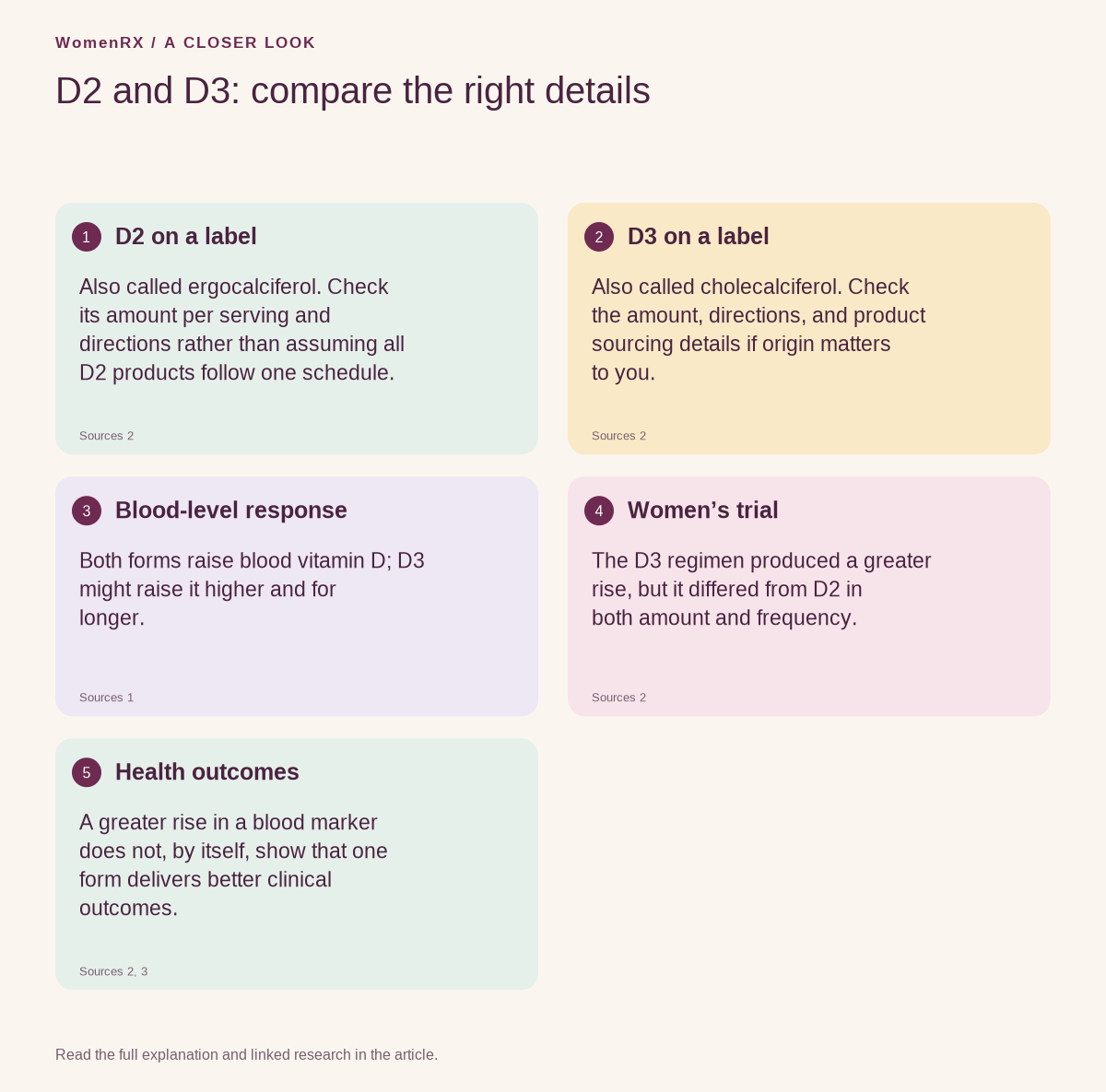
D2 and D3: compare the right details
D2 on a label: Also called ergocalciferol. Check its amount per serving and directions rather than assuming all D2 products follow one schedule.2
D3 on a label: Also called cholecalciferol. Check the amount, directions, and product sourcing details if origin matters to you.2
Blood-level response: Both forms raise blood vitamin D; D3 might raise it higher and for longer.1
Women’s trial: The D3 regimen produced a greater rise, but it differed from D2 in both amount and frequency.2
Health outcomes: A greater rise in a blood marker does not, by itself, show that one form delivers better clinical outcomes.23
Read the figure as text
The form name and product directions matter alongside what blood-level research can tell you.- D2 on a label: Also called ergocalciferol. Check its amount per serving and directions rather than assuming all D2 products follow one schedule.2
- D3 on a label: Also called cholecalciferol. Check the amount, directions, and product sourcing details if origin matters to you.2
- Blood-level response: Both forms raise blood vitamin D; D3 might raise it higher and for longer.1
- Women’s trial: The D3 regimen produced a greater rise, but it differed from D2 in both amount and frequency.2
- Health outcomes: A greater rise in a blood marker does not, by itself, show that one form delivers better clinical outcomes.23
Sources you can check
- Vitamin D: MedlinePlusAccessed 2026-09-25Return to first citation
- Efficacy of plain cholecalciferol versus ergocalciferol in raising serum vitamin D level in Thai female healthcare workers.Amphansap T, Therdyothin A, Stitkitti N, Nitiwarangkul L, Phiphobmongkol V. · Osteoporosis and sarcopenia · 2022Return to first citation
- Vitamin D for the Prevention of Disease: An Endocrine Society Clinical Practice Guideline.Demay MB, Pittas AG, Bikle DD, Diab DL, Kiely ME, Lazaretti-Castro M, Lips P, Mitchell DM, Murad MH, Powers S, Rao SD, Scragg R, Tayek JA, Valent AM, Walsh JME, McCartney CR. · The Journal of clinical endocrinology and metabolism · 2024Return to first citation