How to Choose a Vitamin D Supplement Safely
Compare the amount and form on the label, then consider your total intake and health context before choosing a product.
Start by checking how many micrograms (mcg) or international units (IU) are in one serving, and count vitamin D from your multivitamin and other supplements too. D2 and D3 are both absorbed; D3 may raise blood levels higher and for longer. Your age, pregnancy or breastfeeding, and certain health conditions can affect what makes sense. Healthy adults don’t routinely need vitamin D testing under Endocrine Society guidance. 1 2
A useful vitamin D label comparison starts with the dose per serving, not the brand or the largest number on the front. Check whether the amount fits your overall intake, whether you’re comparing the same form and serving size, and whether your health situation calls for individual advice.
Read the serving size and units first
Find the amount of vitamin D per serving, then check how many pills, gummies, or drops count as one serving. US labels list vitamin D in micrograms (mcg); they may also show international units (IU) in parentheses. For vitamin D, 1 mcg equals 40 IU. For example, 15 mcg is 600 IU. 1
The Daily Value (DV) is a label comparison tool, not a personalized target. The FDA’s DV is 20 mcg, or 800 IU, for adults and children age 4 and older. That differs from the recommended daily amount for many adults: MedlinePlus lists 600 IU for adults ages 19-70 and 800 IU for adults 71 and older. 1 2
D2 or D3? Compare the form, not a “women’s” label
The two main supplement forms are vitamin D2 (ergocalciferol) and D3 (cholecalciferol). Both are absorbed in the small intestine. MedlinePlus notes that D3 might raise blood vitamin D higher and for longer than D2, but that doesn’t establish a need for a women-specific formula or make one form the right choice for everyone. 1 2
Vitamin D is fat-soluble. Having some fat in the gut improves absorption, and MedlinePlus suggests taking a supplement with a meal or snack that includes some fat. 1 2
Add up the sources you already use
Vitamin D can appear in a standalone supplement, a multivitamin, or other combination products. Check the amount in each product and add them together before comparing a new supplement. Fortified foods, such as some milk and cereals, also contribute to intake. 1 2
This total matters because a supplement label shows what that product provides, not necessarily what you need on top of your food and other supplements. If you’re considering an amount well above the usual age-based daily recommendation, don’t choose it just because the product offers it. The National Academies’ review notes that blood levels above 50 ng/mL can be associated with adverse effects; a higher number on a bottle isn’t a reason to aim for a higher blood level. 1
When personal context matters more than the label
For adults, recommended daily amounts vary by age. MedlinePlus lists 600 IU for adults ages 19-70 and for people who are pregnant or breastfeeding, and 800 IU for adults 71 and older. These are daily intake recommendations, not automatically the amount to take as a supplement; food and fortified products count too. 2
A clinician or pharmacist can help you decide whether to supplement, test, or use a different plan if you have a condition that affects absorption or vitamin D processing, have had gastric bypass surgery, or have another reason to think your needs may differ. 1 2
Guidance on testing isn’t simply “test everyone” or “never test.” The NIH Office of Dietary Supplements reports that the Endocrine Society does not recommend routine vitamin D testing in healthy people. MedlinePlus notes that a clinician may suggest a blood test for some people. Ask what the result would change in your case rather than ordering a test just to compare supplement brands. 1 2
Menopause by itself doesn’t point to a special vitamin D product. If you’ve been told you have osteoporosis or a particular bone-health concern, ask how vitamin D fits with your overall bone-health plan. Vitamin D helps the body absorb calcium, and together they help protect older adults from osteoporosis. 1 2
A quick label check
Before buying, look at the amount per serving, the serving size, whether it is D2 or D3, and the vitamin D in products you already take. If you’re pregnant or breastfeeding, older, or managing a health issue that could affect vitamin D, use that context to guide the conversation about total intake and whether testing is useful. The label can help you compare products; it can’t determine your personal need.
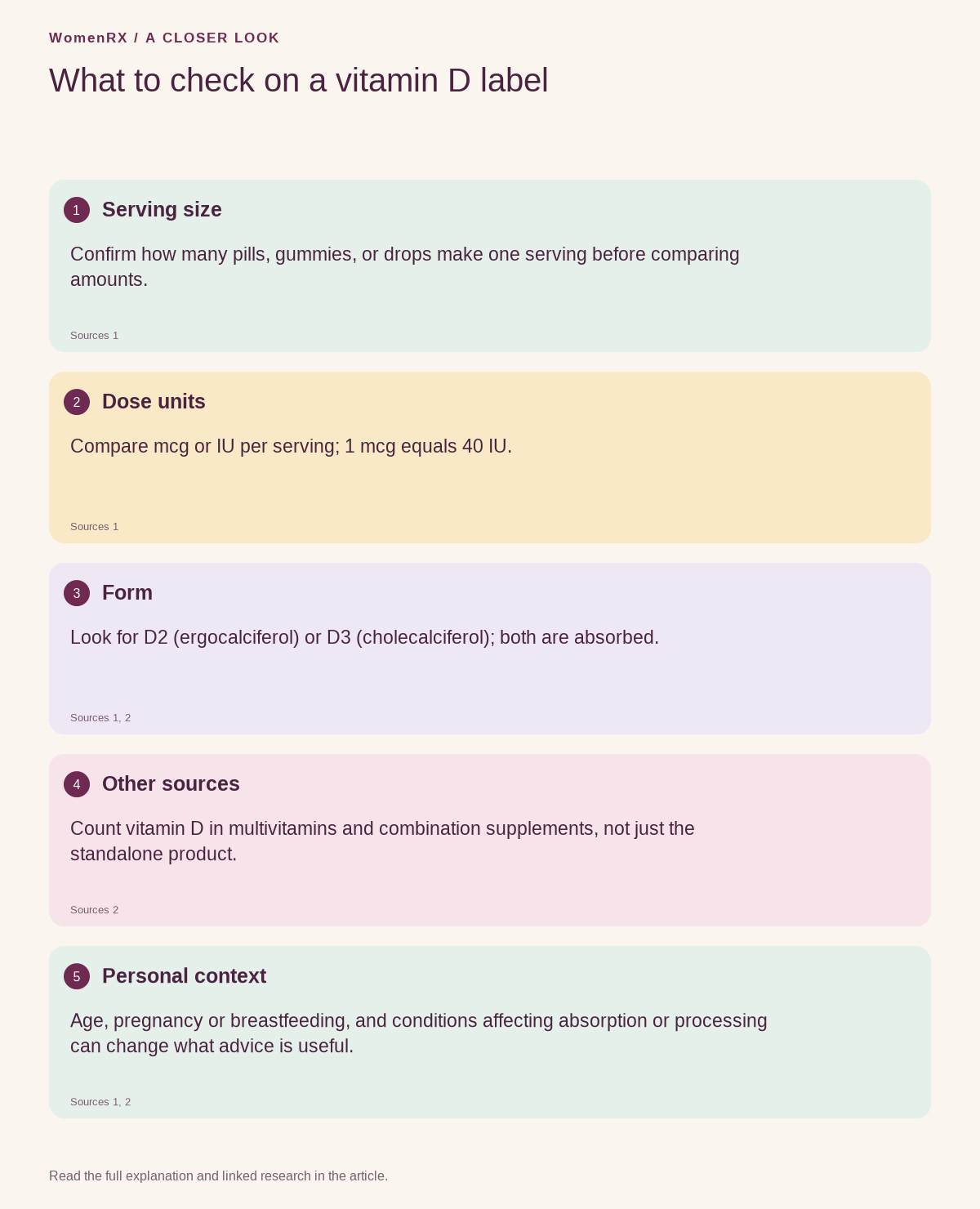
What to check on a vitamin D label
Serving size: Confirm how many pills, gummies, or drops make one serving before comparing amounts.1
Dose units: Compare mcg or IU per serving; 1 mcg equals 40 IU.1
Form: Look for D2 (ergocalciferol) or D3 (cholecalciferol); both are absorbed.12
Other sources: Count vitamin D in multivitamins and combination supplements, not just the standalone product.2
Personal context: Age, pregnancy or breastfeeding, and conditions affecting absorption or processing can change what advice is useful.12
Read the figure as text
Use these checks to compare products and identify when the label alone cannot answer what you need.- Serving size: Confirm how many pills, gummies, or drops make one serving before comparing amounts.1
- Dose units: Compare mcg or IU per serving; 1 mcg equals 40 IU.1
- Form: Look for D2 (ergocalciferol) or D3 (cholecalciferol); both are absorbed.12
- Other sources: Count vitamin D in multivitamins and combination supplements, not just the standalone product.2
- Personal context: Age, pregnancy or breastfeeding, and conditions affecting absorption or processing can change what advice is useful.12
More questions, answered
Why does a bottle show both mcg and IU?
They’re two ways to express the amount of vitamin D. For this vitamin, 1 mcg equals 40 IU, so 20 mcg is 800 IU. Compare the amount per serving and make sure you’re not confusing one serving with the whole container. 1
Does 100% Daily Value mean I need that amount from a supplement?
No. The Daily Value is for comparing labels. It is 800 IU, while the recommended daily amount listed for adults ages 19-70 is 600 IU. Your total intake includes food and other supplements, and your personal needs may differ. 1 2
Sources you can check
- Vitamin D - Health Professional Fact SheetAccessed 2026-09-25Return to first citation
- Vitamin D: MedlinePlusAccessed 2026-09-25Return to first citation