Who Needs Vitamin D Testing Before Taking a Supplement?
Your vitamin D intake, your reason for considering a blood test, and what you’d do with the result are three different questions.
If you’re feeling well, start by looking at the vitamin D you get from food and any supplements you already take. For community-dwelling, nonpregnant adults without symptoms or a condition calling for treatment, the USPSTF says evidence is insufficient to determine whether screening does more good than harm. Obesity or a history of gastric bypass may make an individual discussion about testing and supplementation more useful. 23
Vitamin D helps your body absorb calcium, which makes it relevant to bone health. But needing vitamin D isn’t the same as needing a blood test, and neither automatically means you need a separate supplement. The next step depends on what prompted your question. 2
If you’re wondering whether you get enough
Start with what’s already in your routine. Few foods naturally contain vitamin D, though egg yolks and saltwater fish are examples. Fortified milk, yogurt, and cereal can provide it too. Vitamin D may also be in a multivitamin or another supplement you take. Looking at those sources together is more useful than assuming you need to add a pill. 2
If you’re considering a supplement, the question is how much you need in total, not how much to add on top of your current intake. MedlinePlus notes that needs vary and advises discussing whether a supplement, a test, or both make sense for you. 2
If you’re wondering whether to get tested
Screening means testing before you have symptoms. The US Preventive Services Task Force (USPSTF) considered vitamin D screening in adults who live in the community, aren’t pregnant, have no signs or symptoms of deficiency, and don’t have a condition for which vitamin D treatment is recommended. It found insufficient evidence to determine the balance of screening’s benefits and harms in that group. That is not a recommendation against every vitamin D test. 13
Your circumstances can make the question more individual. MedlinePlus identifies obesity and previous gastric bypass as situations in which some people may need extra vitamin D. If either applies to you, a useful question is: Would a test change what you recommend, or would you make an intake plan without one? The risk factor alone doesn’t answer that question. 2
If you already have a result
A result needs interpretation alongside the reason for testing and your health history. The USPSTF notes that no single blood-level cutoff defines vitamin D deficiency for everyone, and there’s no consensus on the precise level that represents optimal health. A number flagged on a lab report therefore isn’t, by itself, a complete supplement plan. 3
Ask what the result means in your situation and what decision it changes. For example, is the next step to review your food and existing supplements, or is there a health concern that calls for an individual treatment plan? That distinction matters more than choosing a dose from the lab number alone. 23
Pregnancy, breastfeeding, and life after menopause
MedlinePlus lists 600 IU a day as the vitamin D need during pregnancy or breastfeeding. That’s a daily intake amount, not an instruction to add 600 IU on top of a prenatal vitamin or food. The USPSTF screening statement excludes pregnant people, so it doesn’t answer whether testing is appropriate during pregnancy. 23
After menopause, it’s reasonable to think about vitamin D as part of bone health because it helps the body absorb calcium. Menopause itself doesn’t create a separate testing rule in the guidance discussed here. Age can change intake guidance: MedlinePlus lists 800 IU a day for adults 71 and older. Whether to test is still a different question from how much vitamin D to get each day. 23
In short, match the next step to the question in front of you: review intake if you’re unsure what you get, discuss testing if your circumstances may change the plan, and have an existing result interpreted before using it to guide treatment.
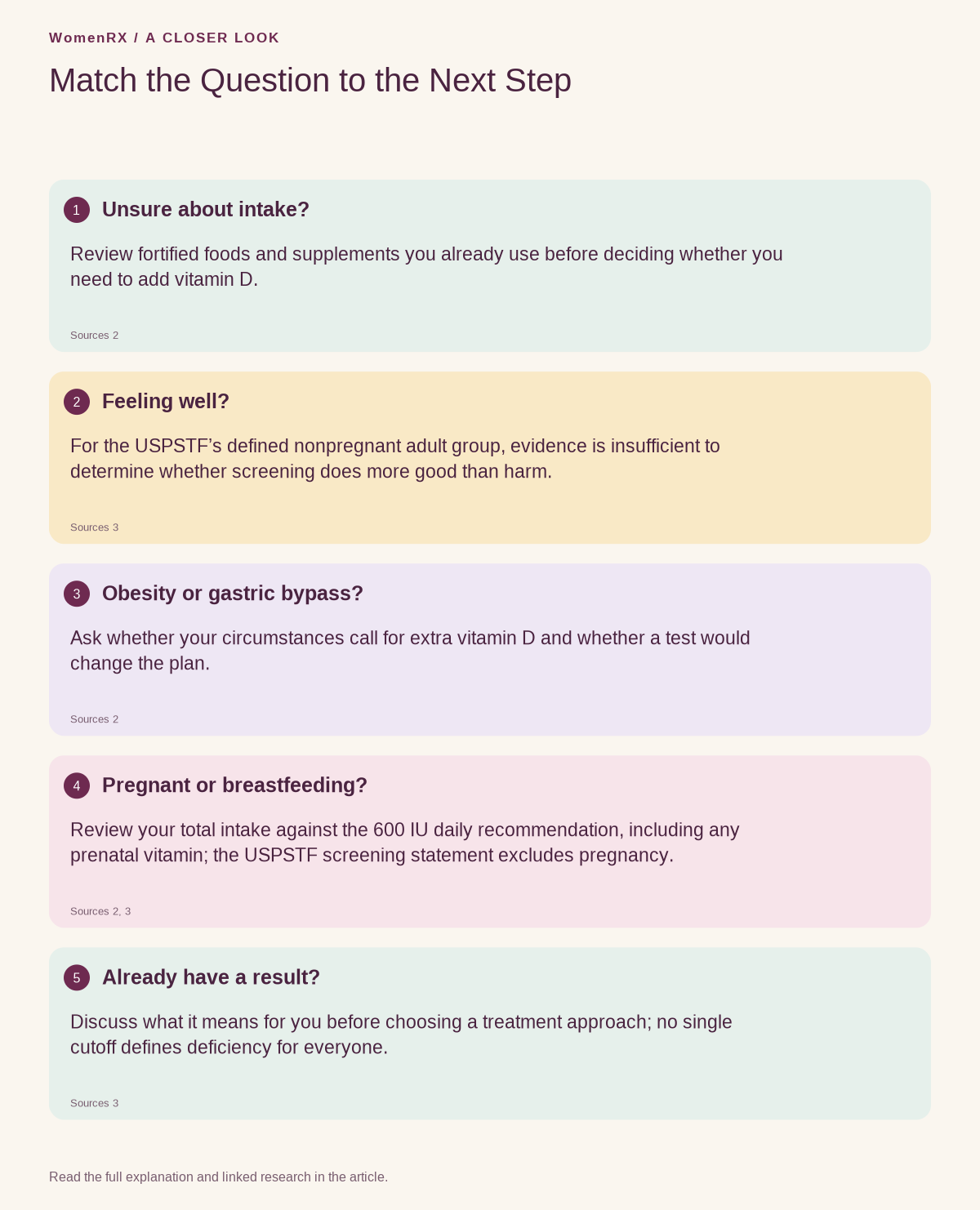
Match the Question to the Next Step
Unsure about intake?: Review fortified foods and supplements you already use before deciding whether you need to add vitamin D.2
Feeling well?: For the USPSTF’s defined nonpregnant adult group, evidence is insufficient to determine whether screening does more good than harm.3
Obesity or gastric bypass?: Ask whether your circumstances call for extra vitamin D and whether a test would change the plan.2
Pregnant or breastfeeding?: Review your total intake against the 600 IU daily recommendation, including any prenatal vitamin; the USPSTF screening statement excludes pregnancy.23
Already have a result?: Discuss what it means for you before choosing a treatment approach; no single cutoff defines deficiency for everyone.3
Read the figure as text
Follow the situation that brought vitamin D to mind; the paths don’t all lead to a blood test.- Unsure about intake?: Review fortified foods and supplements you already use before deciding whether you need to add vitamin D.2
- Feeling well?: For the USPSTF’s defined nonpregnant adult group, evidence is insufficient to determine whether screening does more good than harm.3
- Obesity or gastric bypass?: Ask whether your circumstances call for extra vitamin D and whether a test would change the plan.2
- Pregnant or breastfeeding?: Review your total intake against the 600 IU daily recommendation, including any prenatal vitamin; the USPSTF screening statement excludes pregnancy.23
- Already have a result?: Discuss what it means for you before choosing a treatment approach; no single cutoff defines deficiency for everyone.3
More questions, answered
Does it matter whether a supplement says vitamin D2 or D3?
Both forms raise vitamin D levels in the blood. MedlinePlus says D3 may raise levels higher and for longer than D2, but that difference doesn’t tell you whether you need a supplement or a test in the first place. 2
Sources you can check
- Health Screening: MedlinePlusAccessed 2026-09-25Return to first citation
- Vitamin D: MedlinePlusAccessed 2026-09-25Return to first citation
- Screening for Vitamin D Deficiency in Adults: US Preventive Services Task Force Recommendation Statement.US Preventive Services Task Force, Krist AH, Davidson KW, Mangione CM, Cabana M, Caughey AB, Davis EM, Donahue KE, Doubeni CA, Epling JW, Kubik M, Li L, Ogedegbe G, Owens DK, Pbert L, Silverstein M, Stevermer J, Tseng CW, Wong JB. · JAMA · 2021Return to first citation