Vitamin D Supplements: Dose, Testing, and Safety
The safest vitamin D plan starts with why you’re taking it and how much you already get from every supplement.
For most adults, the recommended daily intake is 600 IU through age 70 and 800 IU after 70; these are reference amounts, not a personal prescription. The adult upper limit is 4,000 IU a day from all sources, not a target. Check overlapping products and consider test results and medical conditions before adding more. Routine testing isn’t recommended for healthy adults.
Start with the reason, not a high-dose bottle
Vitamin D helps your body absorb calcium and supports bone health. A supplement may make sense when food and other sources aren’t enough, or when a clinician is addressing a specific deficiency or health situation. But a bigger dose isn’t automatically better, and a blood test or supplement isn’t necessary for everyone. 1
For healthy adults, the recommended dietary allowance (RDA) is 600 IU (15 mcg) a day through age 70 and 800 IU (20 mcg) after 70. The same 600 IU RDA applies during pregnancy and breastfeeding. These amounts are daily intake references, not a dose selected for treating a deficiency or for every individual. The adult tolerable upper intake level is 4,000 IU (100 mcg) a day, including pregnancy and breastfeeding. It’s a ceiling for usual daily intake, not a goal or a guarantee that this amount is right for you. 1
Add up what’s already in your routine
Before taking another vitamin D product, check the Supplement Facts panels on your multivitamin, prenatal vitamin, calcium supplement, and any separate vitamin D. Add the amounts for a typical day, including the serving size and how often you take each product. Vitamin D may be listed in micrograms (mcg) or International Units (IU); 1 mcg equals 40 IU. 1
This quick total can reveal why a dose that looks modest on one bottle may add up across several. If your total is above the adult upper limit, or a clinician has recommended a higher amount for a particular reason, check the plan with them rather than adjusting it based on the upper limit alone. Some people need individualized management, and vitamin D levels don’t rise in a predictable one-to-one way with intake. 1
What a blood test can tell you
The usual test for vitamin D status is 25-hydroxyvitamin D, often written as 25(OH)D. It reflects vitamin D from food, supplements, and the body’s own production. The active form, 1,25-dihydroxyvitamin D, generally isn’t the right test for checking vitamin D stores. 1
The National Academies’ interpretation is that levels below 12 ng/mL are associated with deficiency risk, 12 to less than 20 ng/mL may be inadequate for some people, and 20 ng/mL or higher is sufficient for most people. Levels above 50 ng/mL can be associated with potential adverse effects. These are reference points, not a reason to chase a higher number: the best level for every health outcome hasn’t been established, and laboratory tests can vary. 1
Routine testing isn’t recommended for healthy adults without a specific reason. If you have a result already, bring the number, units, and date to a discussion about supplements. Ask what the result means for your situation and whether follow-up testing is useful, rather than treating a single number as a dose instruction. 1
Conditions and medicines can change the safety picture
Vitamin D increases calcium absorption. That matters if you have kidney problems, a history of high calcium, hyperparathyroidism, or a history of kidney stones. Thiazide diuretics, a type of medicine used for blood pressure, can reduce calcium lost in urine; combining one with vitamin D may raise the risk of high blood calcium, especially with impaired kidney function or hyperparathyroidism. These are reasons to review your full supplement list and health history before adding vitamin D. 1
Calcium deserves a separate look too. In a seven-year randomized trial of 36,282 postmenopausal women, the group assigned 1,000 mg of calcium and 400 IU of vitamin D daily had a 17% higher risk of kidney stones than the placebo group. The finding applies to that combined supplement regimen and study population; it doesn’t mean that vitamin D alone causes stones or that every woman should avoid calcium. 1
Vitamin D toxicity is usually caused by excessive supplement intake. It can raise blood and urine calcium, and may cause nausea, vomiting, weakness, loss of appetite, unusual thirst, frequent urination, or kidney stones. Severe toxicity can damage the kidneys and affect heart rhythm. 1 A monitored U.S. trial of 2,423 adults with overweight or obesity and prediabetes found no difference from placebo in the overall frequency of specified events such as high calcium, kidney stones, or reduced kidney function during three years of 4,000 IU daily. That result describes one monitored study group; it doesn’t establish that this dose is suitable for everyone. 2
Pregnancy, breastfeeding, and after menopause
Pregnancy and breastfeeding don’t by themselves make high-dose vitamin D necessary. The adult RDA is 600 IU daily in both life stages, and the upper limit is 4,000 IU daily. Check whether a prenatal or other product already contains vitamin D before adding a separate supplement. If you’ve been advised to take a different amount because of a test result or health condition, clarify the reason and follow-up plan. 1
For breastfeeding, keep your own supplement plan distinct from an infant’s needs. The NIH summary of American Academy of Pediatrics guidance says breastfed and partially breastfed infants should receive vitamin D supplementation; a mother’s supplement should not be assumed to replace that infant guidance. 1
After menopause, vitamin D is one part of bone health, not a stand-alone promise to prevent fractures. Research on fracture prevention with supplements is mixed, and much of it combines vitamin D with calcium. If bone health is the reason you’re considering a supplement, discuss both nutrients and your overall bone-health plan rather than choosing a high dose on your own. 1
A useful supplement review
Bring the labels for your supplements and medicines, any 25(OH)D result, and a short list of relevant history such as kidney disease, kidney stones, or a calcium-related condition. Then ask: What is the reason for this amount? What’s my total vitamin D from all products? Does my medical history or medication affect the plan? If I have a test result, does it change what I should take or monitor? Those questions help turn a bottle’s dose into a decision that fits your circumstances.
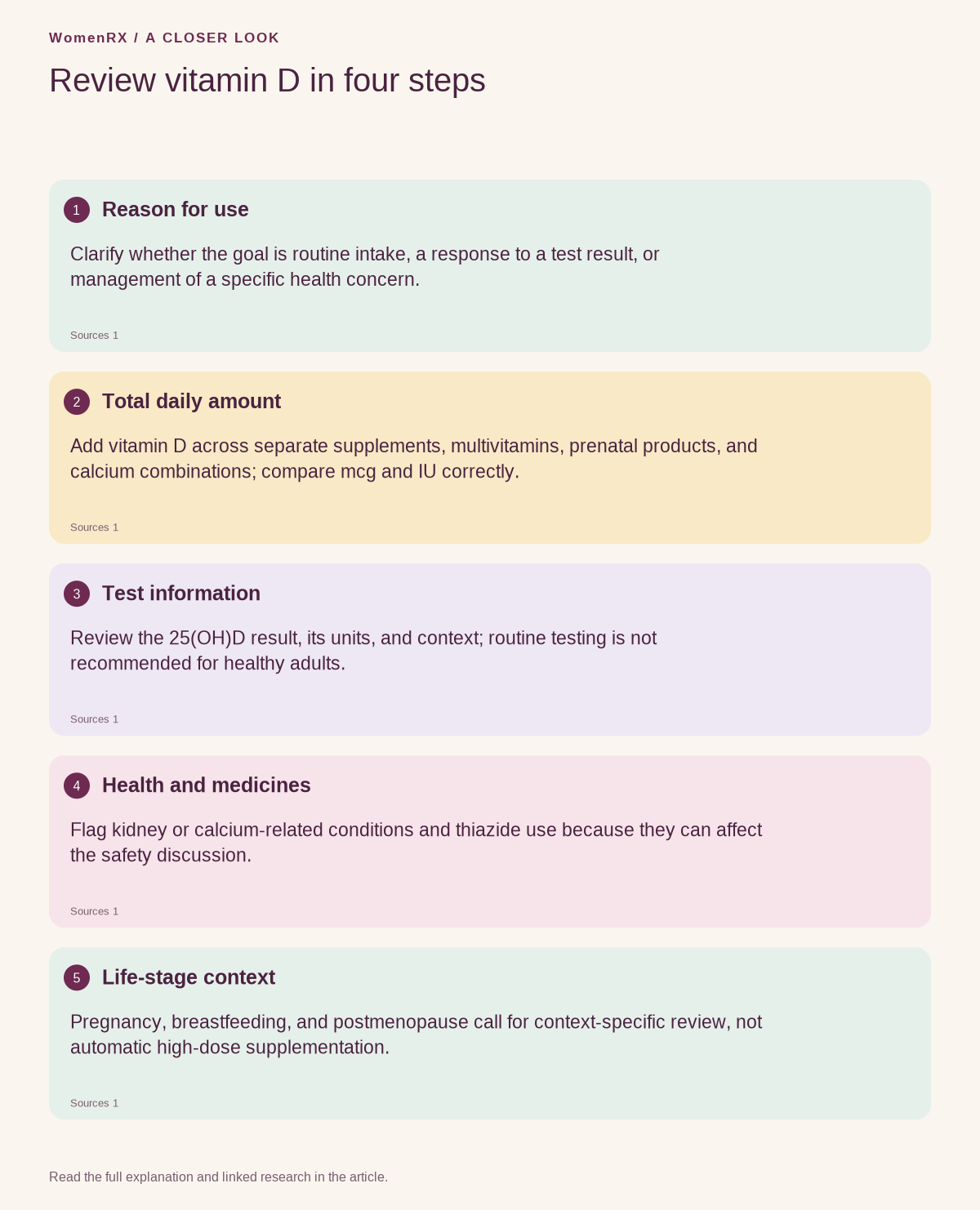
Review vitamin D in four steps
Reason for use: Clarify whether the goal is routine intake, a response to a test result, or management of a specific health concern.1
Total daily amount: Add vitamin D across separate supplements, multivitamins, prenatal products, and calcium combinations; compare mcg and IU correctly.1
Test information: Review the 25(OH)D result, its units, and context; routine testing is not recommended for healthy adults.1
Health and medicines: Flag kidney or calcium-related conditions and thiazide use because they can affect the safety discussion.1
Life-stage context: Pregnancy, breastfeeding, and postmenopause call for context-specific review, not automatic high-dose supplementation.1
Read the figure as text
A supplement decision depends on its purpose, what you already take, relevant test information, and personal safety factors.- Reason for use: Clarify whether the goal is routine intake, a response to a test result, or management of a specific health concern.1
- Total daily amount: Add vitamin D across separate supplements, multivitamins, prenatal products, and calcium combinations; compare mcg and IU correctly.1
- Test information: Review the 25(OH)D result, its units, and context; routine testing is not recommended for healthy adults.1
- Health and medicines: Flag kidney or calcium-related conditions and thiazide use because they can affect the safety discussion.1
- Life-stage context: Pregnancy, breastfeeding, and postmenopause call for context-specific review, not automatic high-dose supplementation.1
More questions, answered
Does everyone need a vitamin D blood test before taking a supplement?
No. Routine testing isn’t recommended for healthy adults. A clinician may interpret a 25(OH)D result in light of your health history, reason for testing, and the limits of laboratory measurements. 1
Is the upper limit the amount I should take?
No. The adult upper limit of 4,000 IU a day is a ceiling for usual intake from all sources, not a target or a personal dose recommendation. 1
Sources you can check
- Vitamin D - Health Professional Fact SheetAccessed 2026-09-25Return to first citation
- Safety and tolerability of high-dose daily vitamin D3 supplementation in the vitamin D and type 2 diabetes (D2d) study-a randomized trial in persons with prediabetes.Johnson KC, Pittas AG, Margolis KL, Peters AL, Phillips LS, Vickery EM, Nelson J, Sheehan PR, Reboussin D, Malozowski S, Chatterjee R, D2d research group. · European journal of clinical nutrition · 2022Return to first citation