How to Review Long-Term Vitamin D Use
A lasting vitamin D routine should still match its reason, your total daily intake, and any health factors that change the safety picture.
Review ongoing vitamin D by checking why you started it, how much you get from every supplement and fortified product, and whether that plan still fits your health and life stage. For most adults, the upper limit is 4,000 IU a day from all sources, not a target. Routine vitamin D testing isn’t recommended for every healthy person, but some medical conditions and medicines make individualized review more relevant. 1
Start with the reason you take it
A supplement that began after a low vitamin D result, a bone-health evaluation, or a condition affecting absorption has a different rationale from one added “just in case.” Write down what prompted it and whether that reason still applies. Vitamin D helps the body absorb calcium, but more isn’t automatically better, and an increased blood level isn’t proof of extra health benefit. The best level for overall health has not been established as one universal target. 1
If you’re taking vitamin D because a clinician identified a deficiency or another medical need, don’t change the plan based only on a general-intake chart. Instead, ask what the supplement is intended to address and what would lead to changing or continuing it.
Add up the whole day, not one bottle
Check the vitamin D amount on your standalone supplement, multivitamin, calcium combination, and other products. Also check labels for fortified foods you regularly use. Vitamin D amounts may appear in micrograms (mcg) or international units (IU); 1 mcg equals 40 IU. The adult Recommended Dietary Allowance is 600 IU daily through age 70 and 800 IU after 70. Those figures refer to total intake, not a dose everyone needs to take as a supplement. 1
For adults, including during pregnancy and breastfeeding, the established upper limit is 4,000 IU a day from food and supplements combined. It’s a ceiling set for usual daily intake, not a suggested dose or a guarantee that every amount below it is right for every person. 1
This is why checking only the front of a vitamin D bottle can miss the bigger picture. For example, a multivitamin and a calcium-plus-vitamin-D product can add vitamin D to a separate supplement, while fortified foods contribute too. Bring the labels or a clear list of products to a review.
Life stage matters, but menopause isn’t a dose by itself
The recommended intake is 600 IU a day for adults ages 19 through 70, including pregnant and lactating adults; after age 70, it is 800 IU. Pregnancy and breastfeeding don’t automatically mean that a higher maternal intake is needed. If you’re breastfeeding, remember that an infant’s vitamin D needs are a separate question: the guidance for breastfed infants is not replaced simply by assuming the parent’s supplement covers the baby. 1
After menopause, bone health may deserve more attention, but that doesn’t make one vitamin D dose right for every woman. The right plan depends on age, diet, bone-health history, and any diagnosed deficiency or osteoporosis. Studies of postmenopausal women have often combined vitamin D with calcium, making it difficult to isolate the effect of vitamin D alone. 1
Calcium is worth including in the review. In a seven-year trial among 36,282 postmenopausal women, the group assigned 1,000 mg of supplemental calcium and 400 IU of vitamin D daily had a 17% higher risk of kidney stones than the placebo group; reported total calcium intake in that group was about 2,100 mg daily. That result concerns the combined regimen in that trial, not vitamin D alone or every woman’s risk. 1
Decide whether testing or closer review fits
Routine vitamin D testing isn’t recommended for every healthy person. The Endocrine Society does not recommend routine 25-hydroxyvitamin D testing in healthy individuals, and the U.S. Preventive Services Task Force has found insufficient evidence to assess the benefits and harms of screening asymptomatic adults. That doesn’t mean testing is never useful; it means a test is best considered in the context of a specific health question rather than assumed to be necessary for everyone. 1
A clinician may have more reason to review vitamin D and calcium together if you have hyperparathyroidism, reduced kidney function, or take a thiazide diuretic. Thiazides reduce calcium excretion in urine, and combining them with vitamin D may contribute to high blood calcium, particularly in older adults or people with impaired kidney function or hyperparathyroidism. Ask whether checking calcium or 25-hydroxyvitamin D makes sense for your situation; there isn’t one monitoring schedule for everyone. 1
Know what high-dose safety evidence says
Vitamin D toxicity is usually linked to excessive supplement intake. It can raise calcium in the blood and urine; possible symptoms of high blood calcium include nausea, vomiting, muscle weakness, unusual thirst, and frequent urination. 1
A review of 22 randomized trials lasting at least six months studied daily vitamin D doses of 3,200 to 4,000 IU in 12,952 participants. Compared with control groups, the vitamin D groups had a higher relative risk of hypercalcemia (RR 2.21); the review reported a vitamin-D-induced frequency of about four cases per 1,000 individuals. The trials included different populations, and safety reporting was incomplete, so this finding is a reason not to treat the upper limit as a target, not a prediction of an individual woman’s risk. 2
A useful review in four steps
Bring the reason for taking vitamin D, the labels for every supplement, and a list of regular medicines to the conversation. Then ask whether the original reason still applies, whether your total intake fits your needs, and whether your health history makes calcium or vitamin D testing appropriate. That’s a more useful review than asking whether vitamin D is simply “safe long-term”: the answer depends on the dose, the reason, and the person taking it.
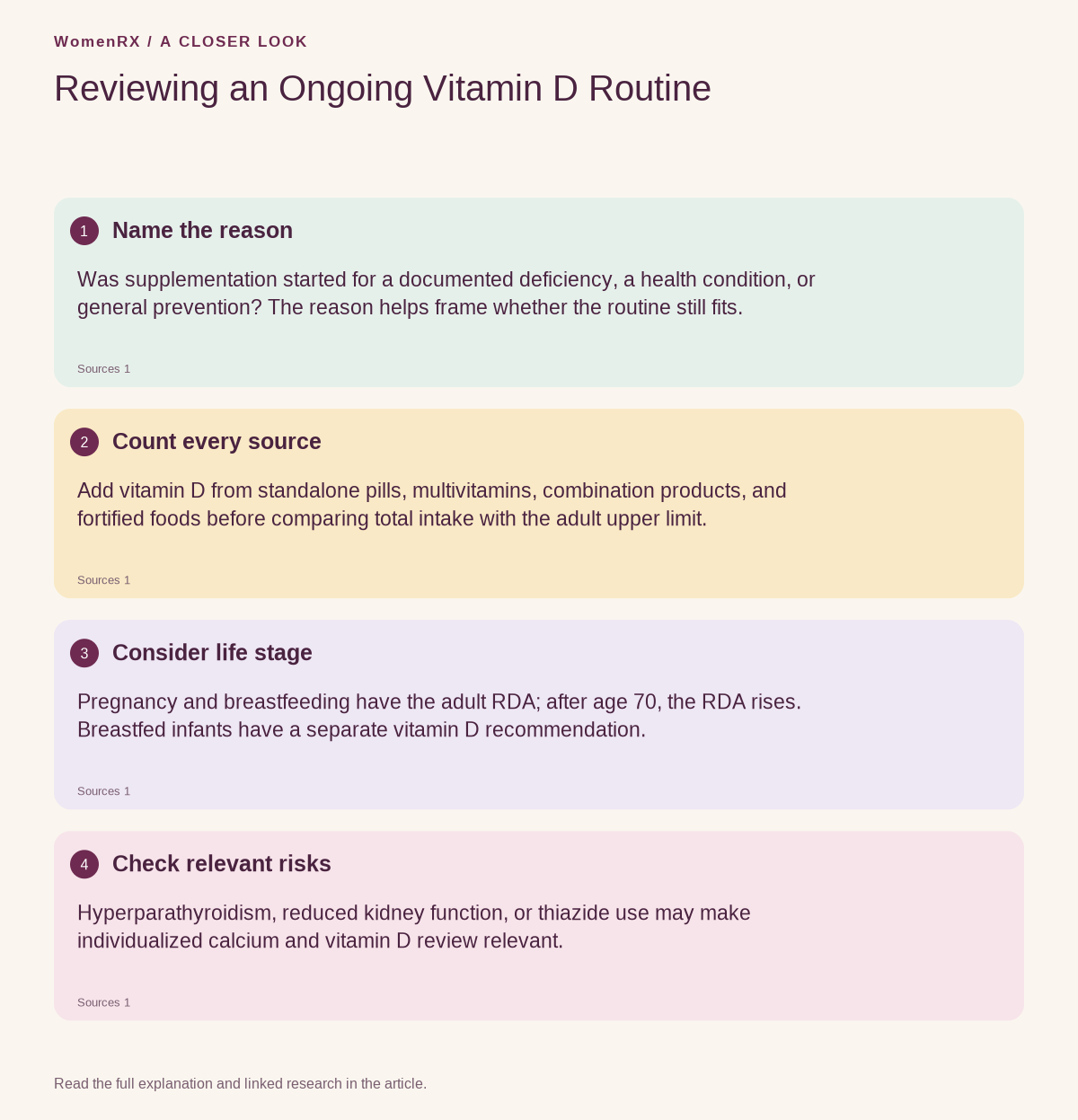
Reviewing an Ongoing Vitamin D Routine
Name the reason: Was supplementation started for a documented deficiency, a health condition, or general prevention? The reason helps frame whether the routine still fits.1
Count every source: Add vitamin D from standalone pills, multivitamins, combination products, and fortified foods before comparing total intake with the adult upper limit.1
Consider life stage: Pregnancy and breastfeeding have the adult RDA; after age 70, the RDA rises. Breastfed infants have a separate vitamin D recommendation.1
Check relevant risks: Hyperparathyroidism, reduced kidney function, or thiazide use may make individualized calcium and vitamin D review relevant.1
Read the figure as text
Use these questions to connect the reason for taking vitamin D with your total intake and the health factors that may change what review is useful.- Name the reason: Was supplementation started for a documented deficiency, a health condition, or general prevention? The reason helps frame whether the routine still fits.1
- Count every source: Add vitamin D from standalone pills, multivitamins, combination products, and fortified foods before comparing total intake with the adult upper limit.1
- Consider life stage: Pregnancy and breastfeeding have the adult RDA; after age 70, the RDA rises. Breastfed infants have a separate vitamin D recommendation.1
- Check relevant risks: Hyperparathyroidism, reduced kidney function, or thiazide use may make individualized calcium and vitamin D review relevant.1
More questions, answered
Does taking less than 4,000 IU a day guarantee safety?
No. The adult upper limit is a guide to total daily intake, not a guarantee that every lower amount is appropriate for every person. Health conditions, medicines, and overlapping products can change the safety picture. 1
Which blood test reflects vitamin D status?
The main indicator is serum 25-hydroxyvitamin D, often written as 25(OH)D. The active form, 1,25-dihydroxyvitamin D, generally isn’t a good measure of vitamin D status because it is tightly regulated. 1
Sources you can check
- Vitamin D - Health Professional Fact SheetAccessed 2026-09-25Return to first citation
- Long-term supplementation with 3200 to 4000 IU of vitamin D daily and adverse events: a systematic review and meta-analysis of randomized controlled trials.Zittermann A, Trummer C, Theiler-Schwetz V, Pilz S. · European journal of nutrition · 2023Return to first citation