How to Review Long-Term Magnesium Use
For ongoing magnesium, review the reason, elemental dose, other magnesium products, kidney health, and medicines rather than relying on a one-size-fits-all stop date.
Ongoing magnesium isn’t automatically inappropriate, but the amount and reason matter. Count elemental magnesium from supplements and magnesium-containing medicines, not magnesium naturally found in food, and check the label against the adult upper limit of 350 mg a day from supplements and medicines. Kidney problems, side effects, or interacting medicines can change what’s suitable, so treatment above that limit calls for clinician direction. 1
A magnesium supplement can be useful for a specific reason, but continuing it on autopilot makes it easy to overlook the total dose, a changed health condition, or a medicine interaction. A practical review starts with what you take it for and what your label actually counts. There isn’t a universal number of weeks or months in the NIH guidance after which everyone must stop; it provides a daily upper limit and describes risks and interactions to consider. 1
For magnesium used as complementary treatment for type 2 diabetes, a 2005 clinical review specifically called for long-term trials to assess safety and benefit. That condition-specific evidence gap doesn’t establish a stop date for other uses. 2
Start with the reason you take it
Write down the original reason: for example, a clinician-directed treatment, a diagnosed deficiency, or a particular symptom. Then ask whether that reason still applies and whether the supplement is doing what you hoped. Magnesium has several roles in the body, but that alone doesn’t mean every person needs a supplement. The NIH fact sheet notes that symptomatic deficiency from low dietary intake is uncommon in otherwise healthy people, though some health conditions and medicines can raise the risk of inadequacy. 1
If magnesium was recommended as treatment, don’t treat the general supplement limit as a replacement treatment plan. For example, NIH describes magnesium as a possible option for migraine prevention, while noting that amounts used for this purpose may exceed the upper limit and should be supervised. Treatment for a specific condition is different from taking a general wellness supplement without a clear reason. 1
Check elemental magnesium, not the compound weight
On a Supplement Facts panel, the magnesium amount is the elemental magnesium in the product, not the weight of the whole compound, such as magnesium citrate or oxide. Use that listed amount when checking your daily total. Different forms can also differ in absorption, so the form name alone doesn’t tell you how much elemental magnesium you’re taking. 1
For adults, the tolerable upper intake level is 350 mg per day from supplements and magnesium-containing medicines combined. It does not include magnesium naturally present in food and beverages. This is a ceiling for routine intake among healthy people, not a target, a recommended supplement dose, or a guarantee that a lower amount is right for someone with particular health risks. 1
Count more than the product you think of as a supplement. Magnesium can also be an ingredient in some antacids and laxatives. Check those labels too, especially if you use them regularly. Laxative products can provide large amounts, and their use shouldn’t be treated as interchangeable with a routine dietary supplement. The amount absorbed can differ because of the laxative effect. 1
Kidney health and symptoms can change the picture
The kidneys help remove excess magnesium. If kidney function is impaired, the body may be less able to clear it, increasing the risk of magnesium building up. That makes kidney disease or reduced kidney function a key reason to review regular magnesium use rather than assuming the general adult limit settles the question. 1
High supplemental or medicinal amounts can cause diarrhea, nausea, and abdominal cramping. Very high amounts can cause more serious effects, including low blood pressure, difficulty breathing, or an irregular heartbeat. If you’re having persistent digestive effects, or you develop concerning symptoms such as unusual weakness, difficulty breathing, or an irregular heartbeat, don’t simply keep taking the same amount and wait for a routine review. 1
Look for medicine interactions, not just a medicine list
Magnesium can reduce absorption of some oral osteoporosis medicines, including bisphosphonates, and of tetracycline and quinolone antibiotics. The timing separation differs by medicine: NIH guidance describes taking magnesium at least two hours before or after oral bisphosphonates; for the listed antibiotics, it describes taking the antibiotic at least two hours before or four to six hours after magnesium. Follow the directions for your specific medicine and check with a pharmacist if the timing is unclear. 1
Some medicines can affect magnesium status rather than simply interact with a supplement. Long-term use of proton pump inhibitors (PPIs) has been associated with low magnesium, typically after more than a year. Loop and thiazide diuretics can increase magnesium loss in urine, while potassium-sparing diuretics can reduce magnesium excretion. These are reasons to review the full medication list, not reasons to add magnesium without checking the situation. 1
Pregnancy and breastfeeding: needs aren’t the same as a supplement prescription
Magnesium intake recommendations vary by life stage. The recommended dietary allowance includes magnesium from all sources, while the 350 mg adult upper limit applies only to supplements and magnesium-containing medicines. For women aged 19-30, the recommended allowance is 310 mg a day, rising to 350 mg during pregnancy; during lactation it is 310 mg. For ages 31-50, the figures are 320 mg, 360 mg in pregnancy, and 320 mg during lactation. 1
These are total-intake recommendations, not instructions to take that amount as a supplement. A woman’s life stage alone doesn’t establish that she needs supplemental magnesium. If you’re pregnant or breastfeeding and considering ongoing use, include medicines and other supplements in the review, and clarify whether the recommendation concerns a specific treatment or meeting dietary needs. 1
A five-part review before you continue
Gather the Supplement Facts panel and the labels for any antacids or laxatives you use. Note the reason you started magnesium, your total elemental amount from products, any digestive symptoms, kidney-related health conditions, and medicines that may interact or affect magnesium levels. That gives you a concrete basis to decide whether your original reason still applies, whether the total is within the general limit, and whether the plan needs to be checked against treatment-specific advice. 1
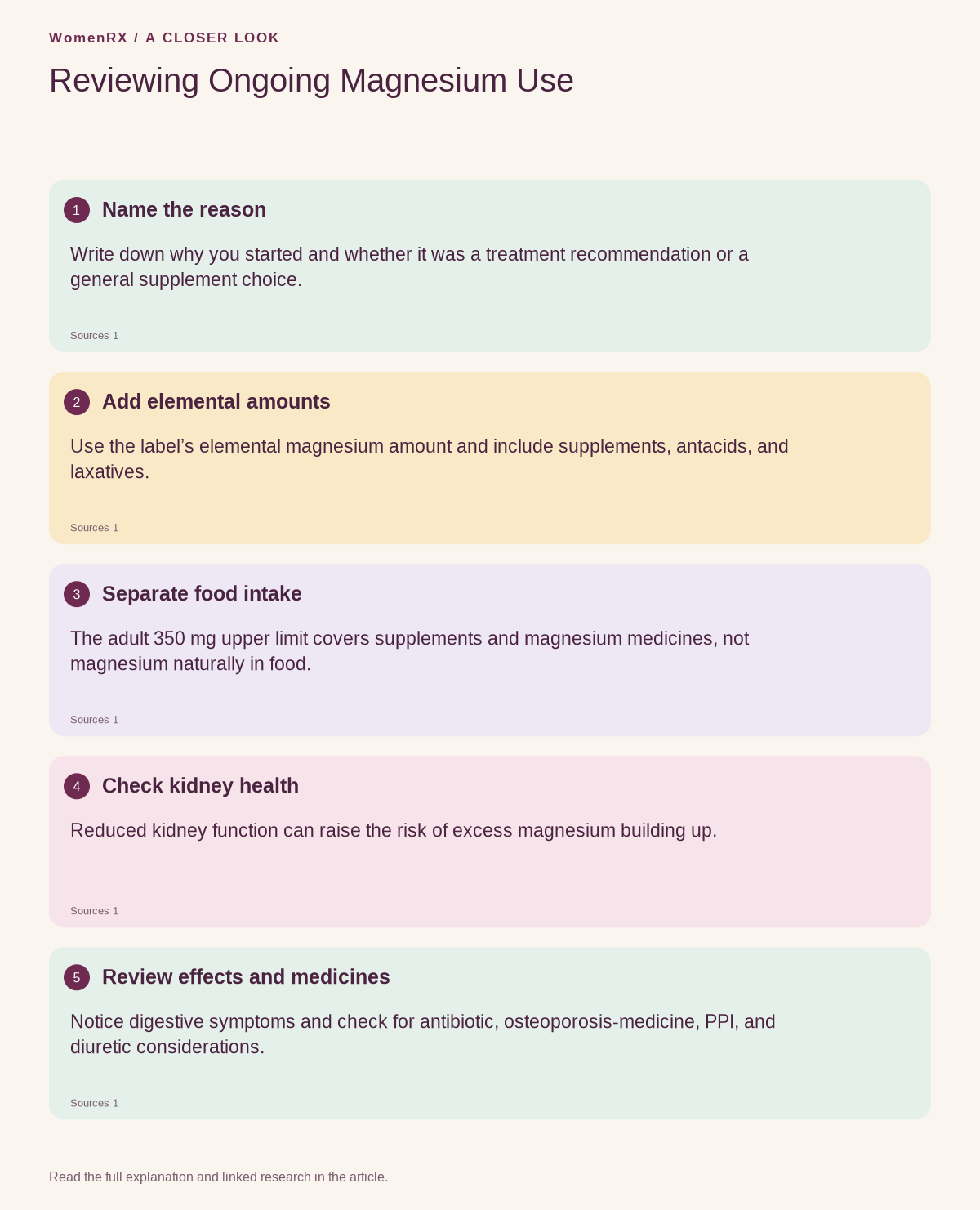
Reviewing Ongoing Magnesium Use
Name the reason: Write down why you started and whether it was a treatment recommendation or a general supplement choice.1
Add elemental amounts: Use the label’s elemental magnesium amount and include supplements, antacids, and laxatives.1
Separate food intake: The adult 350 mg upper limit covers supplements and magnesium medicines, not magnesium naturally in food.1
Check kidney health: Reduced kidney function can raise the risk of excess magnesium building up.1
Review effects and medicines: Notice digestive symptoms and check for antibiotic, osteoporosis-medicine, PPI, and diuretic considerations.1
Read the figure as text
Use these checks to separate everyday supplement use from magnesium in medicines or clinician-directed treatment.- Name the reason: Write down why you started and whether it was a treatment recommendation or a general supplement choice.1
- Add elemental amounts: Use the label’s elemental magnesium amount and include supplements, antacids, and laxatives.1
- Separate food intake: The adult 350 mg upper limit covers supplements and magnesium medicines, not magnesium naturally in food.1
- Check kidney health: Reduced kidney function can raise the risk of excess magnesium building up.1
- Review effects and medicines: Notice digestive symptoms and check for antibiotic, osteoporosis-medicine, PPI, and diuretic considerations.1
More questions, answered
Does magnesium from food count toward the 350 mg upper limit?
No. The adult upper limit applies to magnesium from supplements and magnesium-containing medicines, not magnesium naturally present in food and beverages. The recommended dietary allowance, by contrast, counts magnesium from all sources. 1
Should I stop if my treatment amount is above 350 mg a day?
The 350 mg limit is for routine supplemental and medicinal intake in healthy adults; it isn’t a substitute for a treatment plan. Some clinician-directed uses, such as migraine prevention, may involve amounts above it. Review that use with the clinician directing the treatment rather than treating the general limit as a self-adjustment instruction. 1
Sources you can check
- Magnesium - Health Professional Fact SheetAccessed 2026-09-25Return to first citation
- Complementary therapies for diabetes: the case for chromium, magnesium, and antioxidants.Guerrero-Romero F, Rodríguez-Morán M. · Archives of medical research · 2005Return to first citation