Is Long-Term Magnesium Citrate Use Safe?
Ongoing use depends on the product’s purpose, its elemental magnesium, your kidney function, and how your body responds.
Magnesium citrate isn’t automatically safe for ongoing use just because it’s sold as a supplement. Check whether your specific product is labeled as a supplement or directed for laxative use. The 350 mg adult upper limit is a reference for magnesium from supplements and medicines, not a laxative dosing instruction. Kidney problems, persistent diarrhea, and certain medicines can change the safety discussion. 1
Start with the product’s purpose
Magnesium is sold in dietary supplements and is also an ingredient in some laxatives and medicines for heartburn. Check your particular product’s label and directions to see whether it’s a supplement or intended for laxative use. The name “magnesium citrate” by itself doesn’t tell you how the product is meant to be used. 1
If you’re using a magnesium-containing product regularly for constipation, tell a clinician or pharmacist that it’s being used as a laxative. A recurring need is a good reason to review the product and the reason you need it. Magnesium salts that remain in the gut can draw water into the bowel, so laxative effects and bowel symptoms are part of the safety picture. 1
Evidence on routine supplementation also has a limited time horizon. In one randomized trial, 164 overweight or slightly obese adults, including 104 women, received magnesium citrate, oxide, sulfate, or placebo for 24 weeks. The study assessed arterial stiffness and blood pressure, not years-long safety; magnesium citrate didn’t significantly change either measure compared with placebo at 24 weeks. One serious adverse event was reported and judged unrelated to treatment. This trial doesn’t establish whether taking magnesium citrate for years is safe. 2
Read the label without confusing the limit
On a supplement’s “Supplement Facts” panel, the magnesium amount refers to elemental magnesium, not the weight of the entire citrate compound. For supplement use, check that amount alongside magnesium in other supplements and medicines. Magnesium from food doesn’t count toward the supplemental upper limit. 1
For healthy adults, the upper limit for magnesium from supplements and medicines is 350 mg per day. This is a reference for those sources, not a target, a personal safety guarantee, or a dosing instruction for a laxative product. Some magnesium-containing laxatives provide amounts above this limit; some magnesium is not absorbed because of the laxative effect. Follow the directions for the specific product, and ask a pharmacist or clinician about recurring use rather than using the 350 mg limit to decide a laxative dose. 1
Recommended intake is different from the upper limit and includes magnesium from all sources. For women ages 19-30, the recommended intake is 310 mg daily, and for ages 31-50 it’s 320 mg. The recommended totals are 350 mg during pregnancy at ages 19-30 and 360 mg at ages 31-50; during breastfeeding, they’re 310 mg and 320 mg, respectively. The 350 mg upper limit from supplements and medicines also applies in these adult pregnancy and lactation age groups. These reference values don’t mean you need a magnesium citrate supplement in any life stage. 1
Why kidneys and bowel effects matter
Your kidneys help remove excess magnesium. If kidney function is impaired, excess magnesium can build up because the body may not clear it as effectively. Don’t treat routine supplement limits as a personal safety guarantee if you have kidney disease or reduced kidney function; ask a clinician or pharmacist to review your product and total intake. 1
High amounts of magnesium from supplements or medicines can cause diarrhea, nausea, and abdominal cramping. The laxative effect comes from magnesium salts that remain in the gut, where they draw water into the bowel. Ongoing diarrhea is worth addressing: chronic diarrhea can contribute to magnesium depletion, so increasing magnesium on your own may not solve the problem. 1
Very high magnesium levels can cause more serious effects, including marked weakness, difficulty breathing, very low blood pressure, or an irregular heartbeat. If these symptoms occur after taking a magnesium product, seek urgent medical care. 1
Medicines can change the calculation
Magnesium can reduce the absorption of oral bisphosphonates such as alendronate and of tetracycline or quinolone antibiotics, including doxycycline and ciprofloxacin. NIH guidance describes spacing magnesium from these medicines; ask a pharmacist to check the timing for your exact prescriptions and product. 1
Some medicines can also affect magnesium status. Long-term use of certain diuretics can increase magnesium loss in urine, while potassium-sparing diuretics can reduce it. Prescription proton pump inhibitors, used for acid reflux, have been associated with low magnesium when taken for prolonged periods, typically more than a year. If you use one of these medicines, a pharmacist or clinician can help assess whether your overall intake or monitoring needs a closer look. 1
Pregnancy and breastfeeding
Pregnancy and breastfeeding change the recommended total magnesium intake, but they don’t make magnesium citrate automatically necessary. The recommended values are totals from food, drinks, supplements, and medicines; the adult upper limit of 350 mg applies to magnesium from supplements and medicines, not naturally occurring food magnesium. If you’re considering regular use during pregnancy or while breastfeeding, review the product and its reason for use with your care team rather than assuming the general adult guidance settles the question. 1
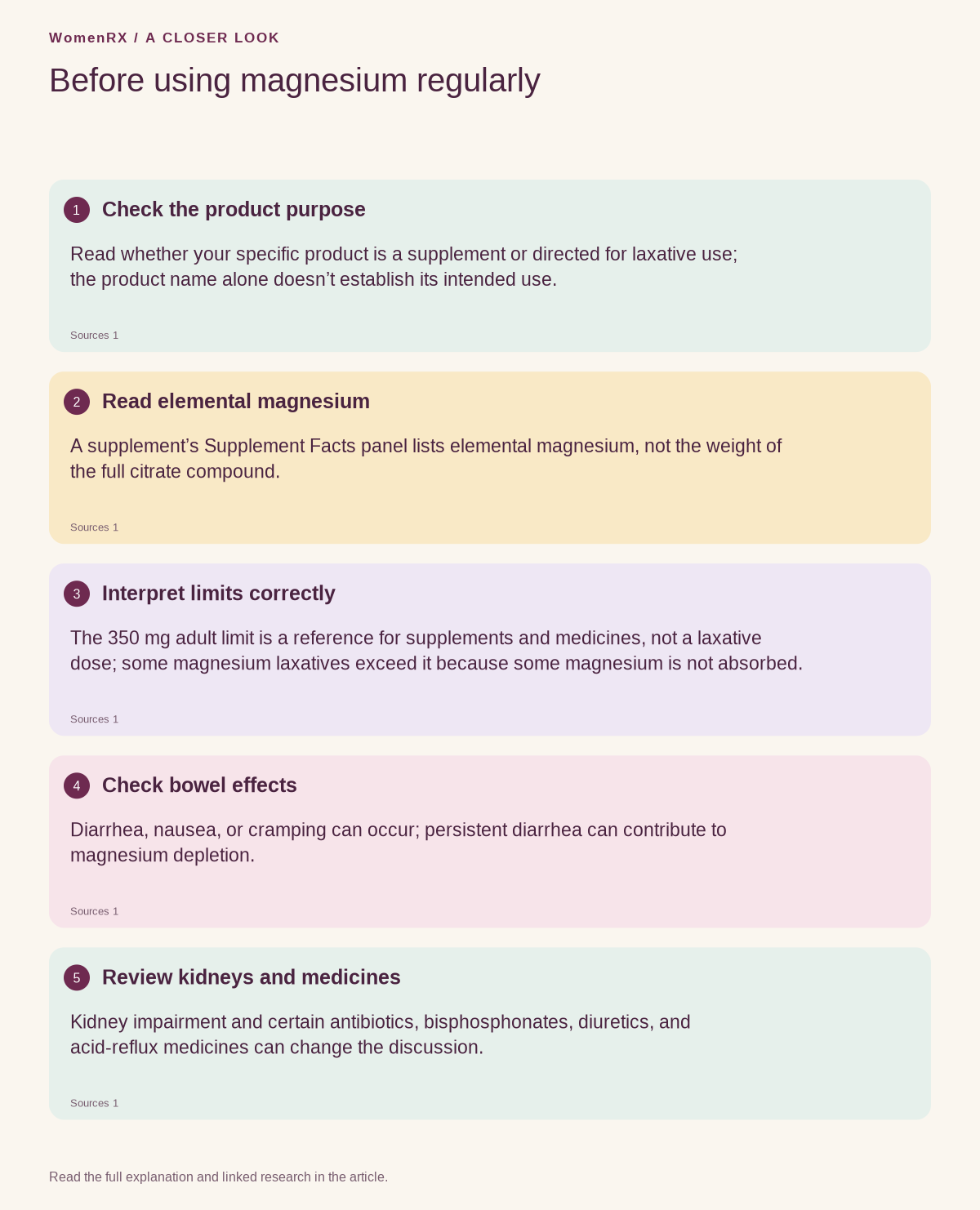
Before using magnesium regularly
Check the product purpose: Read whether your specific product is a supplement or directed for laxative use; the product name alone doesn’t establish its intended use.1
Read elemental magnesium: A supplement’s Supplement Facts panel lists elemental magnesium, not the weight of the full citrate compound.1
Interpret limits correctly: The 350 mg adult limit is a reference for supplements and medicines, not a laxative dose; some magnesium laxatives exceed it because some magnesium is not absorbed.1
Check bowel effects: Diarrhea, nausea, or cramping can occur; persistent diarrhea can contribute to magnesium depletion.1
Review kidneys and medicines: Kidney impairment and certain antibiotics, bisphosphonates, diuretics, and acid-reflux medicines can change the discussion.1
Read the figure as text
Check the product’s purpose, its label, bowel effects, and factors that can change the safety discussion.- Check the product purpose: Read whether your specific product is a supplement or directed for laxative use; the product name alone doesn’t establish its intended use.1
- Read elemental magnesium: A supplement’s Supplement Facts panel lists elemental magnesium, not the weight of the full citrate compound.1
- Interpret limits correctly: The 350 mg adult limit is a reference for supplements and medicines, not a laxative dose; some magnesium laxatives exceed it because some magnesium is not absorbed.1
- Check bowel effects: Diarrhea, nausea, or cramping can occur; persistent diarrhea can contribute to magnesium depletion.1
- Review kidneys and medicines: Kidney impairment and certain antibiotics, bisphosphonates, diuretics, and acid-reflux medicines can change the discussion.1
More questions, answered
Does the 350 mg upper limit tell me how much laxative to take?
No. It’s a reference for magnesium from supplements and medicines, not a laxative dosing instruction. Some magnesium-containing laxatives provide amounts above the limit, partly because some magnesium isn’t absorbed due to the laxative effect. Follow the specific product directions and ask a pharmacist or clinician about recurring use. 1
What should I look for on a supplement label?
Look for the magnesium amount on the Supplement Facts panel. It lists elemental magnesium, not the weight of the entire magnesium citrate compound. For supplement use, include other magnesium supplements and medicines when reviewing your intake. 1
Sources you can check
- Magnesium - Health Professional Fact SheetAccessed 2026-09-25Return to first citation
- Effects of Magnesium Citrate, Magnesium Oxide, and Magnesium Sulfate Supplementation on Arterial Stiffness: A Randomized, Double-Blind, Placebo-Controlled Intervention Trial.Schutten JC, Joris PJ, Groendijk I, Eelderink C, Groothof D, van der Veen Y, Westerhuis R, Goorman F, Danel RM, de Borst MH, Bakker SJL. · Journal of the American Heart Association · 2022Return to first citation