Magnesium Citrate for Constipation: When Might It Work?
A magnesium citrate laxative usually produces a bowel movement within 30 minutes to 6 hours, but a magnesium supplement is a different product.
If you’re taking magnesium citrate sold as a laxative for occasional constipation, it usually produces a bowel movement within 30 minutes to 6 hours. Check your product’s directions rather than using that window to judge a magnesium supplement or taking more because nothing has happened yet. If you still can’t have a bowel movement after using the laxative, contact a doctor. 31
The first thing to check is what the package says the product is for. Magnesium citrate is sold both as a dietary supplement and as a medicine. The laxative is intended for short-term treatment of occasional constipation; a supplement’s Supplement Facts panel lists the amount of elemental magnesium it provides. That panel does not tell you to expect a laxative effect on the medicine’s timetable. 31
What the timing means for a laxative
Magnesium citrate is a saline laxative. It retains water with stool, making stool softer and easier to pass. MedlinePlus says the laxative usually causes a bowel movement within 30 minutes to 6 hours after it’s taken. “Usually” matters: the range is an expectation, not a reason to take another dose if you haven’t gone at the early end of it. Follow the directions on the product you actually have. 3
Formulation matters when reading those directions. Magnesium citrate laxative comes as a ready-to-drink liquid or as a powder that must be mixed with liquid. Those aren’t instructions for a magnesium citrate supplement, even if the name on the front looks similar. Nor should you borrow directions from a bowel-preparation regimen used before a medical procedure. 3
Before you take it, check more than the clock
Kidney health changes the safety question. The kidneys help remove excess magnesium, and impaired kidney function raises the risk of magnesium toxicity. Tell a doctor or pharmacist if you have kidney disease before using magnesium citrate as a laxative. This is also worth checking if you’re pregnant or breastfeeding; don’t assume the usual laxative advice automatically fits your situation. 13
Look at your other medicines, too. Magnesium can interfere with the absorption of some antibiotics, including tetracyclines and quinolones. MedlinePlus advises separating magnesium citrate laxative from other medicines; a pharmacist can help you check the directions that apply to yours. 13
Loose or watery stools can happen. If you cannot have a bowel movement after using magnesium citrate, or you notice blood in your stool, stop using it and call a doctor rather than escalating the dose. MedlinePlus also says not to use it for more than a week unless a doctor tells you to. 3
If this is becoming a pattern
A laxative may help with an occasional episode, but it won’t explain why constipation keeps returning. Changes in fiber or fluid intake, activity, routine, and medicines are among the possible contributors. If constipation is regular or isn’t improving with treatment, it’s worth addressing the pattern rather than repeatedly treating each episode as a new one. 2
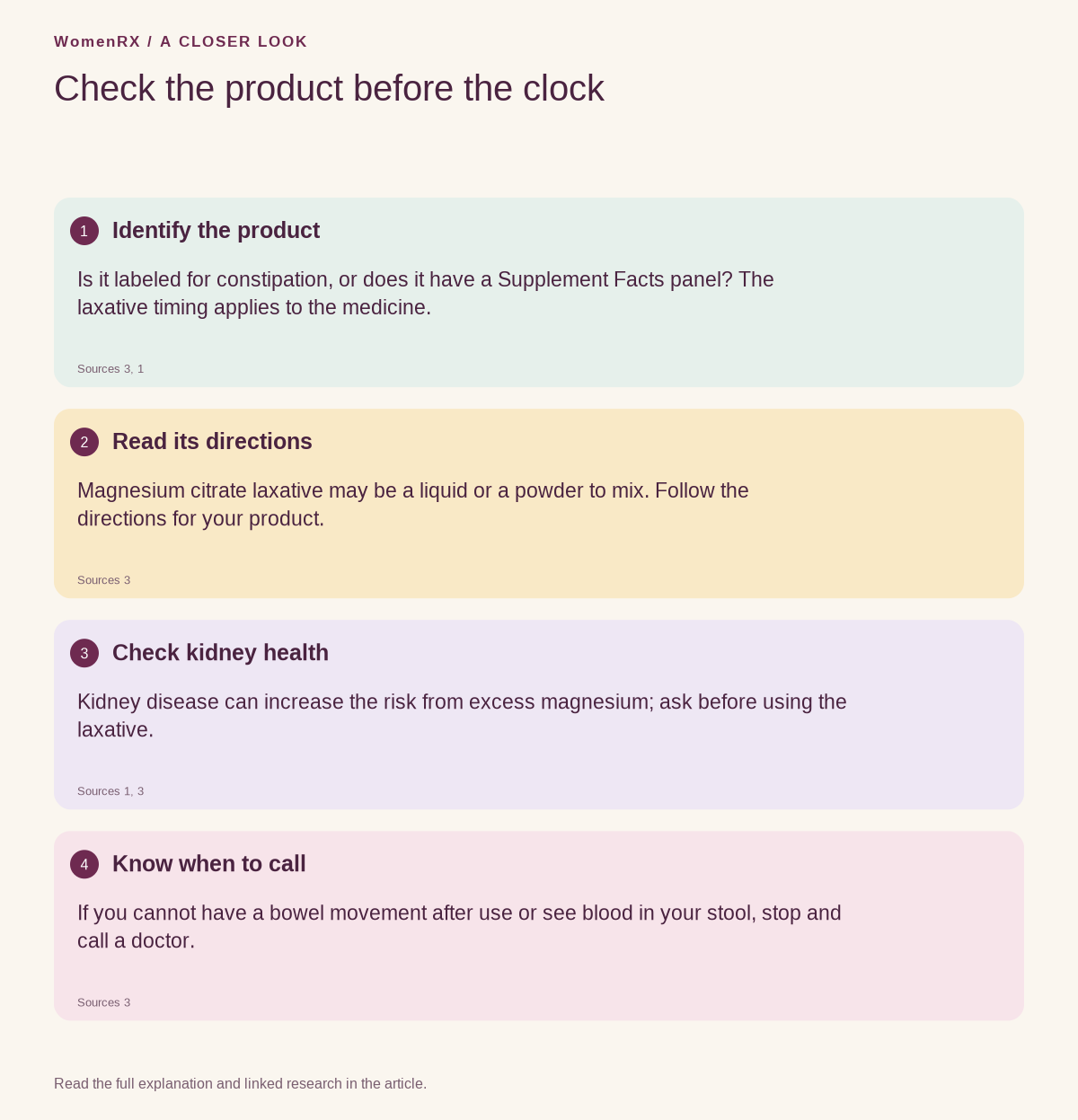
Check the product before the clock
Identify the product: Is it labeled for constipation, or does it have a Supplement Facts panel? The laxative timing applies to the medicine.31
Read its directions: Magnesium citrate laxative may be a liquid or a powder to mix. Follow the directions for your product.3
Check kidney health: Kidney disease can increase the risk from excess magnesium; ask before using the laxative.13
Know when to call: If you cannot have a bowel movement after use or see blood in your stool, stop and call a doctor.3
Read the figure as text
These package and health checks help put the laxative timing range in context.- Identify the product: Is it labeled for constipation, or does it have a Supplement Facts panel? The laxative timing applies to the medicine.31
- Read its directions: Magnesium citrate laxative may be a liquid or a powder to mix. Follow the directions for your product.3
- Check kidney health: Kidney disease can increase the risk from excess magnesium; ask before using the laxative.13
- Know when to call: If you cannot have a bowel movement after use or see blood in your stool, stop and call a doctor.3
More questions, answered
Does a magnesium citrate supplement work within six hours, too?
Don’t use the laxative’s 30-minute-to-6-hour window as a promise for a supplement. Magnesium appears in both supplements and medicines, and a supplement’s label reports elemental magnesium rather than giving the laxative medicine’s directions. Check which type of product you have. 13
Sources you can check
- Magnesium - Health Professional Fact SheetAccessed 2026-09-25Return to first citation
- Constipation - NHSAccessed 2026-09-25Return to first citation
- Magnesium Citrate: MedlinePlus Drug InformationAccessed 2026-09-25Return to first citation