When Might Magnesium Citrate Be Appropriate, and What Should You Check?
Start with why you want it, then check the amount of elemental magnesium and whether the product is a supplement or a laxative.
Magnesium citrate may make sense when you have a specific reason to supplement, such as a clinician-identified need, but it isn’t a must-have for every woman. Check the Supplement Facts panel for elemental magnesium, add up other supplements and magnesium-containing medicines, and don’t mistake a laxative or bowel-prep product for a routine supplement. Kidney problems and certain medicines call for extra care. 1
Magnesium citrate can be a reasonable choice in some situations, but the name alone doesn’t tell you whether a product fits your goal or how much magnesium you’ll get. The useful starting points are your reason for taking it, the amount of elemental magnesium, and whether the product is meant as a dietary supplement or a medicine for bowel cleansing or constipation.
Start with the reason, not the form
Magnesium is needed for normal muscle and nerve function, among other roles. Most healthy people don’t develop symptomatic deficiency just from a low intake, because the kidneys conserve magnesium when levels are low. Certain conditions, including gastrointestinal diseases that cause chronic diarrhea or poor absorption, type 2 diabetes, and alcohol dependence, can increase the chance of inadequate magnesium. Some medicines can also affect magnesium levels. 1
That makes a supplement more relevant when there’s a specific concern about intake, absorption, losses, or a clinician’s recommendation. It doesn’t follow that everyone will benefit from adding magnesium. For general intake, foods such as leafy greens, beans, nuts, seeds, and whole grains provide magnesium too. 1
The citrate form is relatively well absorbed compared with magnesium oxide in small studies. That’s a fact about absorption, not proof that citrate is needed, better for every purpose, or likely to improve a particular symptom. 1
Read the label for elemental magnesium
On a dietary supplement, use the Supplement Facts panel to find the amount of magnesium per serving. That amount is elemental magnesium, not the weight of the full magnesium citrate compound. Also check how many capsules, tablets, or scoops make up one serving. 1
For healthy adults, the upper limit for magnesium from supplements and medicines combined is 350 mg per day. It does not include magnesium naturally present in food, and it is a safety limit, not a recommended target or a dose everyone should take. Higher amounts can be used in some clinician-directed situations, but the limit is a good reason not to stack products or treat “more” as better. 1
The recommended intake is a different number: it refers to magnesium from all sources, including food. For women ages 19-30, that recommended amount is 310 mg daily, or 350 mg during pregnancy; while breastfeeding it’s 310 mg. For ages 31-50, it’s 320 mg, or 360 mg during pregnancy; while breastfeeding it’s 320 mg. From age 51 onward, it’s 320 mg daily. These are total-intake goals, not supplement doses. The supplemental-and-medicine upper limit remains 350 mg for adults, including during pregnancy and lactation. 1
Don’t confuse a supplement with a laxative
Magnesium is an ingredient in some laxatives and antacids, and magnesium-containing medicines can contribute to the same total as a supplement. Some bowel-preparation regimens also use magnesium citrate in combination with another laxative. These products have a different purpose from routine nutritional supplementation, so don’t use a supplement’s label as a laxative plan or take a bowel-prep product as if it were a daily supplement. Follow the directions for the actual medicine, and ask a pharmacist or prescriber if you’re unsure which kind of product you have. 13
If constipation is your reason for considering magnesium, you don’t necessarily need a bowel movement every day. Changes in your usual bowel habits are worth paying attention to; MedlinePlus advises using laxatives only if your health care provider says you should. 2
Check kidney health and medicines
The kidneys remove excess magnesium. If you have impaired kidney function or kidney failure, magnesium can build up, raising the risk of toxicity. That’s a reason to get individualized advice before using a magnesium supplement or magnesium-containing laxative. 1
Magnesium can also interfere with how some medicines are absorbed. It can reduce absorption of oral bisphosphonates, used to treat osteoporosis, and of tetracycline or quinolone antibiotics. The NIH fact sheet gives spacing guidance for these medicines; because schedules differ by drug, check the instructions with a pharmacist rather than guessing. 1
A small crossover study in 15 healthy adults also found that taking levothyroxine with a dissolved magnesium citrate preparation reduced thyroid-hormone exposure by 7%, a change that wasn’t statistically significant. The study tested a specific powdered, dissolved form in people without hypothyroidism, so it can’t establish the effect of every tablet or product. Still, if you take levothyroxine, ask how to separate it from magnesium rather than taking them together by default. 4
Long-term use of proton pump inhibitors and some diuretics can affect magnesium status, though they do so in different ways. If you take one regularly, that may be useful context when discussing a suspected deficiency; it doesn’t by itself mean you should start a supplement. 1
What side effects mean for your decision
Supplemental or medicinal magnesium can cause diarrhea, nausea, or abdominal cramping. These effects can be a sign that the amount or product isn’t suiting you. Severe magnesium toxicity is uncommon but more concerning when kidney function is impaired; it can affect blood pressure, breathing, and heart rhythm. 1
A practical check before buying is: What am I using it for? What does the label list as elemental magnesium per serving? Am I already getting magnesium from another supplement, antacid, or laxative? Do kidney problems, pregnancy or breastfeeding, or a medicine interaction change the plan? If the answer to that last question is yes or you’re not sure, get help sorting out the specific product and schedule before taking it.
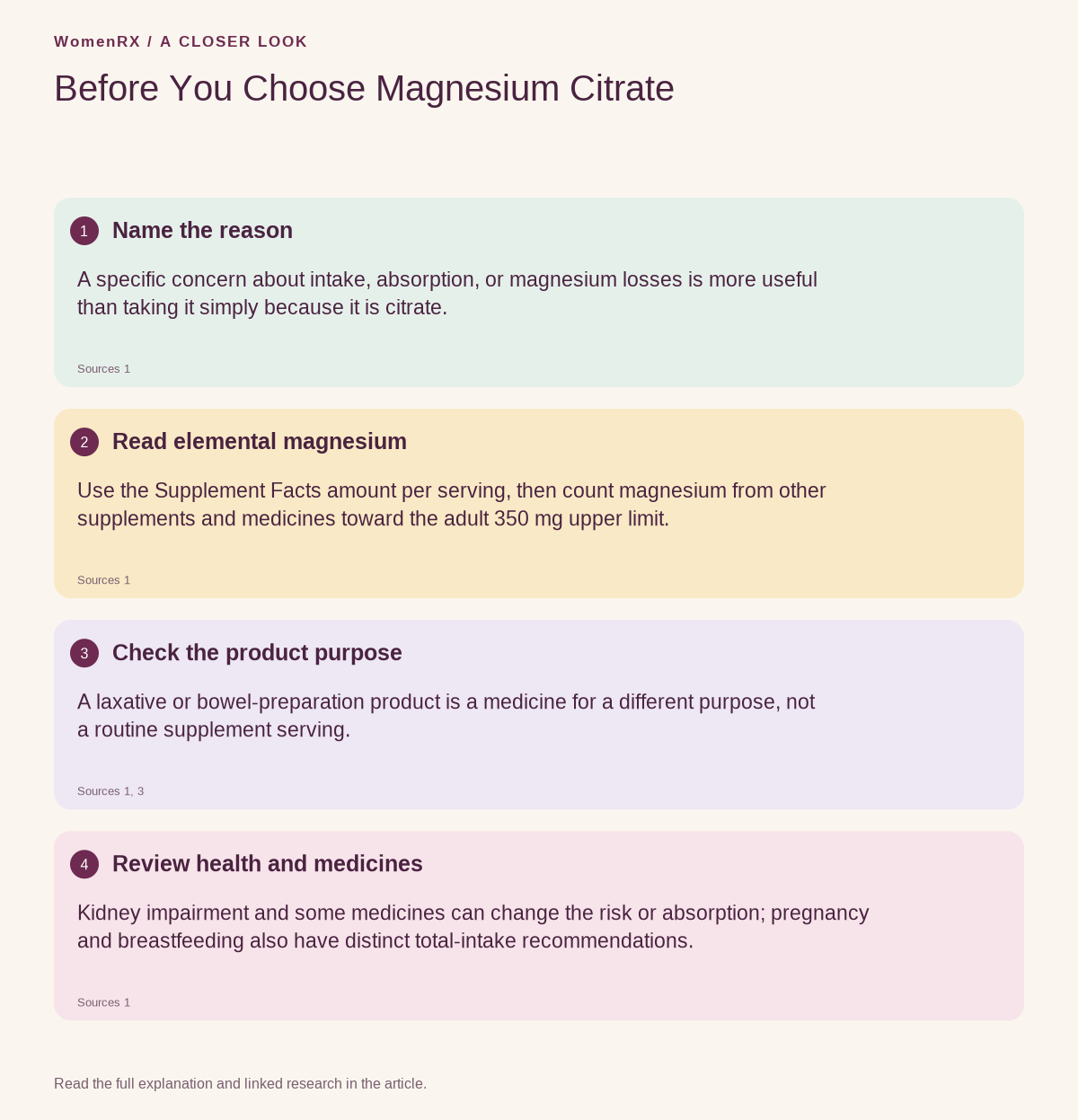
Before You Choose Magnesium Citrate
Name the reason: A specific concern about intake, absorption, or magnesium losses is more useful than taking it simply because it is citrate.1
Read elemental magnesium: Use the Supplement Facts amount per serving, then count magnesium from other supplements and medicines toward the adult 350 mg upper limit.1
Check the product purpose: A laxative or bowel-preparation product is a medicine for a different purpose, not a routine supplement serving.13
Review health and medicines: Kidney impairment and some medicines can change the risk or absorption; pregnancy and breastfeeding also have distinct total-intake recommendations.1
Read the figure as text
Use this sequence to distinguish a reason to supplement from a product intended to work as a laxative, and to spot label or safety questions.- Name the reason: A specific concern about intake, absorption, or magnesium losses is more useful than taking it simply because it is citrate.1
- Read elemental magnesium: Use the Supplement Facts amount per serving, then count magnesium from other supplements and medicines toward the adult 350 mg upper limit.1
- Check the product purpose: A laxative or bowel-preparation product is a medicine for a different purpose, not a routine supplement serving.13
- Review health and medicines: Kidney impairment and some medicines can change the risk or absorption; pregnancy and breastfeeding also have distinct total-intake recommendations.1
More questions, answered
Is the recommended intake the same as the supplement limit?
No. The recommended intake is a total from food, drinks, supplements, and medicines. The adult upper limit of 350 mg applies only to magnesium from supplements and medicines, not magnesium naturally found in food. 1
Does magnesium citrate work better because it’s absorbed well?
Citrate tends to be more bioavailable than magnesium oxide in small studies, but better absorption alone doesn’t show that you need a supplement or that it will treat a particular symptom. 1
Sources you can check
- Magnesium - Health Professional Fact SheetAccessed 2026-09-25Return to first citation
- Constipation | MedlinePlusAccessed 2026-09-25Return to first citation
- Adenoma detection rate and tolerability of 2 ultra-low-volume bowel preparations in screening: a noninferiority randomized controlled trial.Serradesanferm A, Torá-Rocamora I, Pozo À, Ocaña T, Diaz M, Moreira R, Rivero-Sánchez L, Ortiz O, Carballal S, Moreira L, Vaquero EC, Ordás I, Bayarri C, Daca-Alvarez M, Torres S, ... · Gastrointestinal endoscopy · 2025Return to first citation
- Single Center, Open-Label, Randomized Crossover Trial on Drug-Drug Interactions of Levothyroxine/Magnesium-Citrate and Levothyroxine/Magnesium-Aspartate in Healthy Subjects-The ThyroMag Trial.Attinger MC, von Felten S, Rodrigues CL, Krützfeldt J, Risch L, Bonzon J. · Clinical and translational science · 2025Return to first citation