Magnesium Citrate: When It May Fit and What to Check First
Magnesium citrate is a supplement form, but that doesn’t make every citrate product a laxative; check the product’s purpose, elemental magnesium, and your health factors.
If you’re considering magnesium citrate for supplementation, check the Supplement Facts panel for elemental magnesium and count other supplements and magnesium-containing medicines too. If constipation is the concern, choose a product specifically labeled as a laxative; don’t assume a magnesium-citrate supplement is interchangeable with one. Kidney problems and certain medicines can change the safety picture. 1
Start with what you want the product to do
Magnesium citrate is one form of magnesium used in dietary supplements. Magnesium is also an ingredient in some laxatives, but that doesn’t mean a magnesium-citrate supplement is a laxative or works as one. For example, the NIH Office of Dietary Supplements describes magnesium hydroxide as an ingredient in some laxatives. Check what a specific product is labeled and intended to do rather than choosing by the word “magnesium” alone. 1
If your goal is supplementation, look for a dietary supplement and check its Supplement Facts panel. It lists the amount of elemental magnesium, not the total weight of the magnesium-citrate compound. That elemental amount is the useful number when you’re counting magnesium from supplements. 1
If constipation is the concern, look for a product specifically labeled as a laxative and follow that product’s directions. Don’t assume a magnesium-citrate supplement is an equivalent substitute, and don’t use a supplement’s elemental-magnesium amount to create a laxative dose. Magnesium’s laxative effect is related to unabsorbed salts drawing water into the intestine. 1
If you’re considering a nutrient supplement
Compare the elemental-magnesium amount with what you already get from other supplements and magnesium-containing medicines, including some antacids and laxatives. The adult upper limit for magnesium from supplements and medicines is 350 mg a day. This is a safety limit, not a target; it doesn’t include magnesium naturally present in food. 1
That limit also isn’t a laxative dosing guide. Some magnesium-containing laxatives can provide amounts above the supplemental upper limit because some magnesium is not absorbed when the product has a laxative effect. Use the directions for the specific laxative product rather than translating the upper limit into a dose. 1
For context, recommended total daily magnesium intake for adult women is 310 mg at ages 19-30 and 320 mg at ages 31 and older. During pregnancy, the recommended amounts are 350 mg at ages 19-30 and 360 mg at ages 31-50; during lactation, they’re 310 mg and 320 mg, respectively. These are intake recommendations from all sources, not suggested amounts to take as a supplement. The adult upper limit for magnesium from supplements and medicines remains 350 mg a day during pregnancy and lactation. 1
Check kidney health and medicines
The kidneys remove excess magnesium. When kidney function is impaired, the risk of magnesium building up and causing toxicity increases. If you have kidney disease or reduced kidney function, check the specific product with your care team before using a magnesium supplement or laxative. Chronic kidney disease can have no symptoms in its early stages, so feeling well doesn’t establish that kidney function is normal. 12
Magnesium can also interfere with absorption of some medicines. It can reduce absorption of oral bisphosphonates such as alendronate, and it can bind with tetracycline antibiotics such as doxycycline and quinolone antibiotics such as ciprofloxacin or levofloxacin. NIH guidance describes taking magnesium at least two hours before or after oral bisphosphonates; for those antibiotics, it describes taking the antibiotic at least two hours before or four to six hours after magnesium. Check the timing for your particular prescription with a pharmacist rather than rearranging medicines by guesswork. 1
Some medicines affect magnesium status in a different way: long-term use of proton pump inhibitors can contribute to low magnesium, while some diuretics increase magnesium loss in urine and others reduce it. If you take these regularly, include them in the conversation when deciding whether supplementation makes sense. 1
Know what side effects mean
High amounts of magnesium from supplements or medicines can cause diarrhea, nausea, and abdominal cramping. Very high amounts can cause serious toxicity, including low blood pressure, breathing problems, or an irregular heartbeat; impaired kidney function raises that risk. If a product causes significant or persistent symptoms, get advice about the product and amount. 1
Pregnancy and breastfeeding aren’t, by themselves, reasons to choose magnesium citrate. Recommended total magnesium intake changes by life stage, but the adult upper limit for magnesium from supplements and medicines is 350 mg a day whether you’re pregnant, breastfeeding, or neither. If you’re pregnant or breastfeeding, get individualized advice about the exact product, especially if you’re also taking a prenatal vitamin, another magnesium product, or a medicine. 1
A quick decision route
- Adding magnesium to your intake? Choose a dietary supplement and compare its elemental-magnesium amount with other supplements and magnesium-containing medicines.
- Treating constipation? Choose a product specifically labeled as a laxative and follow its directions; don’t assume a magnesium-citrate supplement is interchangeable or convert its supplement amount into a laxative dose.
- Have kidney disease or take interacting medicines? Check the exact product and timing with your care team or pharmacist before use.
- Pregnant or breastfeeding? Ask for advice on the specific product and your total magnesium intake rather than assuming citrate is the right form.
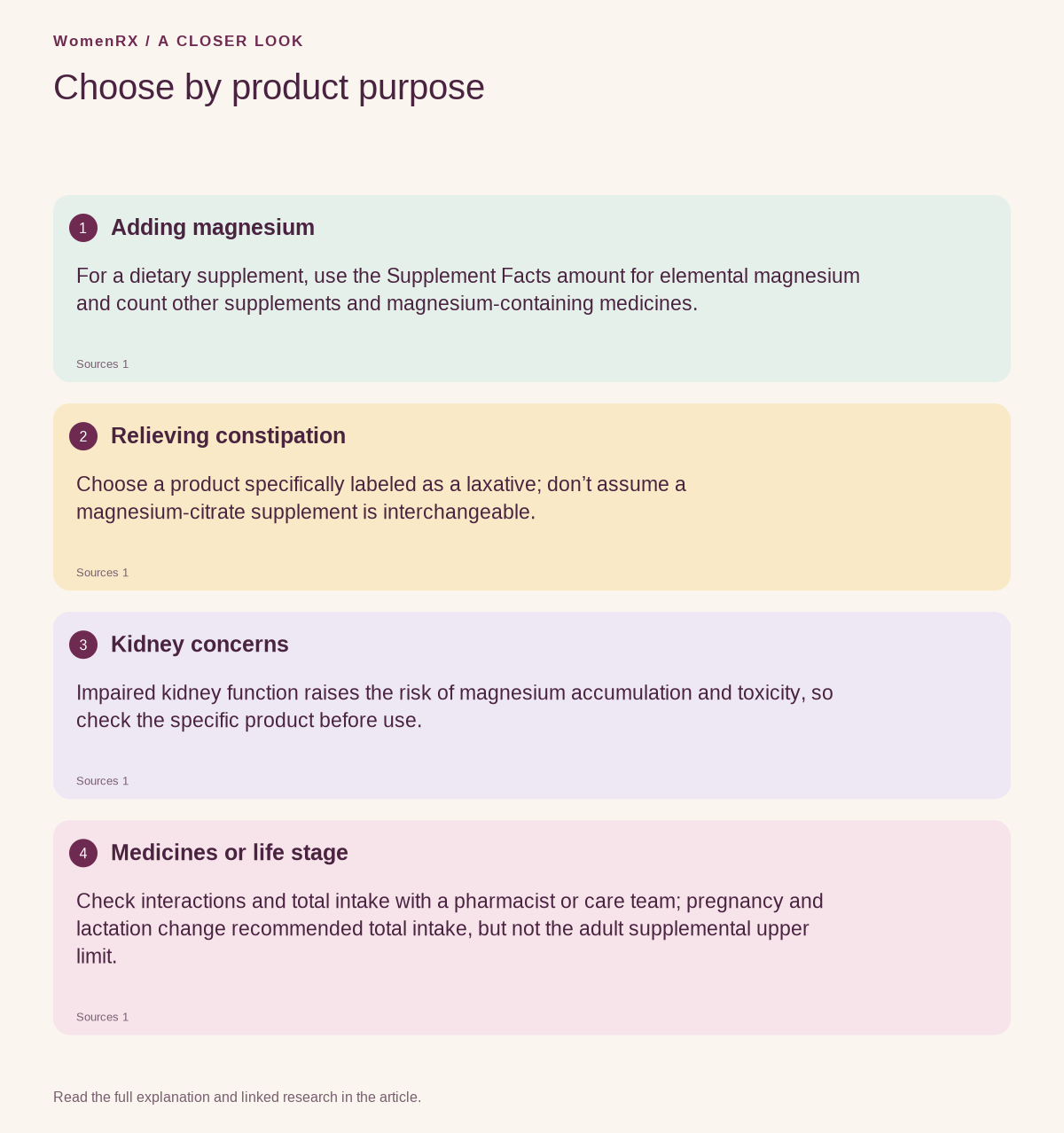
Choose by product purpose
Adding magnesium: For a dietary supplement, use the Supplement Facts amount for elemental magnesium and count other supplements and magnesium-containing medicines.1
Relieving constipation: Choose a product specifically labeled as a laxative; don’t assume a magnesium-citrate supplement is interchangeable.1
Kidney concerns: Impaired kidney function raises the risk of magnesium accumulation and toxicity, so check the specific product before use.1
Medicines or life stage: Check interactions and total intake with a pharmacist or care team; pregnancy and lactation change recommended total intake, but not the adult supplemental upper limit.1
Read the figure as text
Separate magnesium supplementation from laxative use, then check the safety factors that can change your decision.- Adding magnesium: For a dietary supplement, use the Supplement Facts amount for elemental magnesium and count other supplements and magnesium-containing medicines.1
- Relieving constipation: Choose a product specifically labeled as a laxative; don’t assume a magnesium-citrate supplement is interchangeable.1
- Kidney concerns: Impaired kidney function raises the risk of magnesium accumulation and toxicity, so check the specific product before use.1
- Medicines or life stage: Check interactions and total intake with a pharmacist or care team; pregnancy and lactation change recommended total intake, but not the adult supplemental upper limit.1
More questions, answered
Does magnesium citrate absorb better than every other form?
No. The NIH fact sheet says small studies found citrate, aspartate, lactate, and chloride generally more bioavailable than magnesium oxide and sulfate. That comparison doesn’t establish that citrate is best for every person or purpose. 1
Does the 350 mg upper limit include magnesium in food?
No. The adult upper limit applies to magnesium from supplements and medicines, not magnesium naturally present in food. It’s a safety limit, not an intake goal or a laxative dose. 1
Sources you can check
- Magnesium - Health Professional Fact SheetAccessed 2026-09-25Return to first citation
- Chronic Kidney Disease | Kidney Disease | CKD | MedlineplusAccessed 2026-09-25Return to first citation