Magnesium Citrate: Supplement Label or Laxative Directions?
Check what the product is for first: a supplement lists elemental magnesium, while a laxative has directions for bowel relief.
For a dietary supplement, find “Magnesium” on the Supplement Facts panel; that amount is elemental magnesium, not the weight of the whole magnesium citrate compound. If the package is meant for constipation relief, follow the directions for that exact product instead. A supplement amount, a daily nutrient target, and laxative directions aren’t interchangeable. 1
Start with the product’s stated purpose
“Magnesium citrate” names a form of magnesium, not a single purpose or dose. First check whether the package is a dietary supplement, a medicine intended for ordinary bowel relief, or a bowel-preparation product for a procedure. If it’s labeled for constipation relief, use that product’s directions rather than treating its amount as a daily nutrient target. Magnesium is used in some laxatives, but products and purposes differ. 1
For supplements, read the elemental amount
On a dietary supplement, look at the serving size and the “Magnesium” line on the Supplement Facts panel. That number is the amount of elemental magnesium, not the total weight of magnesium citrate. If the front label highlights the weight of the citrate compound, don’t use that figure to estimate how much magnesium you’re getting. 1
The amount listed applies to the stated serving. If you take a different amount than the serving size, the elemental magnesium amount changes too. The form may appear in parentheses, such as magnesium “as magnesium citrate.”
Daily needs aren’t a supplement dose
For women ages 19-30, the recommended dietary allowance (RDA) is 310 mg of magnesium per day from all sources, including food. During pregnancy, it’s 350 mg; during lactation, 310 mg. For women ages 31-50, the RDA is 320 mg, or 360 mg during pregnancy and 320 mg during lactation. For women 51 and older, it’s 320 mg. These are total-intake targets, not amounts to take as a supplement. 1
The adult upper limit is 350 mg per day from supplements and magnesium-containing medicines; magnesium naturally present in food doesn’t count toward it. This limit isn’t a laxative dose or a reason to calculate how much of a bowel-relief product to take. Some magnesium-containing laxatives have use-specific directions that can exceed the upper limit, in part because some of the magnesium isn’t absorbed. Follow the exact product’s directions rather than applying a supplement target to a medicine. 1
When the package is for bowel relief
Unabsorbed magnesium salts can draw water into the intestine and stimulate digestive movement, which helps explain their laxative effect. Higher amounts from supplements or medicines can also cause diarrhea, nausea, or abdominal cramping. If diarrhea develops, don’t add more magnesium on the assumption that the product is simply a nutrient supplement. 1
Don’t infer how quickly a product will work from the words “magnesium citrate” alone. Directions depend on the specific product and its purpose. A preparation intended to clear the bowel for a procedure isn’t a guide to ordinary constipation use. If the package doesn’t make its purpose or directions clear, ask a pharmacist to help identify what kind of product it is.
Kidney function and medicine timing matter
The kidneys help remove excess magnesium. With impaired kidney function, magnesium can build up and the risk of toxicity rises. If you have kidney disease, don’t assume a magnesium product intended for bowel relief is interchangeable with a dietary supplement; check with your care team or pharmacist about that specific product. 1
Magnesium can reduce absorption of some medicines. For oral bisphosphonates such as alendronate, the NIH guidance says taking magnesium at least two hours before or after can minimize the interaction. For tetracycline or quinolone antibiotics, it gives different spacing: take the antibiotic at least two hours before, or four to six hours after, magnesium. Check the directions for your own medicine and ask a pharmacist if the timing is unclear. 1
Levothyroxine is another medicine to separate from magnesium-containing products. In a randomized crossover study of 15 healthy adults, taking levothyroxine with magnesium citrate was associated with a 7% lower measured levothyroxine exposure than taking it alone; the difference wasn’t statistically significant. The study measured short-term absorption in healthy adults, not thyroid control in people being treated for hypothyroidism. The researchers nevertheless advised separating levothyroxine from magnesium products. 2
The practical check: use the elemental magnesium amount for a supplement, and the directions for the exact product when it’s intended for bowel relief. Neither the salt weight nor a supplement’s daily target tells you how to use a laxative.
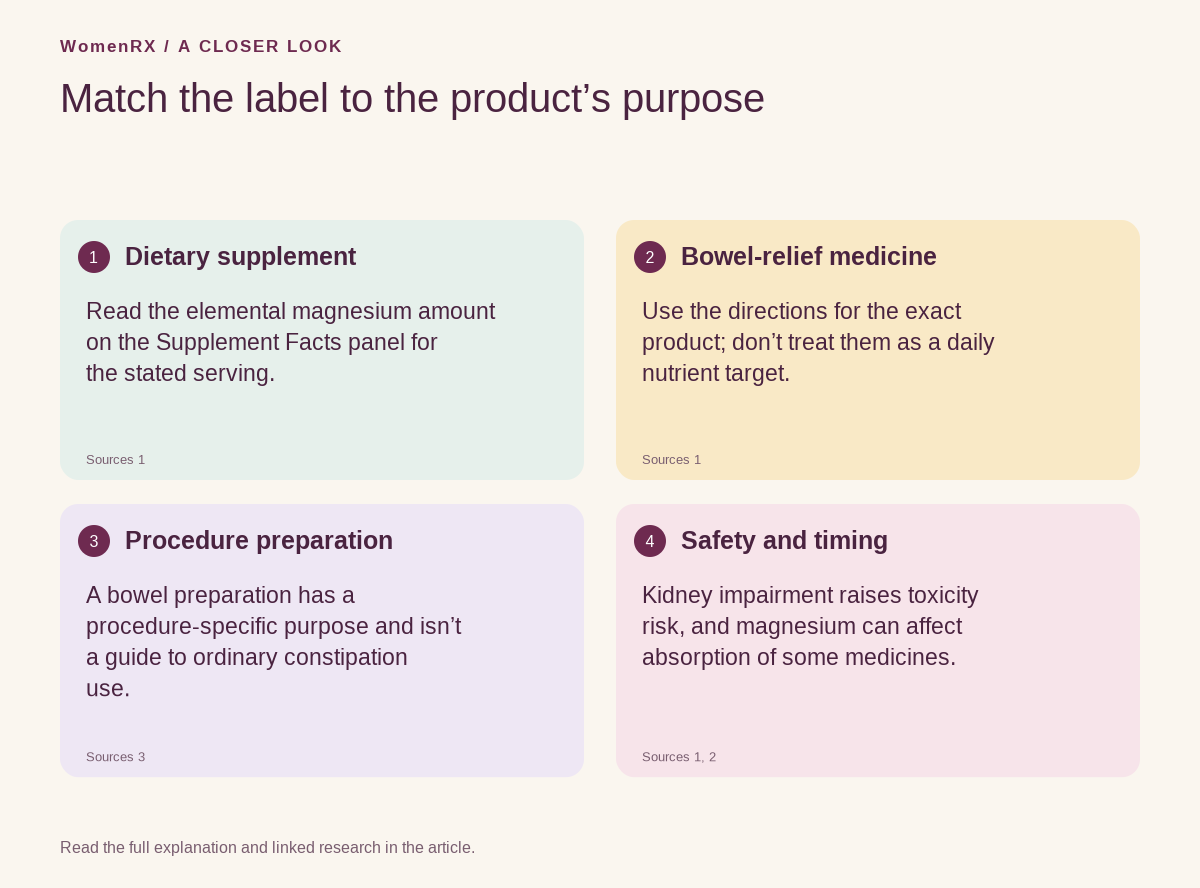
Match the label to the product’s purpose
Dietary supplement: Read the elemental magnesium amount on the Supplement Facts panel for the stated serving.1
Bowel-relief medicine: Use the directions for the exact product; don’t treat them as a daily nutrient target.1
Procedure preparation: A bowel preparation has a procedure-specific purpose and isn’t a guide to ordinary constipation use.3
Safety and timing: Kidney impairment raises toxicity risk, and magnesium can affect absorption of some medicines.12
Read the figure as text
The ingredient name alone doesn’t tell you whether a product is a nutrient supplement or intended for bowel relief.- Dietary supplement: Read the elemental magnesium amount on the Supplement Facts panel for the stated serving.1
- Bowel-relief medicine: Use the directions for the exact product; don’t treat them as a daily nutrient target.1
- Procedure preparation: A bowel preparation has a procedure-specific purpose and isn’t a guide to ordinary constipation use.3
- Safety and timing: Kidney impairment raises toxicity risk, and magnesium can affect absorption of some medicines.12
More questions, answered
Does the 350 mg upper limit include magnesium from food?
No. The adult upper limit applies to magnesium from supplements and medicines, not magnesium naturally present in food. The RDA is different: it’s a total daily intake target from all sources. 1
Sources you can check
- Magnesium - Health Professional Fact SheetAccessed 2026-09-25Return to first citation
- Single Center, Open-Label, Randomized Crossover Trial on Drug-Drug Interactions of Levothyroxine/Magnesium-Citrate and Levothyroxine/Magnesium-Aspartate in Healthy Subjects-The ThyroMag Trial.Attinger MC, von Felten S, Rodrigues CL, Krützfeldt J, Risch L, Bonzon J. · Clinical and translational science · 2025Return to first citation
- Randomized controlled trial comparing efficacy and acceptability of split- and standard-dose sodium picosulfate plus magnesium citrate for bowel cleansing prior to colonoscopy.Manes G, Repici A, Repici A, Hassan C, MAGIC-P study group. · Endoscopy · 2014Return to first citation