Magnesium Citrate: Uses, Safety, and Label Checks
A supplement and a laxative can both contain magnesium citrate, but they aren’t interchangeable products.
Magnesium citrate is a form of magnesium used in dietary supplements, and it also appears in bowel-cleansing medicines and regimens. Check whether the product is labeled as a supplement or as a laxative, and compare the intended use and amount of elemental magnesium rather than the weight of the whole compound. Side effects and safety depend on the product and your health, especially kidney function. 1 4
Magnesium citrate can refer to products with different purposes. A dietary supplement is meant to add magnesium; a laxative or bowel-preparation product is meant to help empty the bowel. Both may contain magnesium, but that doesn’t make their labels, amounts, or directions interchangeable. 1 4
Start with what the product is for
Look first for whether the package identifies the product as a dietary supplement or as a medicine intended to relieve constipation or prepare for a procedure. Magnesium is used in some laxatives, and magnesium citrate appears in bowel-cleansing regimens for colon procedures. Those regimens are not the same thing as taking a daily nutrient supplement. 1 4 5
If your goal is to add magnesium to your diet, check the Supplement Facts panel for elemental magnesium. That is the amount of magnesium the panel declares, not the total weight of the magnesium citrate compound. Comparing products by the weight of the whole compound can therefore be misleading. 1
If your goal is relief from constipation, don’t assume a supplement label gives you the right product or instructions for that purpose. Follow the directions for the specific laxative product, and ask a pharmacist or clinician if you’re unsure which product fits your situation. Avoid turning a bowel-preparation regimen used for a procedure into a home constipation plan. 2 4
Citrate’s absorption doesn’t settle the choice
Small studies summarized by the NIH Office of Dietary Supplements found magnesium citrate, along with aspartate, lactate, and chloride, to be more bioavailable than magnesium oxide and magnesium sulfate. In general, magnesium forms that dissolve more readily in liquid are absorbed more completely. That is a difference in absorption, not proof that citrate is the best choice for every person or that it will treat a particular symptom. 1
The reason a product is being taken still matters. A supplement’s purpose is to provide magnesium. A laxative’s purpose is to change bowel movements. Magnesium salts that aren’t absorbed can draw water into the intestine and stimulate movement through the gut, which helps explain why magnesium-containing products can also cause loose stools or diarrhea. 1
Know the side effects and the kidney concern
High amounts of magnesium from supplements or medicines can cause diarrhea, nausea, and abdominal cramping. Very high amounts can cause magnesium toxicity. The risk is greater when kidney function is impaired, because the kidneys help remove excess magnesium. 1
For adults, the NIH-listed upper intake level is 350 mg per day from supplements and medications combined; magnesium naturally present in food and drinks doesn’t count toward that limit. This is not a laxative dose or a substitute for a product’s own directions. The NIH notes that some magnesium-containing laxatives provide amounts above this level, in part because not all of the magnesium is absorbed. Don’t use the supplement upper limit to calculate a laxative amount. 1
If you have kidney disease or reduced kidney function, check with a clinician or pharmacist before using a magnesium product. Seek prompt medical help for severe symptoms such as difficulty breathing or an irregular heartbeat, which can occur with serious magnesium toxicity. 1
Pregnancy and medicines can change the decision
Constipation is common during pregnancy. General measures such as getting enough fiber and exercise and taking time to use the bathroom when you feel the urge may help. If those steps aren’t enough, ask your pregnancy care team or a pharmacist which specific product is appropriate; don’t assume that a magnesium supplement and a laxative are interchangeable or that a product’s suitability in pregnancy follows from its ingredient alone. 2 3
Some medicines can contribute to constipation, and opioids are a well-recognized example. If constipation began after starting or changing a medicine, ask whether that medicine could be involved before adding a laxative. Don’t stop a prescribed medicine on your own. 2 6
If bowel habits change and the change persists, discuss it with a clinician rather than repeatedly treating it with an over-the-counter product. MedlinePlus notes that having a bowel movement every day isn’t necessary, but a change in your usual pattern is worth attention. 2
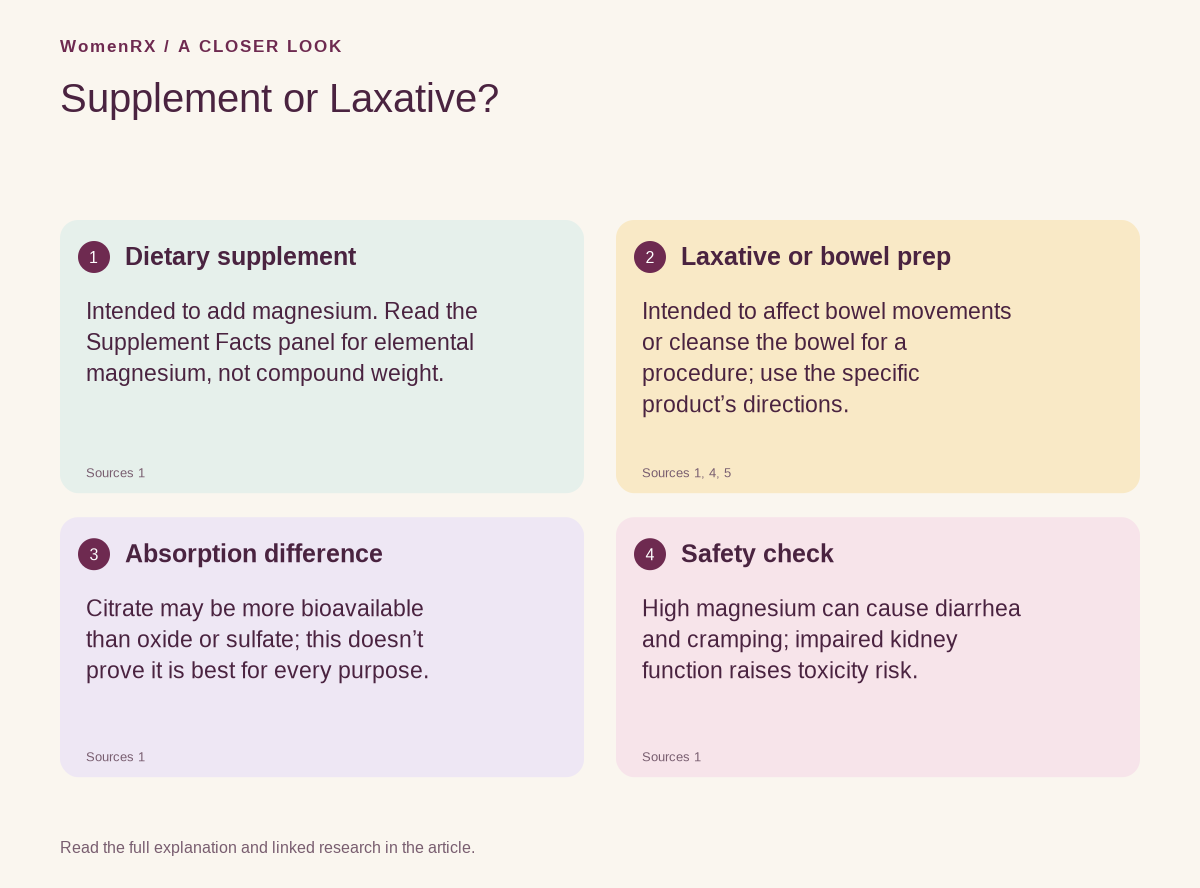
Supplement or Laxative?
Dietary supplement: Intended to add magnesium. Read the Supplement Facts panel for elemental magnesium, not compound weight.1
Laxative or bowel prep: Intended to affect bowel movements or cleanse the bowel for a procedure; use the specific product’s directions.145
Absorption difference: Citrate may be more bioavailable than oxide or sulfate; this doesn’t prove it is best for every purpose.1
Safety check: High magnesium can cause diarrhea and cramping; impaired kidney function raises toxicity risk.1
Read the figure as text
The ingredient alone doesn’t tell you what a magnesium citrate product is for. Check the product type, purpose, and amount before using it.- Dietary supplement: Intended to add magnesium. Read the Supplement Facts panel for elemental magnesium, not compound weight.1
- Laxative or bowel prep: Intended to affect bowel movements or cleanse the bowel for a procedure; use the specific product’s directions.145
- Absorption difference: Citrate may be more bioavailable than oxide or sulfate; this doesn’t prove it is best for every purpose.1
- Safety check: High magnesium can cause diarrhea and cramping; impaired kidney function raises toxicity risk.1
More questions, answered
Does better absorption mean citrate is a better supplement?
Not necessarily. Small studies suggest magnesium citrate is more bioavailable than magnesium oxide and magnesium sulfate, but that finding doesn’t establish that citrate is the right form for every person or purpose. Compare the product’s intended use and elemental magnesium amount, not absorption alone. 1
Can I use a magnesium supplement to treat constipation?
Don’t assume a supplement is an appropriate laxative. Magnesium-containing medicines are used as laxatives, but the product’s purpose and instructions matter. If you’re uncertain, ask a pharmacist or clinician to review the exact product. 1 2
Sources you can check
- Magnesium - Health Professional Fact SheetAccessed 2026-09-25Return to first citation
- Constipation | MedlinePlusAccessed 2026-09-25Return to first citation
- Constipation - NHSAccessed 2026-09-25Return to first citation
- Castor oil as booster for colon capsule endoscopy preparation reduction: A prospective pilot study and patient questionnaire.Takashima K, Komeda Y, Sakurai T, Masaki S, Nagai T, Matsui S, Hagiwara S, Takenaka M, Nishida N, Kashida H, Nakaji K, Watanabe T, Kudo M. · World journal of gastrointestinal pharmacology and therapeutics · 2021Return to first citation
- Efficacy and safety of split-dose ultra-low-volume polyethylene glycol with ascorbic acid versus sodium picosulfate with magnesium citrate for bowel preparation: a systematic review and meta-analysis.Abdallfatah A, Hageen AW, Albader D, Al-Tamimi A, Alsalumi K, Alzmmam A, Abdullah M, Alreshaid L, Aldhuwayhi S, Almarri N, Fallatah W, Altamimi A. · European journal of gastroenterology & hepatology · 2026Return to first citation
- Constipation in people prescribed opioids.Ahmedzai SH, Boland J. · BMJ clinical evidence · 2010Return to first citation