Magnesium Supplements: What They May Help, and When to Be Careful
Magnesium is essential, but a supplement’s value depends on why you’re considering it, your health, and what else you take.
Magnesium supplements are most clearly worth considering when low intake or deficiency is a real concern, or as a clinician-guided option for migraine prevention. Evidence is less convincing for routine use to improve blood sugar or sleep, and supplements haven’t been shown to prevent osteoporosis. Food intake, pregnancy needs, kidney function, and medication interactions all change the decision. 1 5
Start with the reason, not the bottle
Magnesium helps nerves and muscles work, supports bone structure, and participates in hundreds of enzyme systems. But those roles don’t mean taking extra magnesium will improve every symptom linked to nerves, muscles, bones, or sleep. A supplement trial for one condition also doesn’t prove benefit for another. 1
It helps to separate three questions: Are you getting enough from food? Is there a reason you might be losing or absorbing less magnesium? And does research support a supplement for the particular outcome you want?
Most people can get magnesium from foods such as leafy greens, beans, nuts, seeds, and whole grains. For adult women, the recommended intake from all sources is 310 mg a day at ages 19-30 and 320 mg at ages 31 and older. Pregnancy changes the target: it’s 350 mg a day at ages 19-30 and 360 mg at ages 31-50. During breastfeeding, the recommendations are 310 mg and 320 mg for those age groups, respectively. These are total-intake recommendations, not instructions to take that amount as a supplement. 1
A low food intake isn’t the same as a diagnosed deficiency. Magnesium status is difficult to measure: the commonly used blood test doesn’t closely reflect the body’s total stores, so results may need to be considered alongside symptoms and health history. Deficiency is uncommon in otherwise healthy people, but risk is higher with some gastrointestinal conditions, type 2 diabetes, alcohol dependence, and certain medicines. 1
What the evidence says, by reason
Migraine prevention: This is one of the more promising supplement uses. Small, short-term trials have found modest reductions in migraine frequency, and an American Academy of Neurology and American Headache Society guideline described magnesium as probably effective for prevention. The trials weren’t a reason to treat it as a universal fix, and the amounts studied can exceed the general adult upper limit for supplements. If you’re considering it for migraine, discuss it with a clinician who can weigh your health and other treatments. 1
Migraine is more common in women, and some people have attacks around their periods. That makes migraine a relevant question for women, but it doesn’t establish that magnesium specifically treats menstrual migraine. The general migraine-prevention findings summarized here don’t show whether magnesium works specifically for menstrual attacks. 1 2
Blood sugar and diabetes: Higher magnesium intake has been associated with lower type 2 diabetes risk in long-term observational studies. That doesn’t show that a pill prevents diabetes. For people who already have diabetes, earlier small trials of supplements reported mixed results, and the NIH fact sheet says evidence has not supported routine supplementation to improve blood sugar control. A 2026 randomized trial in 247 adults with type 2 diabetes found a modest, statistically non-significant difference in median HbA1c change after 12 months; it doesn’t turn magnesium into a substitute for established diabetes care. 1 3
Sleep: Magnesium is often marketed for sleep, but a 2026 systematic review of randomized trials found inconsistent results and low- to very-low-certainty evidence. The review does not establish a women-specific sleep benefit. That’s not a strong basis for routine use for insomnia. 5
Bone health after menopause: Magnesium contributes to bone health, and observational studies have linked higher intake with bone measures. Those associations don’t prove that supplements prevent fractures or treat osteoporosis. In one small study, 20 postmenopausal women with osteoporosis took magnesium citrate for 30 days; a marker of bone turnover changed, but that short study did not establish stronger bones or fewer fractures. A separate pilot trial in postmenopausal women with osteoporosis found no significant change in pain, anxiety, depression, or sleep measures with magnesium added to osteoporosis treatment. 1 4
Blood pressure: Supplement trials suggest, at most, a small average effect. In a review of 12 trials involving 545 people with hypertension, supplementation for 8-26 weeks was associated with a 2.2 mmHg reduction in diastolic blood pressure. That modest result does not make magnesium a replacement for blood-pressure treatment. 1
The migraine-prevention findings above don’t establish a benefit for ordinary menstrual cramps. And in a small trial of postmenopausal women with osteoporosis, adding magnesium to osteoporosis treatment did not significantly change pain, anxiety, depression, or sleep measures. That finding applies to that group and treatment context; it doesn’t settle whether magnesium helps menopause symptoms generally. 1 4
Safety depends on the source and your health
The adult upper limit is 350 mg a day from supplements and magnesium-containing medicines combined. It does not include magnesium naturally present in food, and it is not a recommended supplement dose. Magnesium in laxatives and antacids counts too, so check those labels before adding a supplement. Higher supplemental or medicine amounts can cause diarrhea, nausea, and abdominal cramping. 1
Kidneys remove excess magnesium. With impaired kidney function, the risk of magnesium building up is higher, so don’t start a supplement or magnesium-containing laxative without checking whether it’s appropriate for you. 1
Magnesium can also interfere with some medicines. It can reduce absorption of oral bisphosphonates, including alendronate, and of tetracycline or quinolone antibiotics. The NIH fact sheet gives separation guidance: magnesium at least two hours before or after an oral bisphosphonate; for those antibiotics, at least two hours before or four to six hours after magnesium. Diuretics can change magnesium losses, and long-term use of proton pump inhibitors can contribute to low magnesium. If you take one of these medicines, have a pharmacist or clinician check the specific combination and timing. 1
For a practical starting point, look at your usual foods and any magnesium in medicines or supplements, then connect that information to the reason you’re considering a pill. A migraine-prevention question is different from a low-intake concern, pregnancy nutrition, or a possible deficiency. The right next step depends on which one applies.
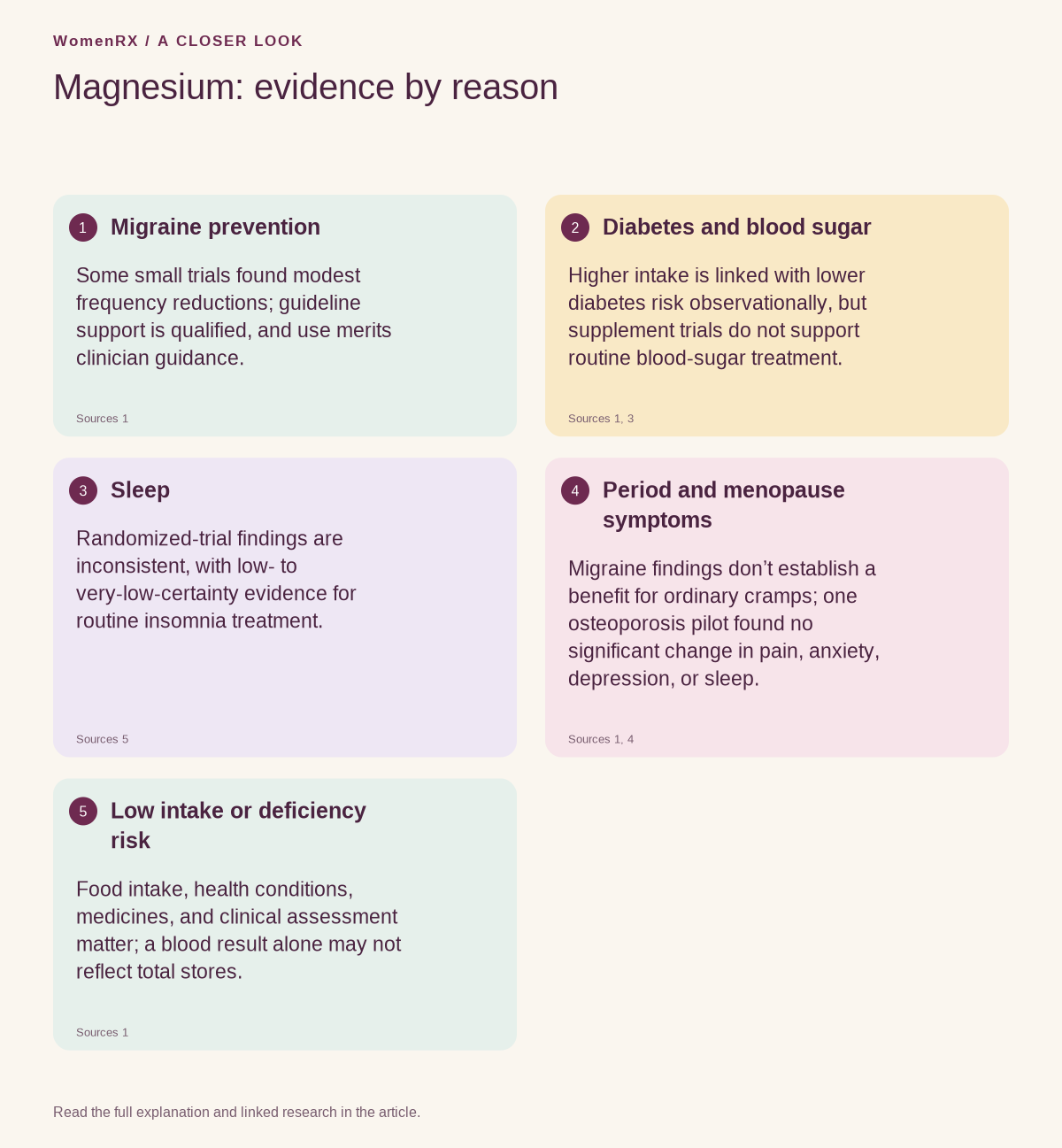
Magnesium: evidence by reason
Migraine prevention: Some small trials found modest frequency reductions; guideline support is qualified, and use merits clinician guidance.1
Diabetes and blood sugar: Higher intake is linked with lower diabetes risk observationally, but supplement trials do not support routine blood-sugar treatment.13
Sleep: Randomized-trial findings are inconsistent, with low- to very-low-certainty evidence for routine insomnia treatment.5
Period and menopause symptoms: Migraine findings don’t establish a benefit for ordinary cramps; one osteoporosis pilot found no significant change in pain, anxiety, depression, or sleep.14
Low intake or deficiency risk: Food intake, health conditions, medicines, and clinical assessment matter; a blood result alone may not reflect total stores.1
Read the figure as text
The same supplement can have a different evidence picture depending on what you hope it will do.- Migraine prevention: Some small trials found modest frequency reductions; guideline support is qualified, and use merits clinician guidance.1
- Diabetes and blood sugar: Higher intake is linked with lower diabetes risk observationally, but supplement trials do not support routine blood-sugar treatment.13
- Sleep: Randomized-trial findings are inconsistent, with low- to very-low-certainty evidence for routine insomnia treatment.5
- Period and menopause symptoms: Migraine findings don’t establish a benefit for ordinary cramps; one osteoporosis pilot found no significant change in pain, anxiety, depression, or sleep.14
- Low intake or deficiency risk: Food intake, health conditions, medicines, and clinical assessment matter; a blood result alone may not reflect total stores.1
More questions, answered
Does magnesium from food count toward the supplement upper limit?
No. The adult upper limit of 350 mg a day applies to magnesium from supplements and medicines, not magnesium naturally found in food. Magnesium in antacids and laxatives does count. 1
Does a normal blood magnesium test rule out low body stores?
Not necessarily. Blood testing is commonly used, but serum magnesium does not closely reflect total body magnesium stores. Results may need to be interpreted alongside clinical assessment. 1
Sources you can check
- Magnesium - Health Professional Fact SheetAccessed 2026-09-25Return to first citation
- Migraine | MedlinePlusAccessed 2026-09-25Return to first citation
- The effect of oral magnesium supplementation on glycemic control and metabolic parameters in type 2 diabetes mellitus: a double-blind randomized controlled trial.Al-Maqbali JS, Al Alawi AM, Osman A, Al-Farqani A, Kumar S, Al Futisi A, Al-Mamari A, Al-Zakwani I, Al Za'abi M. · Frontiers in endocrinology · 2026Return to first citation
- Quantitative sensory testing of pain in osteoporosis: a pilot randomized clinical trial with magnesium supplementation.Pickering ME, Morel V, Nicolas M, Dualé C, Sortais E, Graven-Nielsen T, Pereira B, Pickering G. · Aging clinical and experimental research · 2026Return to first citation
- Magnesium Supplementation for Sleep in Adults: A Systematic Review of Randomized Controlled Trials.Lopresti AL, Smith SJ, Drummond PD. · Journal of dietary supplements · 2026Return to first citation