Magnesium Supplements: Who Might Need Them and What Matters
The magnesium in food is different from the magnesium in supplements and some medicines, and that difference matters when you’re weighing a product or checking a low result.
You don’t need a magnesium supplement just because you menstruate. For healthy adults, magnesium from food is not a safety concern, but supplements and magnesium-containing antacids or laxatives can cause diarrhea, nausea, and cramping. Check the label for elemental magnesium and count it across products. Kidney problems deserve extra caution because the kidneys remove excess magnesium. 1
First, separate the three sources
Magnesium in foods, magnesium in a dietary supplement, and magnesium in a medicine all count toward what your body takes in, but they don’t share the same safety limit. Food sources include leafy greens, beans, nuts, seeds, and whole grains. In healthy people, excess magnesium from food is generally not a concern because the kidneys remove it in urine. 1
Supplements are only one part of the picture. Magnesium is also an ingredient in some antacids and laxatives. If you take more than one product, check each label rather than looking only at the bottle marketed as a supplement. A person using a supplement and a magnesium-containing laxative, for example, could be getting magnesium from both. 1
Read the amount of elemental magnesium
The Supplement Facts panel lists elemental magnesium: the amount of magnesium itself, not the full weight of the compound it comes from. That is the number to use when comparing products and adding up magnesium from supplements. The type of magnesium matters for absorption, too. Small studies cited by the NIH found that citrate, chloride, lactate, and aspartate tend to be absorbed more completely than oxide and sulfate. That doesn’t make one form right for everyone, and absorption alone doesn’t establish that a product will help a particular symptom. 1
The adult tolerable upper intake level (UL) is 350 mg per day from supplements and magnesium-containing medicines combined. It does not include magnesium naturally present in food and beverages. The UL is a population safety benchmark, not a recommended supplement dose or a personal treatment plan. Needs and limits differ for children and adolescents. 1
A food target isn’t a supplement dose
For women ages 19-30, the recommended dietary allowance (RDA) is 310 mg per day; for women 31 and older, it’s 320 mg. During pregnancy, the RDA is 350 mg at ages 19-30 and 360 mg at ages 31-50. During breastfeeding, it’s 310 mg and 320 mg, respectively. These are total daily intake targets from food and other sources, not instructions to take that amount as a supplement. 1
That distinction matters if you’re pregnant or breastfeeding: the target changes, but it doesn’t automatically mean you need a magnesium pill. Check what you’re already getting from food, prenatal or other supplements, and medicines before adding another product. The intake recommendations are based on age and life stage, not menstruation itself; they don’t establish magnesium as a treatment for menstrual symptoms. 1
What can go wrong, and who should take extra care?
Higher amounts from supplements or medicines can cause diarrhea, nausea, and abdominal cramps. These effects are related in part to unabsorbed magnesium salts drawing water into the bowel. A laxative’s magnesium still counts as exposure, even though some of it may not be absorbed. 1
Very high magnesium exposure can become dangerous, with effects that may include low blood pressure, vomiting, difficulty breathing, or an irregular heartbeat. Risk rises when kidney function is impaired, because the kidneys may be less able to clear excess magnesium. If you have kidney disease or reduced kidney function, don’t use a general supplement label or the adult UL as proof that a product is safe for you. 1
A small randomized trial offers a useful caution against oversimplifying the kidney question. In 34 people with stage 3 or 4 chronic kidney disease who completed an eight-week study, researchers reported no serious adverse events related to the study medication. But a small, short trial cannot establish that unsupervised magnesium use is safe for everyone with kidney disease. 2
People with long-lasting diarrhea or fat-malabsorption conditions, type 2 diabetes, alcohol dependence, and some older adults may be more likely to have inadequate magnesium. That is a reason to consider the full health picture, not to self-diagnose based on symptoms alone. 1
A low blood result needs context
A serum magnesium test is commonly used, but it doesn’t accurately reflect the body’s total magnesium stores; most magnesium is in bones and cells. A result is best interpreted alongside your health history and clinical assessment. If a result is low, ask what might be contributing and whether a supplement is appropriate before choosing a dose or product. 1
A practical label check is to write down the elemental magnesium listed on each supplement and the magnesium in any antacid or laxative you use. Then bring that list, along with the test result if you have one, into the conversation about what to do next. It helps separate a dietary target from the amount you may already be taking in products.
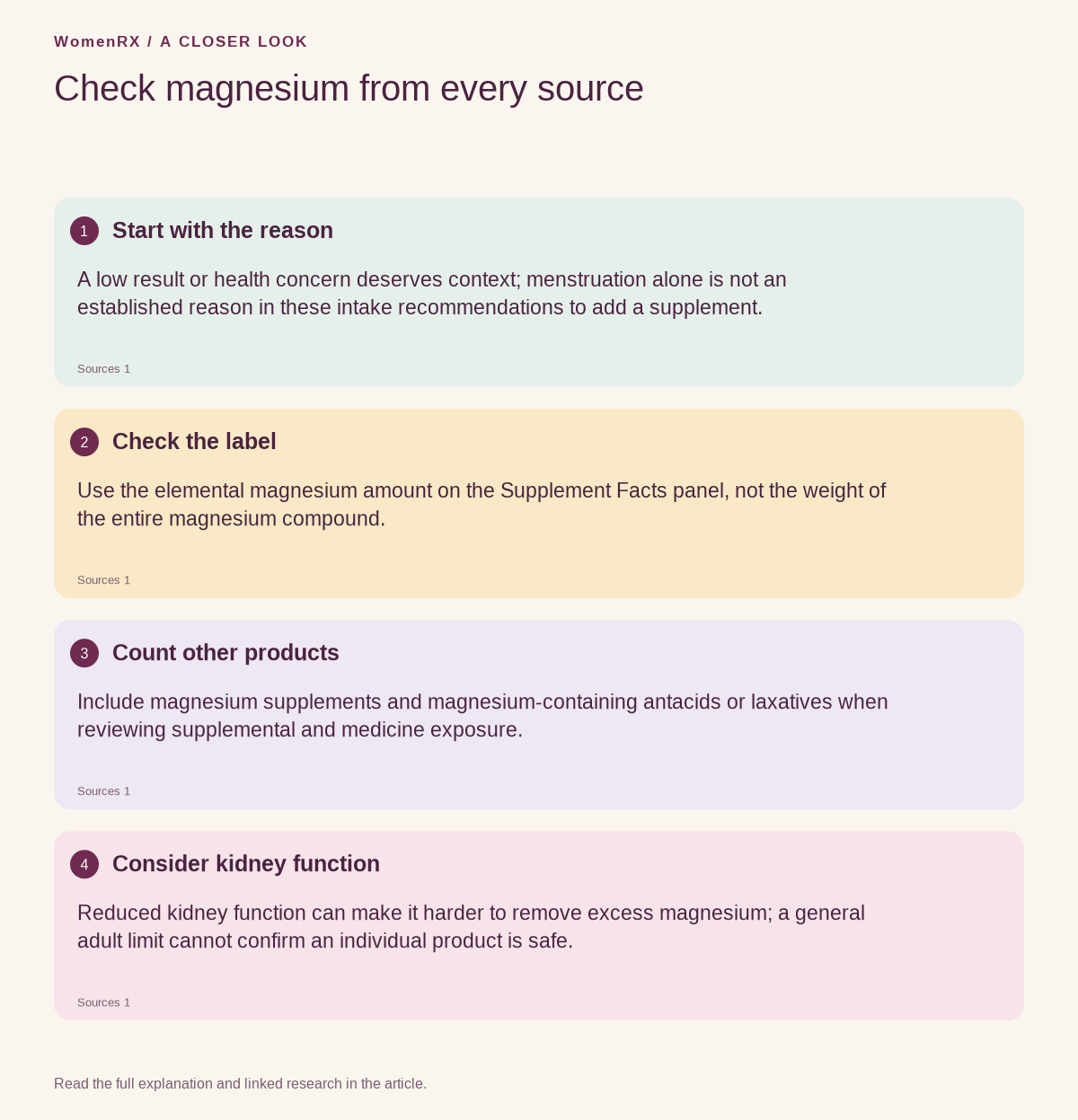
Check magnesium from every source
Start with the reason: A low result or health concern deserves context; menstruation alone is not an established reason in these intake recommendations to add a supplement.1
Check the label: Use the elemental magnesium amount on the Supplement Facts panel, not the weight of the entire magnesium compound.1
Count other products: Include magnesium supplements and magnesium-containing antacids or laxatives when reviewing supplemental and medicine exposure.1
Consider kidney function: Reduced kidney function can make it harder to remove excess magnesium; a general adult limit cannot confirm an individual product is safe.1
Read the figure as text
A simple sequence for distinguishing why you’re considering magnesium, what you already take, and when kidney function changes the safety conversation.- Start with the reason: A low result or health concern deserves context; menstruation alone is not an established reason in these intake recommendations to add a supplement.1
- Check the label: Use the elemental magnesium amount on the Supplement Facts panel, not the weight of the entire magnesium compound.1
- Count other products: Include magnesium supplements and magnesium-containing antacids or laxatives when reviewing supplemental and medicine exposure.1
- Consider kidney function: Reduced kidney function can make it harder to remove excess magnesium; a general adult limit cannot confirm an individual product is safe.1
More questions, answered
Does magnesium from food count toward the 350 mg upper limit?
No. For adults, the 350 mg upper limit applies to magnesium from supplements and magnesium-containing medicines, not magnesium naturally present in food and beverages. It is a safety benchmark, not a supplement target. 1
Can a blood test tell me exactly how much magnesium my body has?
Not by itself. Serum magnesium is commonly measured, but it doesn’t accurately reflect total body magnesium or levels in specific tissues. Results need clinical context. 1
Sources you can check
- Magnesium - Health Professional Fact SheetAccessed 2026-09-25Return to first citation
- Oral Magnesium Supplementation in Chronic Kidney Disease Stages 3 and 4: Efficacy, Safety, and Effect on Serum Calcification Propensity-A Prospective Randomized Double-Blinded Placebo-Controlled Clinical Trial.Bressendorff I, Hansen D, Schou M, Silver B, Pasch A, Bouchelouche P, Pedersen L, Rasmussen LM, Brandi L. · Kidney international reports · 2017Return to first citation