How to Compare Magnesium Supplements by Form and Amount
Compare the elemental magnesium on the label with evidence for your specific goal, not with a brand’s broad promises.
Start with the Supplement Facts panel: it lists elemental magnesium, not the full weight of the magnesium compound. Some forms appear better absorbed than oxide, but that doesn’t prove they work better for a particular goal. Check whether that goal has useful trial evidence, and treat the adult upper limit for supplemental magnesium as a safety boundary, not a target. 1
Choosing a magnesium supplement gets easier when you separate three questions: how much elemental magnesium it provides, how the form is absorbed, and whether that form has evidence for the result you want. A more absorbable product isn’t automatically a more effective one, and a product’s broad claims don’t tell you whether it suits your goal.
Read the amount that counts
On a supplement label, the magnesium amount in the Supplement Facts panel is the elemental magnesium. It is not the total weight of the magnesium-containing compound. That distinction matters when comparing products: two labels may name different forms, but the elemental amount is the more useful figure for comparing how much magnesium each supplies. 1
The NIH Office of Dietary Supplements lists an upper limit of 350 mg per day for magnesium from supplements for adults. This is a safety limit, not a recommended target or proof that a particular amount will help your symptoms. Higher supplemental amounts often cause diarrhea, and nausea or abdominal cramping can occur too. 1
Magnesium from food is a separate consideration: the same fact sheet says excess magnesium from food generally doesn’t pose a health risk for healthy people. If a product’s suggested serving would put your supplemental intake above the adult upper limit, don’t treat that as a reason to choose it. The evidence below doesn’t establish a personal dose for you. 1
Form affects absorption, not necessarily results
Magnesium forms differ in how readily they dissolve and are absorbed. The NIH fact sheet reports that small studies found aspartate, citrate, lactate, and chloride more bioavailable than oxide and sulfate. That’s a difference in absorption, not proof that one form delivers better results for every health goal. 1
A randomized trial illustrates the distinction. Among 164 adults who were overweight or slightly obese, 104 of them women, citrate, oxide, and sulfate taken for 24 weeks did not significantly change blood pressure or arterial stiffness compared with placebo. The trial did not report a women-only result, and it doesn’t establish whether another group or goal would respond differently. 2
So don’t choose a form on absorption claims alone. First ask whether there’s evidence for the outcome you care about, and whether the research tested that form and a similar population.
Match the evidence to your goal
Blood pressure: A 2025 meta-analysis combined 38 randomized trials with 2,709 participants. Compared with placebo, magnesium lowered systolic blood pressure by an average of 2.81 mm Hg and diastolic pressure by 2.05 mm Hg. Results varied considerably across trials, and the analysis found no clear dose-response relationship. These averages don’t identify a best form or amount for an individual. 3
That pooled result and the trial finding no blood-pressure change aren’t necessarily contradictory: one summarizes many trials, while the other tests specific formulations in one defined group. Neither supports picking a brand or form based on a promise of a large, reliable blood-pressure effect. 23
Muscle cramps: For cramps in older adults, a Cochrane review found magnesium unlikely to provide a clinically meaningful preventive benefit. Pregnancy-associated leg-cramp trials were conflicting, and the review couldn’t combine their results. It found no randomized trials of magnesium for exercise-associated cramps. 4
Pregnancy: In a randomized trial of low-income pregnant women in Brazil, preeclampsia occurred in 26 of 143 women in the magnesium group and 29 of 147 in the placebo group. The difference wasn’t statistically significant. That trial doesn’t establish a universal need for a supplement in pregnancy or settle questions about other outcomes. Pregnancy can call for different nutritional and clinical advice, so use pregnancy-specific guidance rather than general product claims. 5
Consider life stage, not just the label
Pregnancy, breastfeeding, and menopause can raise different questions about nutrition and care. The findings discussed here don’t establish a magnesium supplement need or a preferred form and amount for breastfeeding or menopause. They also don’t show that magnesium treats menstrual or menopause symptoms. If you’re pregnant or breastfeeding, base a supplement decision on guidance for that life stage rather than extrapolating from general adult trials.
One practical detail: very high-dose zinc supplements have been reported to interfere with magnesium absorption. That finding involved 142 mg of zinc per day; it isn’t a reason to assume ordinary zinc intake has the same effect. 1
A useful comparison, without a “best” brand
Before buying, compare the elemental magnesium per serving, the form, and the claim the product makes. Ask whether the claim concerns absorption or an outcome you care about, such as blood pressure or cramps. Those are different kinds of evidence. Current findings don’t support a single best form for everyone, and a product label can’t establish that a supplement will help a specific symptom.
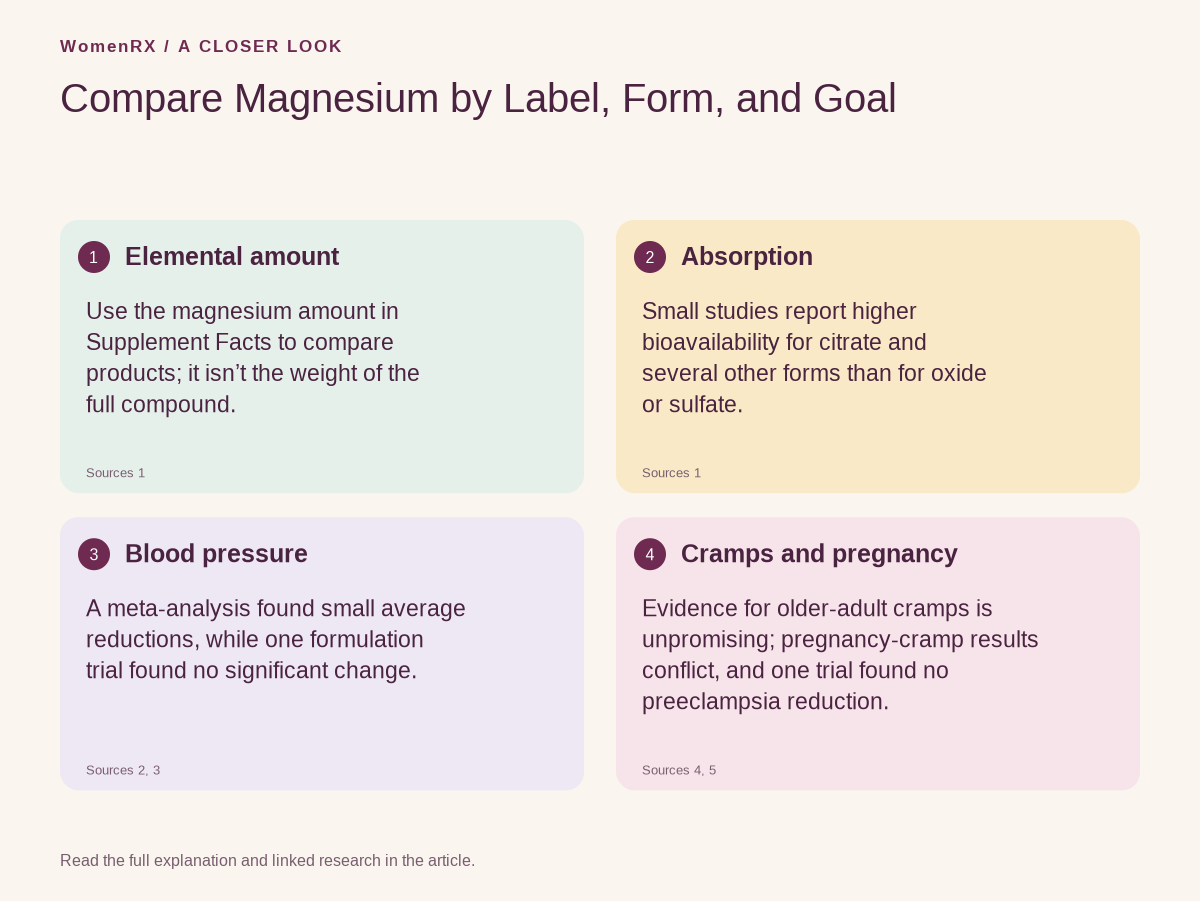
Compare Magnesium by Label, Form, and Goal
Elemental amount: Use the magnesium amount in Supplement Facts to compare products; it isn’t the weight of the full compound.1
Absorption: Small studies report higher bioavailability for citrate and several other forms than for oxide or sulfate.1
Blood pressure: A meta-analysis found small average reductions, while one formulation trial found no significant change.23
Cramps and pregnancy: Evidence for older-adult cramps is unpromising; pregnancy-cramp results conflict, and one trial found no preeclampsia reduction.45
Read the figure as text
These distinctions help separate what a label tells you from what absorption and clinical trials can support.- Elemental amount: Use the magnesium amount in Supplement Facts to compare products; it isn’t the weight of the full compound.1
- Absorption: Small studies report higher bioavailability for citrate and several other forms than for oxide or sulfate.1
- Blood pressure: A meta-analysis found small average reductions, while one formulation trial found no significant change.23
- Cramps and pregnancy: Evidence for older-adult cramps is unpromising; pregnancy-cramp results conflict, and one trial found no preeclampsia reduction.45
More questions, answered
Does a more absorbable form work better?
Not necessarily. Some forms appear more bioavailable than oxide or sulfate, but absorption findings don’t establish a better result for a particular health goal. 1
Is the adult upper limit a recommended amount to take?
No. The 350 mg per day limit applies to magnesium from supplements for adults; it’s a safety boundary, not a target or a personalized dose. 1
Sources you can check
- Magnesium - Health Professional Fact SheetAccessed 2026-09-25Return to first citation
- Effects of Magnesium Citrate, Magnesium Oxide, and Magnesium Sulfate Supplementation on Arterial Stiffness: A Randomized, Double-Blind, Placebo-Controlled Intervention Trial.Schutten JC, Joris PJ, Groendijk I, Eelderink C, Groothof D, van der Veen Y, Westerhuis R, Goorman F, Danel RM, de Borst MH, Bakker SJL. · Journal of the American Heart Association · 2022Return to first citation
- Magnesium Supplementation and Blood Pressure: A Systematic Review and Meta-Analysis of Randomized Controlled Trials.Argeros Z, Xu X, Bhandari B, Harris K, Touyz RM, Schutte AE. · Hypertension (Dallas, Tex. : 1979) · 2025Return to first citation
- Magnesium for skeletal muscle cramps.Garrison SR, Allan GM, Sekhon RK, Musini VM, Khan KM. · The Cochrane database of systematic reviews · 2012Return to first citation
- Magnesium supplementation and preeclampsia in low-income pregnant women - a randomized double-blind clinical trial.de Araújo CAL, de Sousa Oliveira L, de Gusmão IMB, Guimarães A, Ribeiro M, Alves JGB. · BMC pregnancy and childbirth · 2020Return to first citation