Do You Need a Zinc Supplement? A Practical Guide
Most adults can start by checking their usual foods and total supplement intake, while certain health conditions and life stages make a closer look worthwhile.
Zinc supplements aren’t automatically needed because you’re a woman, pregnant, tired, or getting frequent colds. For most adult women, the recommended intake is 8 mg a day; it rises during pregnancy and breastfeeding. Food is a reasonable starting point, but digestive conditions, bariatric surgery, a mostly plant-based diet, or a clinician-identified deficiency may call for an individualized assessment. Check the zinc in every supplement before adding more. 1
Start with what you eat and take
Zinc helps the body make DNA and proteins, heal wounds, and support immune function. That doesn’t mean taking extra zinc improves these functions when you already get enough. A useful first step is to look at your usual meals, fortified foods, multivitamins, prenatal vitamins, and any cold remedies or lozenges that contain zinc. 1
For adults, the recommended dietary allowance (RDA) is 8 mg a day for women and 11 mg for men. It’s 11 mg during pregnancy and 12 mg while breastfeeding for adults; for pregnant or breastfeeding teens, it’s 12 mg and 13 mg, respectively. These are total daily intake targets, not supplement doses. Women don’t have a higher requirement than men at the same adult life stage unless pregnancy or breastfeeding changes the target. 1
Food can cover a range of needs
Meat, seafood, eggs, and dairy provide zinc. Beans, nuts, seeds, and whole grains do too, though phytates in plant foods can make some of their zinc less available for absorption. A meal with varied protein sources can contribute from more than one place: for example, lentils, yogurt, eggs, pumpkin seeds, or fortified cereal may all add zinc to your day. 1
If you eat vegetarian or vegan, that alone doesn’t establish a deficiency. It does mean it can be useful to pay attention to zinc sources and the overall pattern of your meals. Soaking beans, grains, or seeds before cooking is one food-preparation approach that may improve zinc availability. 1
When a closer look makes sense
Some situations raise the chance of inadequate intake or absorption. These include Crohn’s disease or ulcerative colitis, celiac disease, bariatric surgery involving the digestive tract, alcohol use disorder, and a diet that’s limited in both amount and variety. Older adults may also have marginal intakes. Pregnancy and breastfeeding raise recommended intake, but that doesn’t mean everyone in either group needs a separate zinc pill. 1
Symptoms by themselves can’t tell you whether your zinc is low. Zinc deficiency can affect different parts of the body, and signs vary. A clinician may consider your diet, health conditions, symptoms, and, when appropriate, blood testing together. Serum or plasma zinc tests have limitations: results can vary with factors such as age, sex, time of day, infection, and illness, and they don’t always match zinc intake. 1
If a risk factor applies, or you’re concerned about a possible deficiency, bring the question to a clinician or registered dietitian rather than trying to diagnose it from a symptom list. That conversation can help determine whether dietary changes, testing, or a supplement makes sense for you.
Pregnancy: meet the target, don’t assume more is better
Pregnancy raises the adult RDA from 8 mg to 11 mg a day. A prenatal vitamin may already contain zinc, so check its Supplement Facts panel before adding a separate product. The label lists elemental zinc, the amount to use when adding up your intake. 1
Evidence on extra zinc supplements in pregnancy isn’t fully settled. NIH’s zinc fact sheet says routine supplementation does not appear to reduce low birth weight, stillbirth, or neonatal death, though it might lower the risk of preterm birth. A 2025 review of 77 randomized trials reported some favorable pregnancy and infant outcomes with zinc alone, but it also called for further research; the findings don’t establish that every pregnant person needs extra zinc. 13
The practical question is whether your diet and prenatal vitamin together meet your needs, and whether you have a reason to assess your zinc status. If you’re pregnant, check with your prenatal care team before starting a separate supplement. 2
Check the total before you add a pill
For adults, the tolerable upper intake level (UL) is 40 mg a day from food and supplements combined. The UL is a safety boundary for generally healthy people, not a target to aim for. It’s lower for teens: 34 mg a day for ages 14-18, including pregnancy and breastfeeding. 1
Too much zinc can cause nausea, vomiting, dizziness, headache, or stomach upset. Taking 50 mg a day or more for weeks can interfere with copper absorption and affect immune function and HDL cholesterol. This is one reason to check the amount in a multivitamin, prenatal, standalone zinc product, and any zinc-containing cold remedy together. 1
Zinc can also interact with certain medicines. It can reduce absorption of quinolone and tetracycline antibiotics and of penicillamine; thiazide diuretics can increase zinc loss in urine. Taking a supplement with 25 mg or more of elemental iron at the same time can reduce zinc absorption. If one of these applies, ask a pharmacist or prescriber how to handle the combination rather than changing a medicine on your own. 1
A simple decision path
- No specific risk, varied diet: Start with food sources and check what your existing supplements contain.
- Pregnant or breastfeeding: Compare your total intake with the life-stage target and review your prenatal vitamin before adding anything.
- Digestive disease, bariatric surgery, or limited intake: Ask whether your situation warrants assessment; don’t rely on symptoms alone.
- Considering a supplement: Check elemental zinc, total intake, and medicine interactions. Don’t treat the UL as a recommended dose.
The goal isn’t to take zinc just in case. It’s to notice when your diet or health makes a closer look useful, and to avoid accidentally stacking products that push your total intake too high.
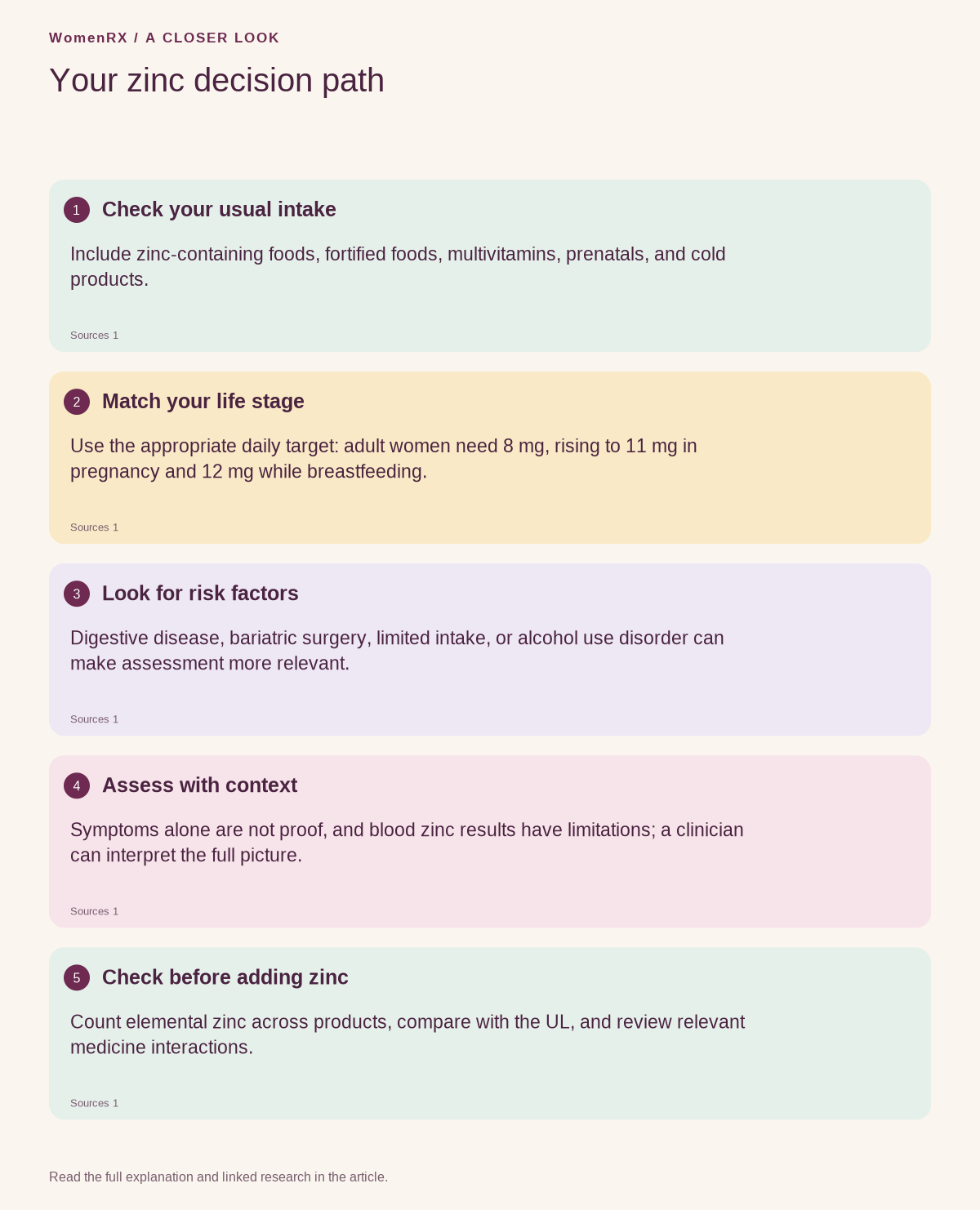
Your zinc decision path
Check your usual intake: Include zinc-containing foods, fortified foods, multivitamins, prenatals, and cold products.1
Match your life stage: Use the appropriate daily target: adult women need 8 mg, rising to 11 mg in pregnancy and 12 mg while breastfeeding.1
Look for risk factors: Digestive disease, bariatric surgery, limited intake, or alcohol use disorder can make assessment more relevant.1
Assess with context: Symptoms alone are not proof, and blood zinc results have limitations; a clinician can interpret the full picture.1
Check before adding zinc: Count elemental zinc across products, compare with the UL, and review relevant medicine interactions.1
Read the figure as text
Move from usual intake to a reason for assessment or a supplement safety check, rather than treating symptoms alone as proof of deficiency.- Check your usual intake: Include zinc-containing foods, fortified foods, multivitamins, prenatals, and cold products.1
- Match your life stage: Use the appropriate daily target: adult women need 8 mg, rising to 11 mg in pregnancy and 12 mg while breastfeeding.1
- Look for risk factors: Digestive disease, bariatric surgery, limited intake, or alcohol use disorder can make assessment more relevant.1
- Assess with context: Symptoms alone are not proof, and blood zinc results have limitations; a clinician can interpret the full picture.1
- Check before adding zinc: Count elemental zinc across products, compare with the UL, and review relevant medicine interactions.1
More questions, answered
Does a plant-based diet mean I need a zinc supplement?
Not by itself. Plant foods contain zinc, though phytates can reduce how much is absorbed. Consider the overall pattern of your diet and any additional risk factors rather than assuming a supplement is necessary. 1
Can a blood test confirm zinc deficiency?
A clinician may use a serum or plasma zinc test as part of an assessment, but the result has limitations and can be affected by factors such as illness and the time of day. It should be interpreted alongside your diet and health history. 1
Should I take extra zinc with my prenatal vitamin?
Check the prenatal’s Supplement Facts panel first. It lists elemental zinc, which counts toward your daily total. Because evidence for routine extra zinc in pregnancy is mixed, review a separate product with your prenatal care team. 13
Sources you can check
- Zinc - Health Professional Fact SheetAccessed 2026-09-25Return to first citation
- Pregnancy and Medicines | MedlinePlusAccessed 2026-09-25Return to first citation
- The Efficacy of Zinc Supplementation Alone or in Combination for Improving Pregnancy and Infant Outcomes: A Systematic Review and Meta-Analysis.Diao S, Feng Y, Peng X, Liu D, Huang L, Zeng L, Zhang L. · Journal of evidence-based medicine · 2025Return to first citation