Who May Need a Zinc Supplement?
A diet pattern or health condition can raise the chance of low zinc, but neither symptoms nor one blood result tells the whole story.
Zinc supplements are most worth discussing if you have a condition that can limit absorption, such as inflammatory bowel disease or prior bariatric surgery, regularly eat too little, or follow a vegetarian or vegan diet. Pregnancy can also prompt a closer look at intake, but it does not automatically mean you need a supplement. Clinicians interpret blood zinc alongside diet, health and test conditions. 1
Start with circumstances, not a symptom checklist
Zinc deficiency can affect different parts of the body, and its signs vary. That makes a symptom such as a skin or hair change a poor stand-alone way to decide that you need zinc. A more useful starting point is whether something could be reducing how much zinc you eat or absorb. Clinicians consider factors such as inadequate food intake, chronic alcohol use and digestive conditions that interfere with absorption. 1
Inflammatory bowel disease (including Crohn’s disease and ulcerative colitis) and some bariatric surgeries are notable risk factors. In IBD, poor intake, reduced absorption and inflammation-related losses can all contribute. People with IBD may be at risk during active disease and remission. 1 A vegetarian or vegan diet can also mean lower average zinc intake and lower serum zinc than a diet that includes animal products. That is a reason to consider the overall eating pattern, not proof that any one person is deficient. 1
Pregnancy changes the conversation, not the conclusion
Pregnancy is a reasonable time to review zinc intake as part of nutrition care. In U.S. data from 2001 to 2014, 11% of pregnant women had total zinc intake from food and supplements below the Estimated Average Requirement (EAR). That figure describes intake, not a blood-test diagnosis or an individual woman’s need. 1
Studies of routine zinc supplementation during pregnancy have not shown reduced risks of low birthweight, stillbirth or neonatal death, though supplementation might lower preterm-birth risk. Those findings do not establish that every pregnant woman should take zinc; they make individual intake and circumstances more relevant than a blanket rule. 1
During breastfeeding, studies disagree about whether eating zinc-rich foods or taking zinc supplements increases zinc in breast milk. Breastfeeding alone therefore does not settle whether a supplement is needed. 1
What assessment can and cannot tell you
A clinician may review your usual food intake, relevant health conditions and symptoms, then consider a serum or plasma zinc test. These blood measurements are commonly used, but they do not always match dietary intake or supplement use. Results can vary with the time of the blood draw and with factors such as infection, changes in steroid hormones, illness or weight loss. 1
The NIH fact sheet says serum zinc below 70 micrograms per deciliter in women indicates inadequate zinc status. That number needs context: a low result is not a complete explanation on its own, and a result that does not fall below it cannot by itself rule out a problem. A review of zinc assessment likewise describes serum zinc as the main commonly used marker while emphasizing that meals, time of day, inflammation and other factors can complicate interpretation. 12
That is why assessment works best as a combination: a plausible risk factor, the clinical picture, dietary context and a test interpreted with its collection conditions in mind. If a result seems borderline or doesn’t fit the rest of the picture, the clinician may weigh those circumstances rather than treating one number as the whole answer. 12
A practical path to a decision
If you’re wondering about zinc, start by noting what makes the question relevant: a restrictive or low-intake diet, ongoing digestive disease, prior gastrointestinal surgery, or pregnancy. A useful conversation can then distinguish between an intake concern and a suspected deficiency, and whether testing would change what you do next.
Food choices may be part of the discussion. Plant-based diets can provide zinc, but phytates in foods can reduce zinc absorption; the overall pattern and individual circumstances matter. 13 If a supplement is being considered, factor in what you already take rather than adding a separate product automatically. Excess zinc can interfere with copper absorption, which is another reason to avoid treating an unconfirmed deficiency with high supplemental intake. 3
The useful question is not simply “Do women need zinc?” It’s “Is there a reason my intake or absorption might be low, and would an assessment change my next step?”
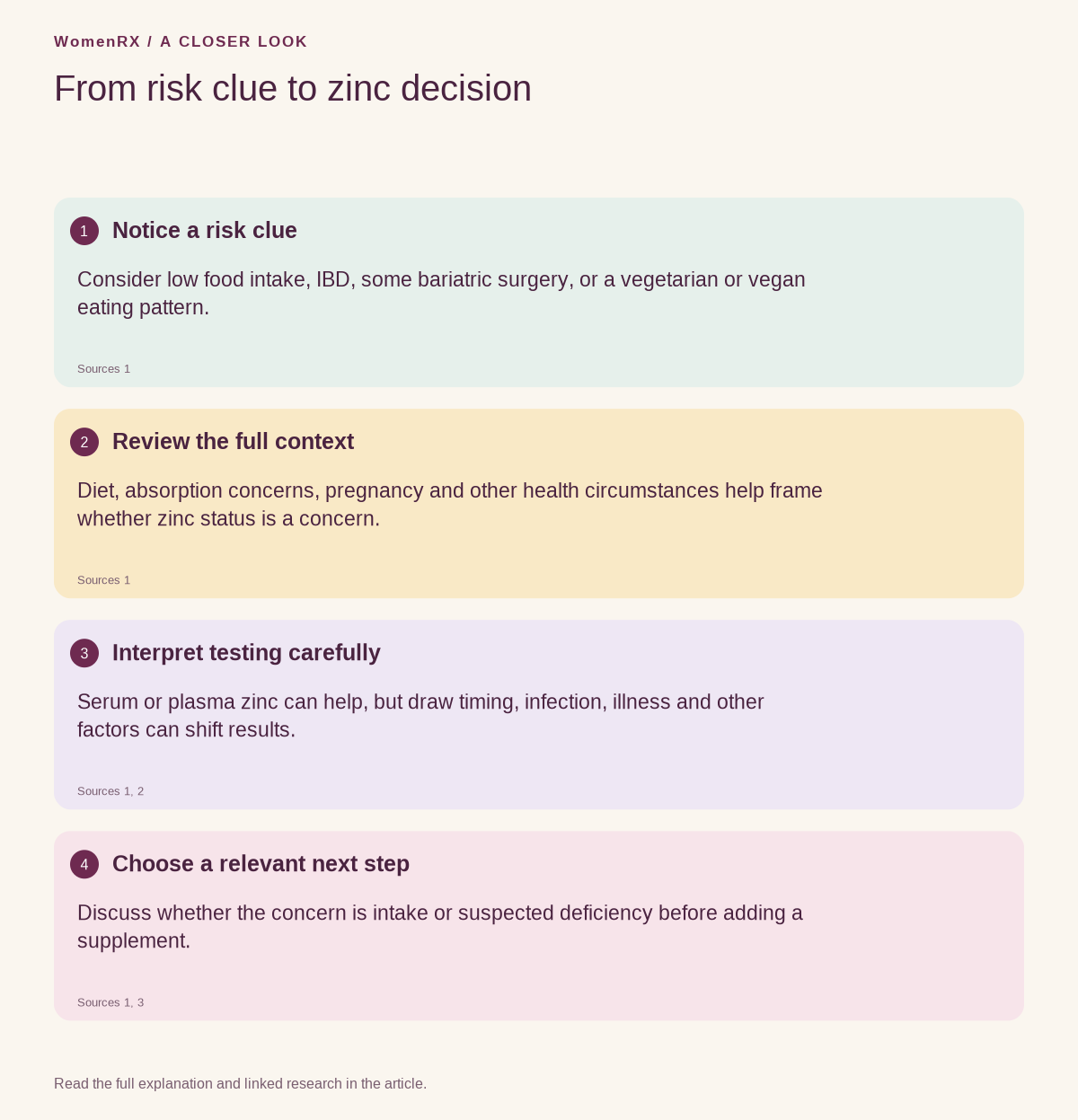
From risk clue to zinc decision
Notice a risk clue: Consider low food intake, IBD, some bariatric surgery, or a vegetarian or vegan eating pattern.1
Review the full context: Diet, absorption concerns, pregnancy and other health circumstances help frame whether zinc status is a concern.1
Interpret testing carefully: Serum or plasma zinc can help, but draw timing, infection, illness and other factors can shift results.12
Choose a relevant next step: Discuss whether the concern is intake or suspected deficiency before adding a supplement.13
Read the figure as text
A risk factor can justify a closer look, but it does not by itself diagnose deficiency or determine that a supplement is needed.- Notice a risk clue: Consider low food intake, IBD, some bariatric surgery, or a vegetarian or vegan eating pattern.1
- Review the full context: Diet, absorption concerns, pregnancy and other health circumstances help frame whether zinc status is a concern.1
- Interpret testing carefully: Serum or plasma zinc can help, but draw timing, infection, illness and other factors can shift results.12
- Choose a relevant next step: Discuss whether the concern is intake or suspected deficiency before adding a supplement.13
More questions, answered
Does a low zinc blood result always mean I’m deficient?
Not by itself. Serum or plasma zinc is useful, but levels can shift with collection time, food, infection and other health factors. The result makes more sense alongside your diet, health history and reason for testing. 12
Does being vegetarian or vegan mean I need a supplement?
No. These diets are associated with lower average zinc intake and serum levels, but that does not establish deficiency in an individual. Intake, food pattern and any additional risk factors matter. 1
Sources you can check
- Zinc - Health Professional Fact SheetAccessed 2026-09-25Return to first citation
- A Narrative Review of Zinc Deficiency-Associated Anemia.Basmajian K, Dermarderosian A, Thoreson RJ, Adams J, Farjami C, Yang A, Akhtari E, Araji S, Khan Z, Saadat S, Arabian S, Tansy C, Knutzen G, Akhtari M. · Hematology reports · 2026Return to first citation
- Role of zinc in health and disease.Stiles LI, Ferrao K, Mehta KJ. · Clinical and experimental medicine · 2024Return to first citation