Who May Not Be Able to Take Fezolinetant?
Before starting Veozah, the U.S. label calls for a check of liver and kidney health, liver-test results, and medicines that may interact.
Under U.S. prescribing information, known cirrhosis, severe kidney impairment or end-stage kidney disease, and taking a CYP1A2 inhibitor are contraindications to fezolinetant (Veozah). A prescriber also needs baseline liver tests: treatment should not start if ALT, AST, or total bilirubin reaches the label’s specified threshold. Liver testing continues if treatment begins. 1
If you’re considering fezolinetant (Veozah) for menopause-related hot flashes or night sweats, it helps to separate three questions: Do you have a condition the U.S. label lists as a contraindication? Are you taking a medicine that rules out using it together? And what do your liver tests show before treatment? These are different checks, and a medicine list matters just as much as your health history. 1
Which conditions are formal exclusions?
The U.S. prescribing information lists known cirrhosis and severe kidney impairment or end-stage kidney disease as contraindications. These aren’t simply reasons for closer monitoring while taking fezolinetant. 1
For kidney function, the label describes severe impairment as an estimated glomerular filtration rate (eGFR) of 15 to less than 30 mL/min/1.73 m² and end-stage kidney disease as an eGFR below 15 mL/min/1.73 m². If you know you have kidney disease but aren’t sure of your current eGFR, your recent results are more useful to the prescriber than the diagnosis name alone. 1
Which medicines can rule out taking it?
Taking a CYP1A2 inhibitor at the same time is also a formal contraindication. Fezolinetant is processed through CYP1A2, and medicines that inhibit it can increase fezolinetant exposure. The U.S. label includes weak, moderate, and strong CYP1A2 inhibitors in this exclusion, not just strong ones. It names cimetidine, mexiletine, and fluvoxamine as studied examples. Those three medicines aren’t a complete interaction list. 1
Bring a current list of prescription medicines, over-the-counter medicines, and supplements so the prescriber or pharmacist can check the exact products.
What do liver tests decide before treatment?
Cirrhosis isn’t the only liver-related check. The U.S. label calls for a liver blood test before starting fezolinetant. Do not start if ALT or AST is at least twice the testing laboratory’s upper limit of normal, or if total bilirubin is at least twice that limit. These are thresholds for starting treatment, distinct from the label’s rules for stopping treatment after it begins. 1 If you’ve previously been told a liver test was abnormal, bring the actual result and any more recent tests rather than assuming the past result settles today’s decision.
Liver testing continues if treatment begins: the label calls for tests monthly for the first three months, then at months six and nine. 1 In a 24-week randomized trial involving people considered unsuitable for hormone therapy, liver-test elevations were reported in 10 of 226 participants given fezolinetant and 6 of 226 given placebo. That trial result cannot predict an individual’s risk or replace the label’s monitoring schedule. 21
It’s also worth keeping hormone-therapy eligibility separate from fezolinetant eligibility. A randomized trial studied fezolinetant in people considered unsuitable for hormone therapy, whether because of a contraindication, a reason for caution, prior discontinuation, or a preference not to use it. Being unable or unwilling to use hormone therapy doesn’t, by itself, answer whether fezolinetant is suitable for you. Its own prescribing checks still apply. 21
If treatment starts, which symptoms need prompt action?
The U.S. label says to stop fezolinetant and seek medical attention, including liver testing, if symptoms suggest liver injury. These include new fatigue, decreased appetite, nausea or vomiting, itching, yellowing of the skin or eyes, pale stools, dark urine, or abdominal pain. 1
These distinctions describe U.S. prescribing information. If you receive care elsewhere, the applicable local labeling and your individual circumstances will guide the decision.
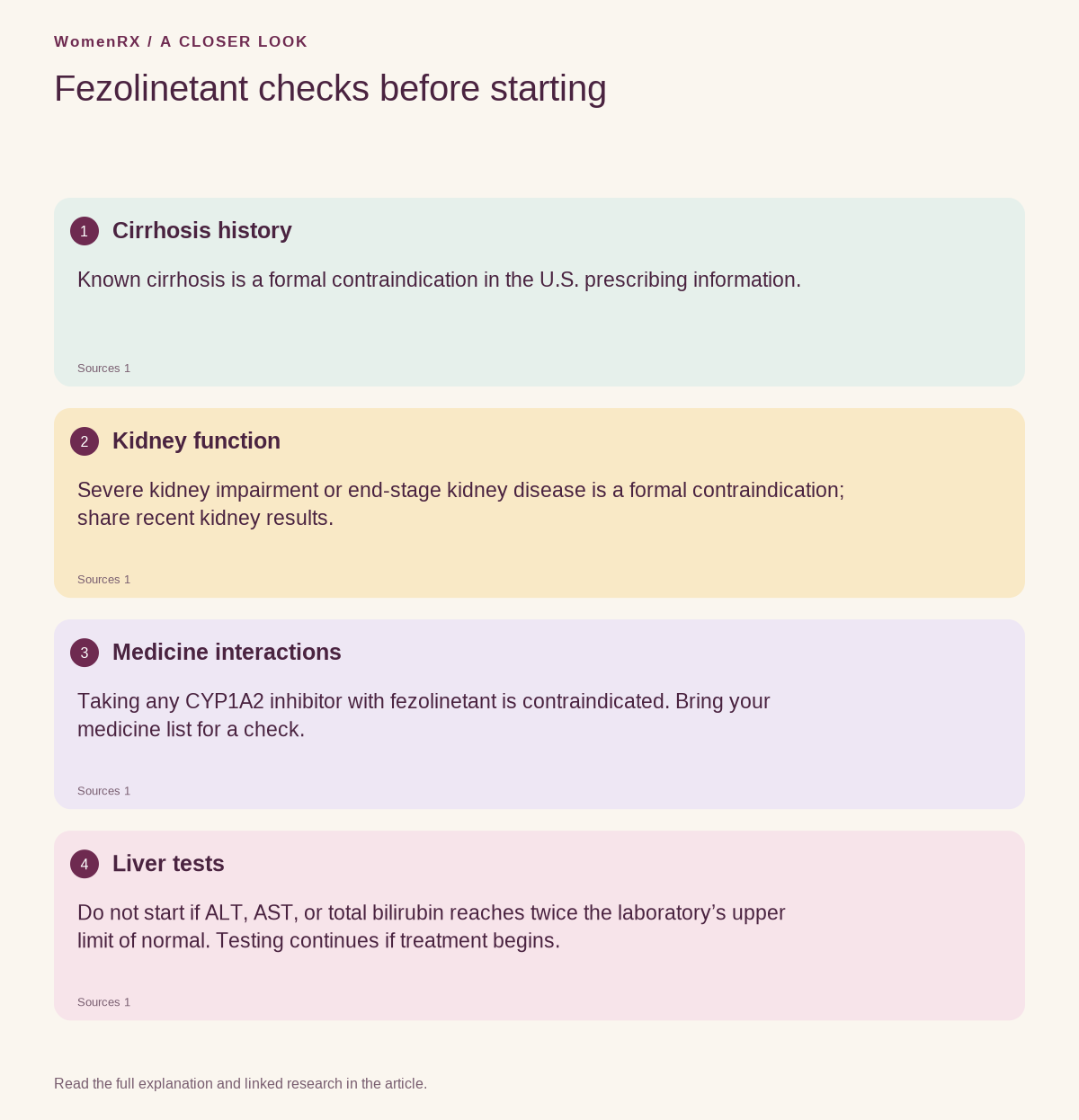
Fezolinetant checks before starting
Cirrhosis history: Known cirrhosis is a formal contraindication in the U.S. prescribing information.1
Kidney function: Severe kidney impairment or end-stage kidney disease is a formal contraindication; share recent kidney results.1
Medicine interactions: Taking any CYP1A2 inhibitor with fezolinetant is contraindicated. Bring your medicine list for a check.1
Liver tests: Do not start if ALT, AST, or total bilirubin reaches twice the laboratory’s upper limit of normal. Testing continues if treatment begins.1
Read the figure as text
Use these distinct checks to prepare for a prescribing decision, rather than treating every health concern as a formal contraindication.- Cirrhosis history: Known cirrhosis is a formal contraindication in the U.S. prescribing information.1
- Kidney function: Severe kidney impairment or end-stage kidney disease is a formal contraindication; share recent kidney results.1
- Medicine interactions: Taking any CYP1A2 inhibitor with fezolinetant is contraindicated. Bring your medicine list for a check.1
- Liver tests: Do not start if ALT, AST, or total bilirubin reaches twice the laboratory’s upper limit of normal. Testing continues if treatment begins.1
More questions, answered
Does being unable to take hormone therapy rule out fezolinetant?
Not necessarily. A randomized trial included people considered unsuitable for hormone therapy, but fezolinetant has separate contraindications, medicine interactions, and liver-testing requirements. One decision doesn’t settle the other. 21
Sources you can check
- VEOZAH (FEZOLINETANT) TABLET, FILM COATED [ASTELLAS PHARMA US, INC.] | US prescribing information and patient instructionsAccessed 2026-09-25Return to first citation
- Efficacy and safety of fezolinetant for moderate-severe vasomotor symptoms associated with menopause in individuals unsuitable for hormone therapy: phase 3b randomised controlled trial.Schaudig K, Wang X, Bouchard C, Hirschberg AL, Cano A, Shapiro C M M, Stute P, Wu X, Miyazaki K, Scrine L, Nappi RE. · BMJ (Clinical research ed.) · 2024Return to first citation