Vaginal Estrogen: Who May Use It and What Safety Questions Matter?
Vaginal estrogen is intended to ease menopause-related vaginal and urinary symptoms, and its local use differs from systemic hormone therapy.
Low-dose vaginal estrogen is used for menopause-related genitourinary symptoms, such as vaginal discomfort, when nonhormonal options haven’t helped enough. It’s absorbed mainly locally, with much less reaching the bloodstream than with systemic hormone therapy, but absorption isn’t zero. The specific product and dose matter. If you’ve had breast cancer, especially if you take an aromatase inhibitor, discuss options with your clinicians before deciding. 1 2

Vaginal estrogen may be worth discussing if dryness, irritation, discomfort with sex, or other genitourinary symptoms are affecting your life during the menopause transition or after menopause. Its purpose is local symptom relief. It isn’t the same treatment as systemic hormone therapy, and the difference matters when you’re weighing benefits and personal risks.
Local treatment, different goal
Vaginal estrogen comes in locally applied forms such as creams, gels, tablets, pessaries, and rings. These products are used for genitourinary symptoms associated with menopause. A clinician can help you choose a form that fits your symptoms and preferences. Vaginal moisturizers or lubricants can also be used alone or alongside vaginal estrogen. 2
Systemic hormone therapy is taken or applied in ways intended to affect the body more broadly. It may be used for symptoms such as hot flashes, as well as genitourinary symptoms. Vaginal estrogen is generally considered when the main concern is local genitourinary symptoms, rather than symptoms throughout the body. The benefits and risks of hormone therapy vary with its type, dose, route, duration, and whether a progestogen is used, so the two approaches shouldn’t be treated as interchangeable. 1
What “local” does and doesn’t mean
Vaginal estrogen is absorbed locally. Compared with systemic hormone therapy, only a minimal amount is absorbed into the bloodstream, and this is unlikely to have a significant effect throughout the body. That’s a meaningful difference, but it doesn’t mean absorption is zero or that every formulation and dose is identical. Ask which specific product and dose are being considered, and why it fits your symptoms. 1 2
Treatment can help with menopause-related genitourinary symptoms, but it may not be a permanent fix: symptoms often return after vaginal estrogen is stopped, and treatment can be restarted if needed. Regular review gives you a chance to revisit whether it’s helping and whether the plan still suits you. 2
When your medical history changes the conversation
A history of breast cancer doesn’t automatically settle the question either way. NICE recommends offering nonhormonal moisturizers or lubricants first for people with a personal history of breast cancer. If symptoms continue despite trying nonhormonal options, vaginal estrogen may be considered, with an individualized discussion of the person’s recurrence risk and the uncertainty about whether vaginal estrogen affects recurrence. 2
If you’re currently taking an aromatase inhibitor as part of breast cancer treatment, NICE recommends working with a breast cancer specialist on options when symptoms persist despite nonhormonal treatment. This is a reason to coordinate the decision with your oncology team, not to assume that advice for someone without that history applies to you. 2
Research reviews describe low systemic absorption, but safety evidence for people with hormone-sensitive cancers is not complete. In particular, one review notes that evidence about recurrence for breast cancer survivors taking aromatase inhibitors remains unsettled. That uncertainty calls for a personal risk-benefit discussion, rather than either a blanket promise of safety or an assumption that local estrogen is always off-limits. 3 4
Useful questions to bring to the conversation
You can make the discussion more specific by asking:
- Are my symptoms likely to be menopause-related genitourinary symptoms, and what is vaginal estrogen intended to improve?
- Which formulation and dose are you suggesting, and how does that compare with systemic hormone therapy?
- Given my medical history and current medicines, should I start with moisturizers or lubricants, or consider vaginal estrogen?
- If I’ve had breast cancer, should my oncology team be involved, especially if I’m taking an aromatase inhibitor?
- How will we tell whether treatment is helping, and what should I do if symptoms return after stopping?
The practical distinction is simple: local vaginal estrogen is aimed at local symptoms and has much less systemic absorption than systemic hormone therapy, but product, dose, and personal history still matter. That’s why the most useful discussion is about the specific treatment you’re considering, not “estrogen” as one single category. 1 2
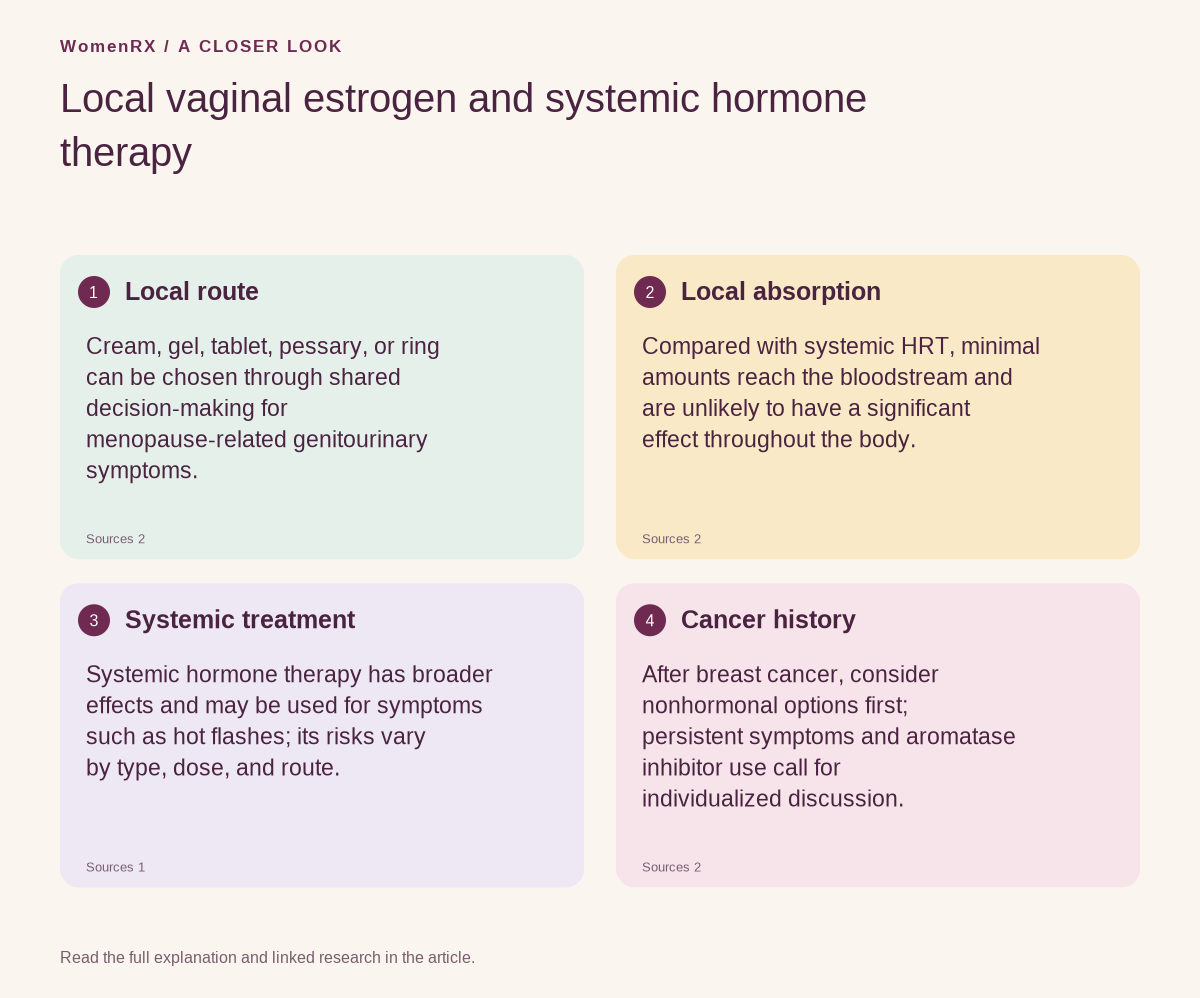
Local vaginal estrogen and systemic hormone therapy
Local route: Cream, gel, tablet, pessary, or ring can be chosen through shared decision-making for menopause-related genitourinary symptoms.2
Local absorption: Compared with systemic HRT, minimal amounts reach the bloodstream and are unlikely to have a significant effect throughout the body.2
Systemic treatment: Systemic hormone therapy has broader effects and may be used for symptoms such as hot flashes; its risks vary by type, dose, and route.1
Cancer history: After breast cancer, consider nonhormonal options first; persistent symptoms and aromatase inhibitor use call for individualized discussion.2
Read the figure as text
The route and intended treatment goal help distinguish local vaginal products from systemic hormone therapy. Personal medical history still matters.- Local route: Cream, gel, tablet, pessary, or ring can be chosen through shared decision-making for menopause-related genitourinary symptoms.2
- Local absorption: Compared with systemic HRT, minimal amounts reach the bloodstream and are unlikely to have a significant effect throughout the body.2
- Systemic treatment: Systemic hormone therapy has broader effects and may be used for symptoms such as hot flashes; its risks vary by type, dose, and route.1
- Cancer history: After breast cancer, consider nonhormonal options first; persistent symptoms and aromatase inhibitor use call for individualized discussion.2
More questions, answered
Does vaginal estrogen treat hot flashes?
Vaginal estrogen is used for genitourinary symptoms. Systemic hormone therapy is the hormone therapy described as an effective treatment for hot flashes, so ask about a separate approach if hot flashes are your main concern. 1
What if symptoms come back after I stop vaginal estrogen?
Menopause-related symptoms often return when vaginal estrogen is stopped. NICE says treatment can be restarted if necessary, so recurrence is a useful reason to review your options. 2
Sources you can check
- The 2022 hormone therapy position statement of The North American Menopause Society.“The 2022 Hormone Therapy Position Statement of The North American Menopause Society” Advisory Panel. · Menopause (New York, N.Y.) · 2022Return to first citation
- Recommendations | Menopause: identification and management | Guidance | NICEAccessed 2026-09-25Return to first citation
- Safety of vaginal estrogen in breast cancer survivors: Current evidence on systemic absorption and oncologic outcomes.Mainar LB, Nieto-Pascual L, Bravo EI, García-Ramos BO, Llaneza IP, Vilanova CT, Lloret AM, Alsina JC. · Maturitas · 2026Return to first citation
- Genitourinary syndrome of menopause in women with cancer - a narrative review.Ryan HM, Brennan DJ. · Maturitas · 2026Return to first citation