Vaginal Estradiol Cream: Local Treatment, Use, and Safety Questions
Vaginal estradiol cream is aimed at menopause-related vaginal symptoms, not hot flashes, and its instructions and safety questions depend on the exact product and your health history.
Vaginal estradiol cream delivers estrogen inside the vagina to treat menopause-related dryness and irritation. It is a local treatment, not a substitute for systemic hormone therapy when symptoms such as hot flashes are the main concern. Cream instructions are product-specific, so confirm the amount and schedule for your exact prescription. Discuss your medical history and report unusual vaginal bleeding promptly. 1 2 5
Vaginal dryness, irritation, soreness, or pain with sex can develop during or after menopause as estrogen levels fall. Vaginal estradiol cream is one local treatment for these symptoms. It may also help some urinary symptoms, including urgency and frequency; research reviews have also found fewer urinary tract infections with vaginal estrogen in postmenopausal women. 2 4
Local cream and systemic hormone therapy have different targets
Vaginal cream is placed inside the vagina. Other local forms include vaginal tablets, inserts, and rings. These treatments are intended for genitourinary symptoms such as dryness and irritation. They aren’t expected to treat hot flashes, mood changes, or sleep problems. If you’re dealing with both vaginal symptoms and hot flashes, ask about each symptom separately; systemic hormone therapy is a different treatment discussion. 2 5
“Local” doesn’t mean that every cream has identical absorption, instructions, or safety considerations. Product and dose matter. Don’t assume that directions for a tablet, ring, or another cream apply to your prescription. 1 2
Confirm the directions for your exact cream
Before you start, make sure you know which cream you have and how its label says to use it. Useful questions include:
- What amount should I use, and how often?
- Does the applicator have markings that show the amount?
- Should I use the applicator, or is there another product-specific direction?
- What should I do if I miss an application or the cream causes irritation?
The Estrace patient information says to use the dose recommended by your prescriber and to discuss how well it is working. It also recommends regular conversations about whether to continue and whether the dose is still needed; its patient information gives every three to six months as an example. That is product-specific guidance, not a schedule to apply to every vaginal estrogen product. 1
If you miss an application, check the instructions that came with your exact product or ask your pharmacist rather than guessing. If insertion causes burning, irritation, or itching, those are listed reactions for Estrace; ask the prescriber or pharmacist what to do if they persist or are troublesome. 1
What it may help, and what else might be considered
A systematic review found that vaginal estrogen improved dryness and pain with sex compared with placebo, and also improved some urinary symptoms, including urgency and frequency. For women with two or more vaginal symptoms, estrogen improved symptoms more than nonhormonal moisturizers in the studies reviewed; for one or mild symptoms, either approach could help. A moisturizer or lubricant may therefore be worth discussing if symptoms are mild or you prefer a nonhormonal option. 4
For recurrent urinary tract infections, a 2026 review of five randomized trials reported fewer culture-confirmed infections with low-dose vaginal estrogen. The review did not find head-to-head trials that establish one vaginal formulation as best. This evidence is about prevention in peri- and postmenopausal women with recurrent infections, not a reason to treat every episode of urinary symptoms as an infection or as menopause-related. 3
Make safety a product-and-history conversation
Tell the prescriber if you have had breast or uterine cancer, a blood clot, or another serious health condition. Estrace’s patient information specifically advises discussing use if you currently have or have had certain cancers or blood clots. If you have a uterus, ask whether the dose and product you’re using call for a progestin. Advice can differ: general guidance describes low-dose vaginal estrogen as having little medicine enter the rest of the body, while Estrace’s US patient information says to discuss whether adding a progestin is right for you and says it is generally recommended for a woman with a uterus. Don’t apply a broad rule from another product to your own prescription. 1 2
Report unusual vaginal bleeding promptly. Bleeding after menopause needs evaluation to find its cause, even if you’re using vaginal estradiol. Estrace’s patient information specifically says to report unusual bleeding right away. 1
At follow-up, describe which symptoms have changed and which haven’t. If dryness improves but urinary urgency or repeated infections continue, say so; it helps keep the next discussion focused on the symptom that still needs attention.
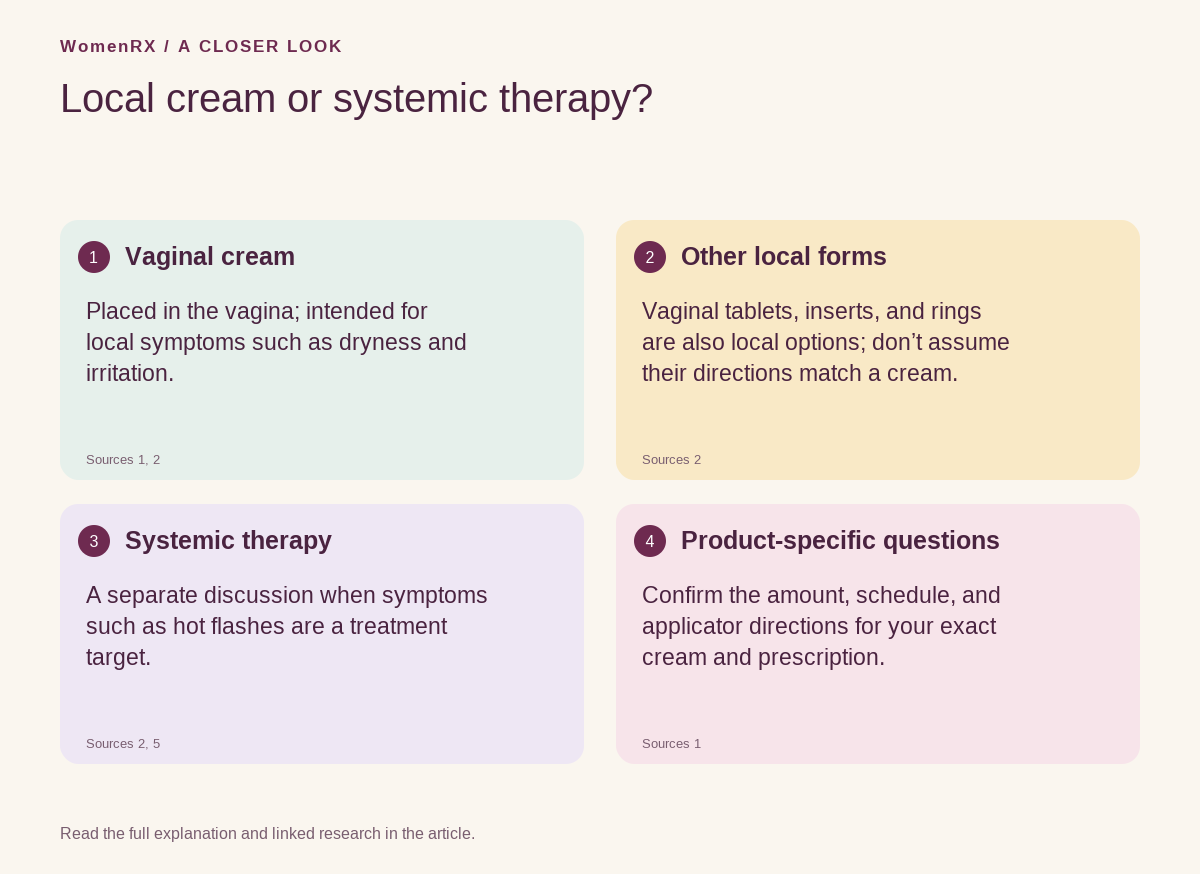
Local cream or systemic therapy?
Vaginal cream: Placed in the vagina; intended for local symptoms such as dryness and irritation.12
Other local forms: Vaginal tablets, inserts, and rings are also local options; don’t assume their directions match a cream.2
Systemic therapy: A separate discussion when symptoms such as hot flashes are a treatment target.25
Product-specific questions: Confirm the amount, schedule, and applicator directions for your exact cream and prescription.1
Read the figure as text
The route and symptom target help clarify which treatment conversation you need; cream directions still depend on the exact product.- Vaginal cream: Placed in the vagina; intended for local symptoms such as dryness and irritation.12
- Other local forms: Vaginal tablets, inserts, and rings are also local options; don’t assume their directions match a cream.2
- Systemic therapy: A separate discussion when symptoms such as hot flashes are a treatment target.25
- Product-specific questions: Confirm the amount, schedule, and applicator directions for your exact cream and prescription.1
More questions, answered
Will vaginal estradiol cream help hot flashes?
It is intended for local vaginal symptoms such as dryness and irritation, not hot flashes. If you have both, ask about treatment options for each rather than expecting the cream to address both. 2 5
Does vaginal estrogen always mean I need a progestin?
There isn’t a single answer to apply to every product and dose. General guidance describes low-dose vaginal estrogen as having little systemic absorption, but Estrace’s US patient information says women with a uterus should discuss whether adding a progestin is right for them. Ask about your exact product and dose. 1 2
Sources you can check
- ESTRACE (ESTRADIOL) CREAM [ALLERGAN, INC.] | US prescribing information and patient instructionsAccessed 2026-09-25Return to first citation
- About vaginal oestrogen - NHSAccessed 2026-09-25Return to first citation
- Vaginal Estrogen for Urinary Tract Infection Prevention: A Narrative Review of Evidence, Guidelines, and Regulatory Gaps.Ghasoub R, Mackay W, Shepherd A. · Gynecologic and obstetric investigation · 2026Return to first citation
- Vaginal estrogen for genitourinary syndrome of menopause: a systematic review.Rahn DD, Carberry C, Sanses TV, Mamik MM, Ward RM, Meriwether KV, Olivera CK, Abed H, Balk EM, Murphy M, Society of Gynecologic Surgeons Systematic Review Group. · Obstetrics and gynecology · 2014Return to first citation
- The 2022 hormone therapy position statement of The North American Menopause Society.“The 2022 Hormone Therapy Position Statement of The North American Menopause Society” Advisory Panel. · Menopause (New York, N.Y.) · 2022Return to first citation