Vaginal Estrogen Cream for Menopause: Uses and Key Safety Questions
Vaginal estrogen cream can help with local menopause symptoms, but the exact cream, your health history, and any unexplained bleeding matter.
Vaginal estrogen cream may relieve menopause-related dryness and irritation, but it won’t treat hot flashes. Cream is one local option alongside vaginal tablets, inserts, and rings. Before using it, ask about the exact product and amount, whether it could affect your contraception, and how your health history affects the choice. Have unexplained bleeding after menopause checked. 1 2 4
What cream is meant to treat
As estrogen levels fall around menopause, vaginal tissue can become dry or irritated. Vaginal estrogen treats symptoms in and around the vagina; it isn’t a treatment for hot flashes, mood changes, or trouble sleeping. 2
Dryness isn’t the only possible concern. Pain with sex, urinary urgency, and recurrent urinary tract infections can occur as part of genitourinary syndrome of menopause. If urinary symptoms are what’s bothering you, describe what’s happening rather than assuming estrogen loss is the cause. The symptom alone doesn’t tell you why it’s happening. 7
A cream may be worth discussing when local symptoms remain bothersome despite nonhormonal options. Vaginal moisturizers and lubricants may help, and the North American Menopause Society recommends low-dose vaginal estrogen or other therapies for bothersome genitourinary symptoms that haven’t improved with over-the-counter treatments. 3 8
The practical differences between cream and other forms
Cream, tablets or inserts, and rings all deliver estrogen vaginally, but they don’t have identical directions or product warnings. A cream is applied from a tube; tablets and inserts are separate vaginal preparations. A vaginal ring is placed in the vagina and, for the ring described in NHS guidance, remains in use for up to three months before replacement. If remembering repeated applications is a concern, that difference is worth asking about. It doesn’t make the ring the best choice for everyone. 2 4
Cream also raises a practical contraception question: some estrogen creams and gels can damage condoms and diaphragms, making them less effective. If you rely on either, ask whether that warning applies to the cream you’re considering and what option would work with your contraception. Don’t assume all creams or all vaginal estrogen forms have this effect. 3 4
The exact cream matters for another reason. US prescribing information for Estrace 0.01% estradiol vaginal cream says systemic absorption may occur and directs prescribers to consider warnings associated with oral estrogen treatment. That is a warning for this product, not proof that every vaginal estrogen preparation has the same amount of absorption or the same risk. Ask which estrogen cream is being proposed and why that formulation fits your situation. 1
Safety questions worth settling before you start
Have you had bleeding after menopause? Unusual bleeding needs evaluation to find its cause, whether it began before treatment or while you’re using cream. Estrace’s prescribing information specifically calls for investigation of persistent or recurring unexplained bleeding. Don’t assume bleeding is simply irritation or a normal effect of estrogen. 1
Do you have a uterus, and would you need a progestogen? General guidance says a progestogen is usually unnecessary with low-dose vaginal estrogen because little reaches the rest of the body. Estrace’s label also warns about endometrial cancer risk with unopposed estrogen in women with a uterus and notes that absorption may occur with its cream. These statements address different levels of specificity. Rather than applying a rule for all vaginal estrogen to a particular cream, ask how your product, prescribed amount, and bleeding history affect the plan. 1 2
Have you had breast or uterine cancer or blood clots? Bring up those histories before choosing a cream; they appear in Estrace’s safety information. After breast cancer, nonhormonal treatments are generally considered first. If they aren’t enough, low-dose vaginal estrogen may still be discussed, but long-term safety evidence is limited and decisions are individualized, particularly if you take an aromatase inhibitor. In that situation, involve your oncology team in the decision. 1 5 6 7
The useful comparison isn’t simply “cream versus no cream.” It’s which symptom you want to relieve, whether a nonhormonal option is doing enough, and which product’s practical details and safety questions fit your life. For example, someone relying on condoms may need a different product discussion than someone whose main concern is remembering applications. 3 4 8
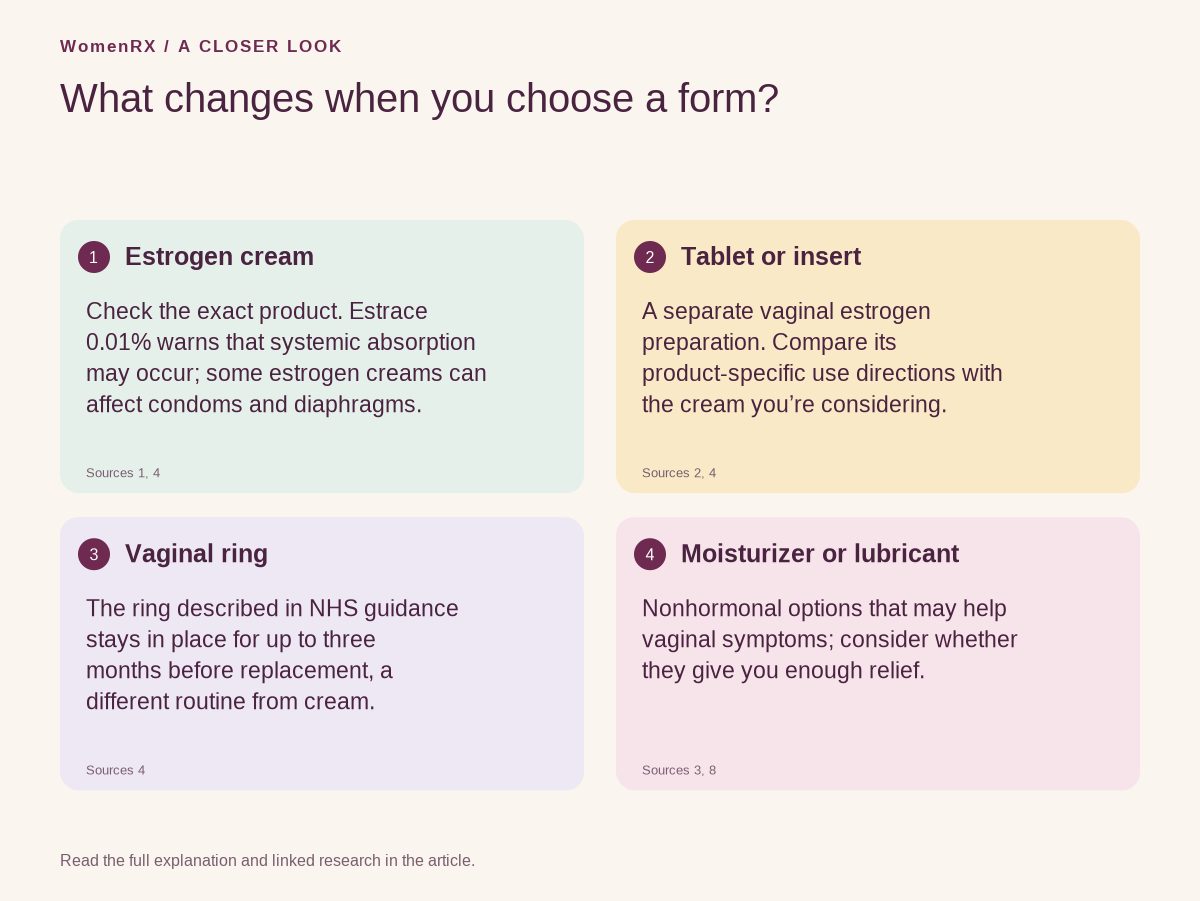
What changes when you choose a form?
Estrogen cream: Check the exact product. Estrace 0.01% warns that systemic absorption may occur; some estrogen creams can affect condoms and diaphragms.14
Tablet or insert: A separate vaginal estrogen preparation. Compare its product-specific use directions with the cream you’re considering.24
Vaginal ring: The ring described in NHS guidance stays in place for up to three months before replacement, a different routine from cream.4
Moisturizer or lubricant: Nonhormonal options that may help vaginal symptoms; consider whether they give you enough relief.38
Read the figure as text
All four options address local symptoms, but they raise different practical questions. This comparison does not rank their effectiveness or safety.- Estrogen cream: Check the exact product. Estrace 0.01% warns that systemic absorption may occur; some estrogen creams can affect condoms and diaphragms.14
- Tablet or insert: A separate vaginal estrogen preparation. Compare its product-specific use directions with the cream you’re considering.24
- Vaginal ring: The ring described in NHS guidance stays in place for up to three months before replacement, a different routine from cream.4
- Moisturizer or lubricant: Nonhormonal options that may help vaginal symptoms; consider whether they give you enough relief.38
More questions, answered
How soon might vaginal estrogen help?
Improvement may take time. NHS guidance says vaginal estrogen can take up to three months to work fully; if symptoms still aren’t improving, it’s reasonable to revisit whether the treatment or the assumed cause fits. 2 3
Sources you can check
- ESTRACE (ESTRADIOL) CREAM [ALLERGAN, INC.] | US prescribing information and patient instructionsAccessed 2026-09-25Return to first citation
- About vaginal oestrogen - NHSAccessed 2026-09-25Return to first citation
- Common questions about vaginal oestrogen - NHSAccessed 2026-09-25Return to first citation
- How and when to use vaginal oestrogen - NHSAccessed 2026-09-25Return to first citation
- Menopausal hormone therapy in breast cancer survivors: A review.Granat LM, Pederson HJ, Kruse M. · Maturitas · 2026Return to first citation
- Menopausal hormone therapy and breast cancer: risk and management.Sanserino K. · Current opinion in obstetrics & gynecology · 2026Return to first citation
- Case-Based Perspectives on the Management of Genitourinary Syndrome of Menopause.Cyriac J, Sood R. · Clinics and practice · 2026Return to first citation
- The 2022 hormone therapy position statement of The North American Menopause Society.“The 2022 Hormone Therapy Position Statement of The North American Menopause Society” Advisory Panel. · Menopause (New York, N.Y.) · 2022Return to first citation