Oral Estrogen for Menopause: Forms, Use, and Key Questions
The estrogen ingredient, delivery route, and whether you have a uterus all shape the questions to ask about menopause hormone therapy.
Oral menopause estrogen isn’t one single treatment: pills may contain estradiol or conjugated estrogens, and the plan may or may not include a progestogen. If you have an intact uterus, a progestogen is generally used to protect the uterine lining. The choice also involves route: oral estrogen has been linked with more blood clots than transdermal estrogen in observational research, so personal risk factors matter. 2 6
Start with what’s in the pill
“Oral estrogen” describes how the medicine is taken, not one specific ingredient. Oral products may contain estradiol or conjugated estrogens. Ask which ingredient is being considered and why it fits your symptoms and health history. Research on one estrogen product shouldn’t automatically be treated as proof that every formulation has identical effects.
Hormone therapy is an effective treatment for hot flashes and other vasomotor symptoms, but its benefits and risks depend on factors including type, dose, duration, route, timing, and whether a progestogen is used. The North American Menopause Society recommends individualizing treatment and periodically revisiting the balance. 7
A randomized trial involving perimenopausal and postmenopausal women with hot flashes studied low-dose oral 17β-estradiol against placebo. It supports oral estradiol as a treatment studied for these symptoms, but it doesn’t compare every oral estrogen ingredient or establish that one pill is best for every woman. 3
The uterus changes the plan
If you have an intact uterus, estrogen can stimulate the uterine lining. A progestogen is generally added to reduce the risk of endometrial overgrowth and cancer associated with estrogen without adequate protection. The right type and regimen matter; there isn’t one progestogen plan that fits everyone. 5 6
If you’ve had a hysterectomy, bring that up when discussing treatment. The relevant question is whether any uterine lining remains and whether a progestogen is needed in your particular situation. Don’t assume that a past surgery makes every hormone plan the same.
“Progesterone” and “progestogen” aren’t always interchangeable terms in treatment discussions. Micronized progesterone is one type of progestogen; other progestogens are also used. Ask which one is proposed, what it is intended to do, and how its schedule may affect bleeding or other side effects. The evidence supports the need for adequate endometrial protection when estrogen is used with an intact uterus, but it doesn’t establish one preferred regimen for all women. 5 6
Oral or through the skin?
A pill isn’t the only way to take systemic estrogen. Transdermal estrogen, such as a patch or gel, is absorbed through the skin. Route can matter for blood-clot risk: a meta-analysis of 15 observational studies in postmenopausal women found oral estrogen was associated with a higher risk of a first venous blood clot than transdermal estrogen (relative risk 1.63) and of deep-vein thrombosis (relative risk 2.09). The studies followed participants for 3 to 20.25 years, had moderate risk of bias, and the review rated confidence in the evidence as low. These are relative comparisons, not your personal chance of a clot. 2
A later systematic review focused on women with VTE risk factors also found that route and whether a progestogen was used mattered, but the included studies varied in treatment and in the risk factors they examined. That makes a personal history of blood clots or other clotting risks worth raising when you compare oral and transdermal options. The research doesn’t make an individual treatment decision on its own. 1
Make the dose discussion practical
There isn’t a dose recommendation here that can safely be applied to every reader. Instead, ask what symptom the prescribed dose is intended to address, how you’ll tell whether it’s helping, and when you’ll review the plan. Dose is one of several factors that can affect the benefit-risk balance, and treatment decisions should be individualized. 7
Useful questions to take into the conversation include:
- Which estrogen ingredient are you recommending, and why?
- Would an oral or transdermal route make more sense given my health history?
- Do I have an intact uterus, and does that mean I need a progestogen for lining protection?
- Which progestogen is being considered, and what side effects or bleeding changes should I discuss?
- What symptoms are we treating, and when should we reassess whether the plan is working?
These questions help separate three decisions that can otherwise blur together: the estrogen ingredient, how it’s delivered, and whether the uterus needs protection. The clearest comparison is the one that accounts for all three, rather than treating “estrogen pills” as a single uniform option.
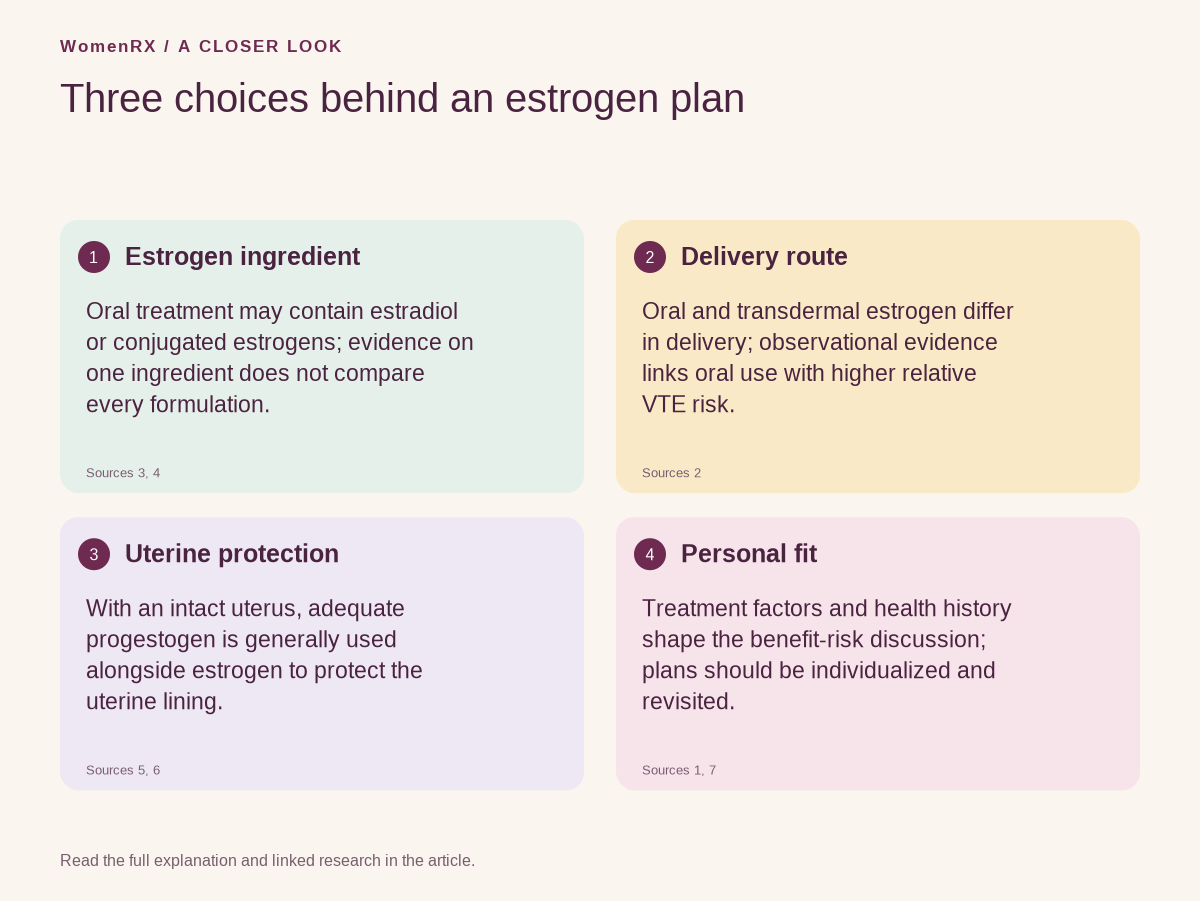
Three choices behind an estrogen plan
Estrogen ingredient: Oral treatment may contain estradiol or conjugated estrogens; evidence on one ingredient does not compare every formulation.34
Delivery route: Oral and transdermal estrogen differ in delivery; observational evidence links oral use with higher relative VTE risk.2
Uterine protection: With an intact uterus, adequate progestogen is generally used alongside estrogen to protect the uterine lining.56
Personal fit: Treatment factors and health history shape the benefit-risk discussion; plans should be individualized and revisited.17
Read the figure as text
Separate the active estrogen, its route, and the question of uterine protection instead of treating all estrogen pills as interchangeable.- Estrogen ingredient: Oral treatment may contain estradiol or conjugated estrogens; evidence on one ingredient does not compare every formulation.34
- Delivery route: Oral and transdermal estrogen differ in delivery; observational evidence links oral use with higher relative VTE risk.2
- Uterine protection: With an intact uterus, adequate progestogen is generally used alongside estrogen to protect the uterine lining.56
- Personal fit: Treatment factors and health history shape the benefit-risk discussion; plans should be individualized and revisited.17
More questions, answered
Does every oral estrogen pill include progesterone?
No. Estrogen and progestogen may be prescribed as separate treatments or as a combined plan. If you have an intact uterus, ask how the plan protects the uterine lining; adequate progestogen protection is generally recommended with estrogen in that situation. 5 6
Is oral estrogen riskier than transdermal estrogen?
For venous blood clots, observational evidence suggests higher risk with oral estrogen than with transdermal estrogen, but it cannot tell you your personal absolute risk. Your health history and the treatment details matter when weighing routes. 1 2
Sources you can check
- Safety of menopause hormone therapy in postmenopausal women at higher risk of venous thromboembolism: a systematic review.Hicks A, Robson D, Tellis B, Smith S, Dunkley S, Baber R. · Climacteric : the journal of the International Menopause Society · 2025Return to first citation
- Oral vs Transdermal Estrogen Therapy and Vascular Events: A Systematic Review and Meta-Analysis.Mohammed K, Abu Dabrh AM, Benkhadra K, Al Nofal A, Carranza Leon BG, Prokop LJ, Montori VM, Faubion SS, Murad MH. · The Journal of clinical endocrinology and metabolism · 2015Return to first citation
- Changes in serum endogenous estrogen concentrations are mediators of the effect of low-dose oral estradiol on vasomotor symptoms.Ensrud KE, Larson JC, Guthrie KA, Crandall CJ, LaCroix AZ, Reed SD, Bhasin S, Mitchell CM, Joffe H. · Menopause (New York, N.Y.) · 2022Return to first citation
- Transdermal delivery of bioidentical estrogen in menopausal hormone therapy: a clinical review.Files J, Kling JM. · Expert opinion on drug delivery · 2020Return to first citation
- The impact of micronized progesterone on the endometrium: a systematic review.Stute P, Neulen J, Wildt L. · Climacteric : the journal of the International Menopause Society · 2016Return to first citation
- Role of progestogen in hormone therapy for postmenopausal women: position statement of The North American Menopause Society.North American Menopause Society. · Menopause (New York, N.Y.) · 2003Return to first citation
- The 2022 hormone therapy position statement of The North American Menopause Society.“The 2022 Hormone Therapy Position Statement of The North American Menopause Society” Advisory Panel. · Menopause (New York, N.Y.) · 2022Return to first citation