When Is Prescription Estrogen Considered for Menopause?
The decision starts with the symptoms you want to treat, then weighs timing, health history, treatment route, and whether a progestogen is needed.
Prescription estrogen may be considered when menopause symptoms are bothersome, especially hot flashes and night sweats. For people younger than 60 or within 10 years of menopause onset, the benefit-risk balance is generally favorable for these symptoms if there are no contraindications. Vaginal symptoms may call for a local treatment instead. Your health history, uterine status, preferences, and periodic reassessment all matter. 1
Begin with what you want treated
Prescription estrogen isn’t an automatic step at menopause. The first distinction is whether your main concern is hot flashes and night sweats, vaginal or urinary symptoms, or both. Systemic hormone therapy is the most effective treatment for hot flashes and night sweats, and it can help prevent bone loss. 1
For bothersome vaginal or urinary symptoms that haven’t improved with over-the-counter options, low-dose vaginal estrogen may be considered even when there isn’t a reason to use systemic hormone therapy. These are different treatment discussions, so describing your main symptoms can help narrow the options. 1
Use age and timing as context, not a verdict
The North American Menopause Society says the benefit-risk balance is generally favorable for treating bothersome hot flashes and night sweats, or preventing bone loss, for people younger than 60 or within 10 years of menopause onset who have no contraindications. Starting more than 10 years after menopause or after age 60 tends to make the balance less favorable, in part because the absolute risks of coronary heart disease, stroke, blood clots in the veins, and dementia are higher. These are guideposts for a discussion, not a personal prediction or an automatic yes or no. 1
If you’re in perimenopause, you can still discuss your symptoms and options; the timing guidance is one part of the conversation, not the whole decision. The treatment goal matters too: hormone therapy should not be used to prevent cardiovascular disease. 14
Review health history before choosing a route
Some medical histories can change whether systemic hormone therapy is appropriate. A menopause position statement on nonhormone treatment names estrogen-dependent cancers and cardiovascular disease as examples of contraindications, and notes that personal preference may also lead someone to choose nonhormone care. Make sure the discussion accounts for your own conditions and concerns rather than relying on a general rule. 2
For hot flashes and night sweats, evidence-supported nonhormone options include cognitive behavioral therapy, clinical hypnosis, certain antidepressants (SSRIs or SNRIs), gabapentin, and fezolinetant. They aren’t interchangeable, and the right fit depends on the person and treatment goal. 2
Route may also come up in the discussion. A joint FIGO and World Heart Federation position paper describes transdermal estrogen as an option to consider when tailoring treatment for people with cardiovascular risk factors or high thromboembolic risk. That does not make it the right choice for everyone with those risks; the overall benefit-risk balance still needs review. 3
Ask how uterine status affects the plan
Estrogen treatment can be systemic or local, and the product, dose, duration, route, timing, and use of a progestogen all affect the risk discussion. If you have a uterus, ask whether your plan needs a progestogen to protect the uterine lining. The question is whether that protection applies to your specific treatment plan, not which regimen to choose on your own. 15
Make the next conversation concrete
You might ask:
- Which of my symptoms could this option reasonably help?
- Are my symptoms better suited to systemic treatment, low-dose vaginal estrogen, or a nonhormone option?
- How do my age and time since menopause affect the expected benefits and risks?
- Does my medical history change whether systemic estrogen is considered, or which route is discussed?
- Does my uterine status mean I need a progestogen for endometrial protection?
- If I use treatment, when and how will we reassess whether its benefits still outweigh its risks?
There isn’t one risk-benefit balance that applies to everyone. If hormone therapy is used, benefits and risks should be reevaluated periodically. Longer use is considered in light of a documented reason, such as persistent symptoms, with shared decision-making. 1
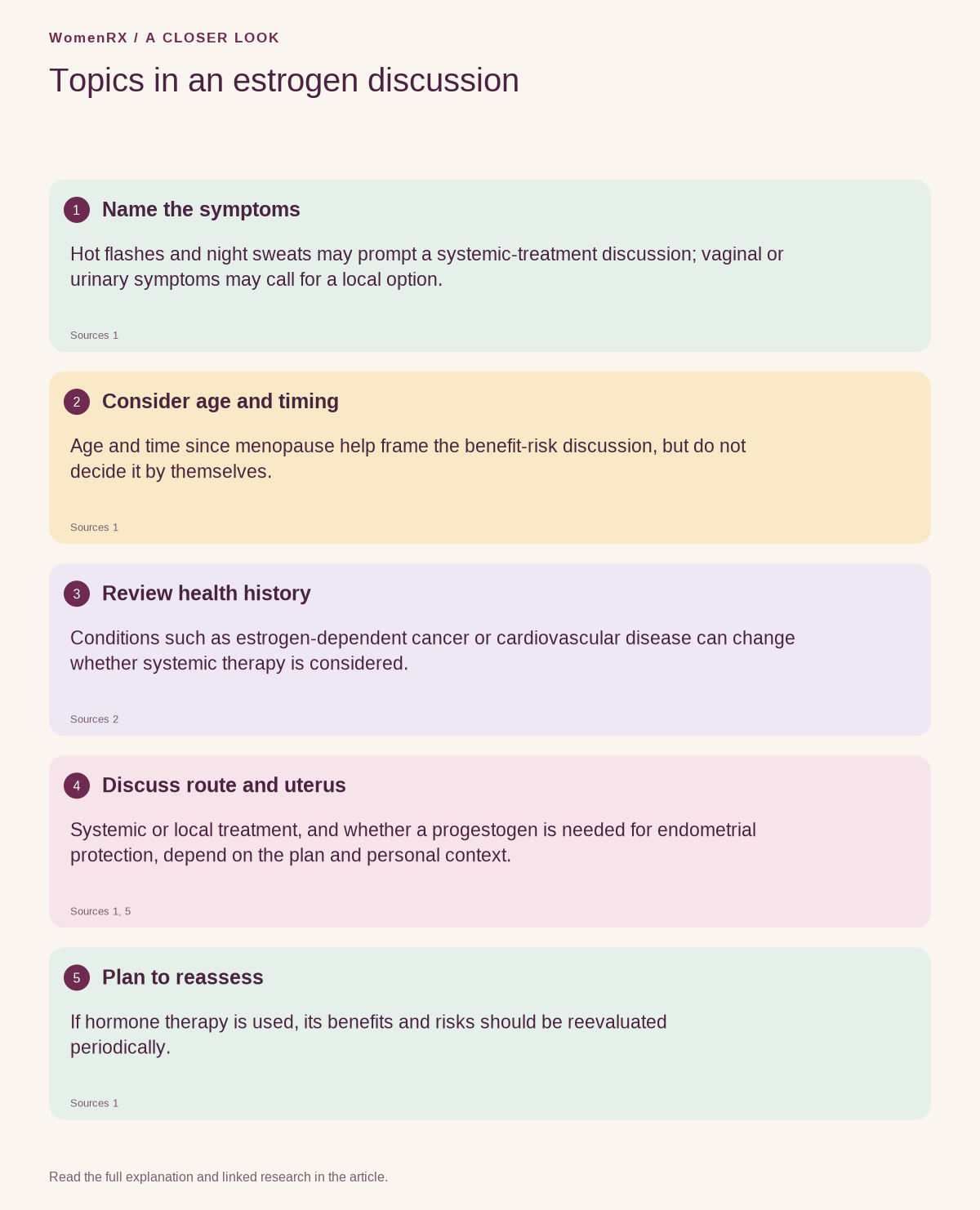
Topics in an estrogen discussion
Name the symptoms: Hot flashes and night sweats may prompt a systemic-treatment discussion; vaginal or urinary symptoms may call for a local option.1
Consider age and timing: Age and time since menopause help frame the benefit-risk discussion, but do not decide it by themselves.1
Review health history: Conditions such as estrogen-dependent cancer or cardiovascular disease can change whether systemic therapy is considered.2
Discuss route and uterus: Systemic or local treatment, and whether a progestogen is needed for endometrial protection, depend on the plan and personal context.15
Plan to reassess: If hormone therapy is used, its benefits and risks should be reevaluated periodically.1
Read the figure as text
These connected questions organize a conversation without deciding whether estrogen is right for you.- Name the symptoms: Hot flashes and night sweats may prompt a systemic-treatment discussion; vaginal or urinary symptoms may call for a local option.1
- Consider age and timing: Age and time since menopause help frame the benefit-risk discussion, but do not decide it by themselves.1
- Review health history: Conditions such as estrogen-dependent cancer or cardiovascular disease can change whether systemic therapy is considered.2
- Discuss route and uterus: Systemic or local treatment, and whether a progestogen is needed for endometrial protection, depend on the plan and personal context.15
- Plan to reassess: If hormone therapy is used, its benefits and risks should be reevaluated periodically.1
More questions, answered
Is menopause hormone therapy used to prevent heart disease?
No. It should not be used for cardiovascular disease prevention. Its role is generally discussed in relation to symptoms and, in some cases, prevention of bone loss. 14
Do vaginal symptoms automatically mean I need systemic estrogen?
No. For bothersome genitourinary symptoms that haven’t improved with over-the-counter therapies, low-dose vaginal estrogen may be considered when systemic hormone therapy isn’t otherwise indicated. 1
Sources you can check
- The 2022 hormone therapy position statement of The North American Menopause Society.“The 2022 Hormone Therapy Position Statement of The North American Menopause Society” Advisory Panel. · Menopause (New York, N.Y.) · 2022Return to first citation
- The 2023 nonhormone therapy position statement of The North American Menopause Society.Menopause (New York, N.Y.) · 2023Return to first citation
- Menopause hormone therapy in women with cardiovascular risk factors or established ischemic heart disease: A joint FIGO and WHF position paper.Benedetto C, Gulati M, Khadilkar SS, Maas AHEM, Frezet F, de Oliveira GMM, Genazzani AR, Divakar H, Poppas A, World Heart Federation (WHF) and the International Federation of Gynec... · International journal of gynaecology and obstetrics: the official organ of the International Federation of Gynaecology and Obstetrics · 2026Return to first citation
- Menopausal Hormone Therapy and Cardiovascular Risk: Current Evidence and Clinical Implications.Buzduga CM, Bobu AM, Covali R, Costea CF, Cucu AI, Graur M, Patrascanu E, Solomon-Condriuc I, Carauleanu A. · Medical sciences (Basel, Switzerland) · 2026Return to first citation
- Menopausal Hormone Therapy: A Narrative Review of Contemporary Evidence.Finks SW, Cieri-Hutcherson NE, Vernon V, McBane SE. · Pharmacotherapy · 2026Return to first citation