What to Check Before Getting Estrogen Online
A useful online menopause visit should explain why a treatment may fit you, what product is being considered, and how you’ll revisit the plan.
Before accepting an estrogen prescription online, look for an individualized discussion of your symptoms, menopause stage, health history, and treatment goals, not just a transaction. Ask why the clinician recommends a particular type and route, whether that specific product and route call for a progestogen, which licensed clinician and pharmacy are involved, and how follow-up will work. Suitability depends on personal factors, including age and time since menopause. 3
Start with what you want treatment to help
A menopause visit should connect a proposed treatment to a specific concern. Menopausal hormone therapy is the most effective treatment for bothersome hot flashes and night sweats, and it can also help genitourinary symptoms of menopause. Those are different problems, though, and they don’t necessarily call for the same product or route. 3
For example, if your main concern is vaginal dryness or discomfort and you don’t have a reason to use systemic hormone therapy, the North American Menopause Society statement recommends considering low-dose vaginal estrogen or other options when over-the-counter treatments haven’t helped. Systemic therapy may be considered for bothersome hot flashes, among other indications. Ask the clinician to explain which symptoms the suggested treatment is meant to address. 3
Your stage matters, too. Perimenopause, menopause after a final menstrual period, and menopause after surgery aren’t interchangeable situations. The menopause position statement says the benefit-risk balance is generally more favorable for people younger than 60 or within 10 years of menopause onset who have no contraindications. It appears less favorable when therapy is started later, as absolute risks of coronary heart disease, stroke, blood clots, and dementia are greater. These are broad considerations, not a decision made from age alone. 3
Check whether the assessment is personal
Before a prescription is written, the clinician should ask what symptoms you have, how bothersome they are, and what you hope will change. Expect to discuss your age and menopause timing, relevant medical conditions, previous hormone use, and any vaginal bleeding. Bring up a history of estrogen-dependent cancer or cardiovascular disease, which the menopause statement gives as examples of reasons someone may not be a good candidate for hormone therapy. 4
If you’re postmenopausal and have persistent or recurring unexplained vaginal bleeding, don’t treat it as a detail to mention after a prescription arrives. Estradiol product information says that this bleeding needs appropriate evaluation to rule out malignancy. Ask what assessment is needed before treatment is considered. 2
A thoughtful clinician may decide that estrogen isn’t the best fit, suggest a different approach, or need more information before deciding. A prescription shouldn’t be presented as the inevitable result of paying for a visit.
Ask what the product is, and why it fits
“Estrogen” can mean different products. Ask for the exact medication, whether it is intended to work throughout the body or mainly in vaginal tissues, and why its route fits your symptoms and health history. The menopause position statement says risks vary with hormone type, dose, duration, route, timing of initiation, and whether a progestogen is used. That’s why an explanation of the specific choice matters more than a generic promise that one form is best. 3
If you have a uterus, ask whether the particular product and route being proposed require a progestogen. Product information for systemic estrogen warns that using it without a progestogen increases endometrial cancer risk in people with a uterus; adding a progestogen reduces the risk of endometrial hyperplasia, which can precede cancer. Don’t assume that a product advertised as “natural” removes the need to discuss this. 12
If you’ve had a hysterectomy, tell the clinician, but still ask how that affects the proposed plan. The relevant details depend on your situation and the particular treatment being considered.
Verify the people and the handoff
Before the appointment, identify the state you’ll be in during the visit and ask the service what prescribing requirements apply there. Request the clinician’s name, credentials, license information, and the name of the dispensing pharmacy. You can check those details against the appropriate state licensing and pharmacy resources; if the service won’t say who is prescribing or where the prescription will go, you don’t have what you need to verify the pathway.
Ask what happens after the prescription is sent: who answers questions about the medication, how to report a problem, and how you’ll review whether treatment is helping. Menopause guidance recommends periodic reevaluation of benefits and risks, and says longer treatment should have a documented reason and involve shared decision-making. 3
A quick pathway check
Before you proceed, see whether you can get clear answers to these questions:
- What symptom or treatment goal is this meant to address?
- What parts of my health history could change the recommendation?
- Why this product and route, rather than another option?
- If I have a uterus, what is the plan for endometrial protection?
- Who is prescribing, which pharmacy will dispense it, and how can I verify them locally?
- When and how will we reassess whether the treatment is helping?
If those answers are missing, ask for them before treating the prescription as settled. A worthwhile online visit should leave you understanding the reasoning and the follow-up plan, even if the answer is that estrogen isn’t right for you.
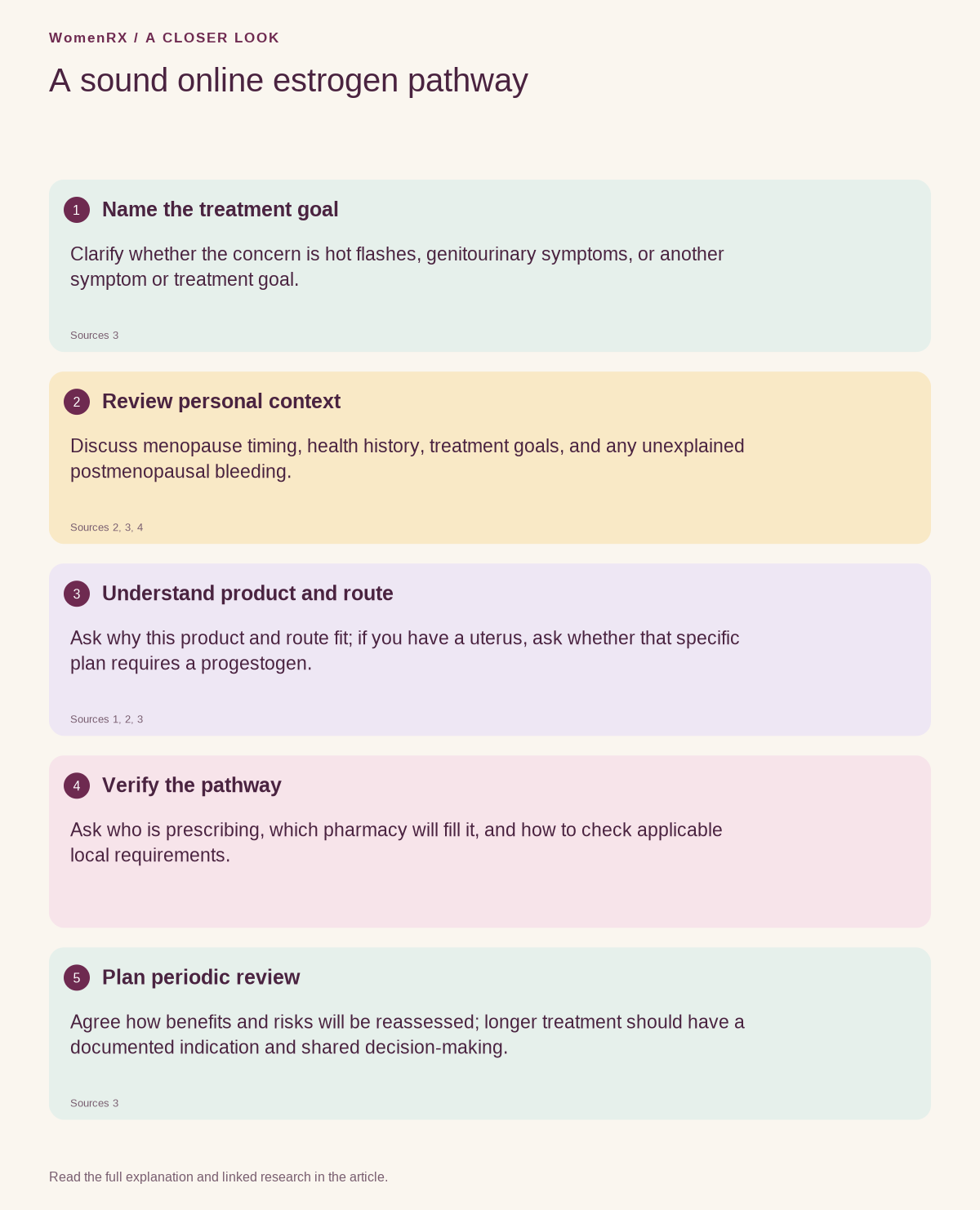
A sound online estrogen pathway
Name the treatment goal: Clarify whether the concern is hot flashes, genitourinary symptoms, or another symptom or treatment goal.3
Review personal context: Discuss menopause timing, health history, treatment goals, and any unexplained postmenopausal bleeding.234
Understand product and route: Ask why this product and route fit; if you have a uterus, ask whether that specific plan requires a progestogen.123
Verify the pathway: Ask who is prescribing, which pharmacy will fill it, and how to check applicable local requirements.
Plan periodic review: Agree how benefits and risks will be reassessed; longer treatment should have a documented indication and shared decision-making.3
Read the figure as text
Use these checks to see whether an online visit connects your symptoms to an individualized treatment choice and a follow-up plan.- Name the treatment goal: Clarify whether the concern is hot flashes, genitourinary symptoms, or another symptom or treatment goal.3
- Review personal context: Discuss menopause timing, health history, treatment goals, and any unexplained postmenopausal bleeding.234
- Understand product and route: Ask why this product and route fit; if you have a uterus, ask whether that specific plan requires a progestogen.123
- Verify the pathway: Ask who is prescribing, which pharmacy will fill it, and how to check applicable local requirements.
- Plan periodic review: Agree how benefits and risks will be reassessed; longer treatment should have a documented indication and shared decision-making.3
More questions, answered
Does an online visit mean I’ll get an estrogen prescription?
No. The visit should assess whether treatment fits your symptoms, health history, and goals. Hormone therapy isn’t the only option for hot flashes; the menopause society also identifies evidence-supported nonhormonal treatments. 34
What if my main symptoms are vaginal?
Say so specifically. For bothersome genitourinary symptoms not relieved by over-the-counter therapies, the menopause position statement recommends considering low-dose vaginal estrogen or other options for people without an indication for systemic therapy. 3
Sources you can check
- CLIMARA PRO (ESTRADIOL AND LEVONORGESTREL) PATCH [BAYER HEALTHCARE PHARMACEUTICALS INC.] | US prescribing information and patient instructionsAccessed 2026-09-25Return to first citation
- CLIMARA (ESTRADIOL) PATCH [BAYER HEALTHCARE PHARMACEUTICALS INC.] | US prescribing information and patient instructionsAccessed 2026-09-25Return to first citation
- The 2022 hormone therapy position statement of The North American Menopause Society.“The 2022 Hormone Therapy Position Statement of The North American Menopause Society” Advisory Panel. · Menopause (New York, N.Y.) · 2022Return to first citation
- The 2023 nonhormone therapy position statement of The North American Menopause Society.Menopause (New York, N.Y.) · 2023Return to first citation