How Is Menopausal Hormone Therapy Assessed and Monitored Online?
A useful remote consultation should explain why a treatment fits your symptoms and health history, what alternatives exist, and how you’ll review its effects.
An online appointment can support a treatment decision, but the format alone doesn’t show whether the assessment covered what matters. Ask what symptom the proposed treatment is meant to address, whether it’s systemic or vaginal, how your medical and medication history affects the choice, and who will follow up. Hormone therapy should be individualized and periodically reevaluated. 3
The decision matters more than the format
Before agreeing to menopausal hormone therapy (MHT), you should be able to explain what symptom the treatment is intended to help, why the suggested type fits that symptom, and what would prompt a change in plan. The benefit-risk balance depends on factors including the therapy’s type, dose, route and duration, whether a progestogen is used, and when treatment begins relative to menopause. 3
A remote visit doesn’t automatically mean the assessment is incomplete, and it doesn’t prove the assessment is complete, either. Use the questions below to understand the decision and identify anything that still needs clarification. They’re a practical checklist, not a test that can certify a service or prescribe a treatment for you.
Before a prescription: understand the treatment choice
1. What symptom are we treating, and what improvement should I look for?
MHT is an effective treatment for bothersome hot flashes and night sweats, as well as some genitourinary symptoms of menopause. Ask the prescriber to connect the proposed treatment to your main concern rather than presenting “hormone balance” as a goal on its own. Hormone therapy should not be used to prevent heart disease, heart attacks, strokes or dementia. 13
2. Is the suggested treatment systemic or local vaginal therapy?
These aren’t interchangeable choices. For bothersome vaginal or other genitourinary symptoms that aren’t relieved by over-the-counter options, low-dose vaginal estrogen may be appropriate for some people who don’t need systemic hormone therapy. Ask why the proposed route fits your symptoms and whether another option would be more suitable. 3
3. How do my age and menopause timing affect the discussion?
The benefit-risk balance is generally more favorable for people younger than 60 or within 10 years of menopause onset who have no contraindications and are treating bothersome symptoms. Starting later may involve greater absolute risks, so ask how your own age and timing factor into the recommendation. 3
4. What parts of my history could change the plan?
Share your relevant health history and ask directly what it means for the proposed treatment. For example, professional guidance identifies estrogen-dependent cancers and cardiovascular disease among reasons someone may not be a good candidate for hormone therapy. Your age, time since menopause and other health conditions may also affect the benefit-risk discussion. 34
5. What does the plan mean for my uterus and progesterone?
If you have a uterus and systemic estrogen is being considered, ask how the treatment plan addresses the uterine lining and whether a progestogen is part of the regimen. Estrogen and progestogen decisions are linked to endometrial considerations; the appropriate plan depends on your circumstances. 26
6. Have my medicines and supplements been reviewed?
Provide a current list, including prescriptions, over-the-counter medicines and supplements. Ask whether any could affect the proposed treatment or require coordination with another prescriber. Reviews of menopause guidance note that polypharmacy and medication interactions aren’t addressed consistently, which makes it reasonable to ask who has checked them in your case. 5
Before you finish the visit: make the plan specific
Ask what benefit you and the prescriber will look for, what unwanted effects you should report, and whom to contact if a concern comes up after the appointment. Ask when the service expects to review how treatment is working and reconsider its benefits and risks. Guidance supports periodic reevaluation, but it doesn’t establish one follow-up interval that fits everyone. 35
Also ask what happens if the proposed treatment isn’t a good fit or doesn’t help your main symptom. Depending on the concern, alternatives may include a different hormone approach or an evidence-supported nonhormone treatment for hot flashes and night sweats. 4
You should leave knowing who is responsible for follow-up and how to reach them. If the service can’t explain why it’s recommending a particular treatment, how your history was considered, or what happens after prescribing, pause and ask for those answers before deciding. These questions help you assess the conversation; they can’t establish that a remote assessment is complete.
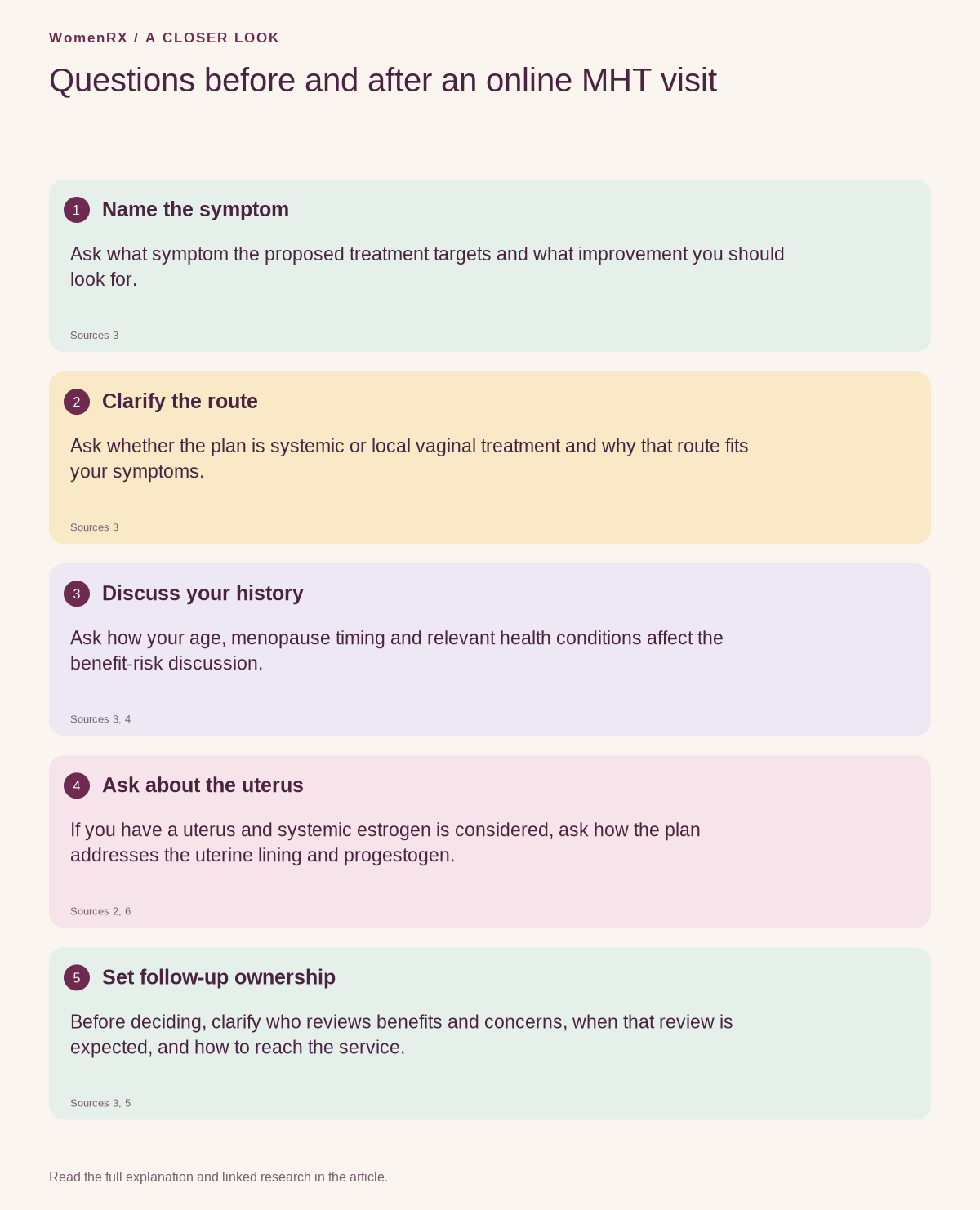
Questions before and after an online MHT visit
Name the symptom: Ask what symptom the proposed treatment targets and what improvement you should look for.3
Clarify the route: Ask whether the plan is systemic or local vaginal treatment and why that route fits your symptoms.3
Discuss your history: Ask how your age, menopause timing and relevant health conditions affect the benefit-risk discussion.34
Ask about the uterus: If you have a uterus and systemic estrogen is considered, ask how the plan addresses the uterine lining and progestogen.26
Set follow-up ownership: Before deciding, clarify who reviews benefits and concerns, when that review is expected, and how to reach the service.35
Read the figure as text
Use these prompts to see whether the discussion covered the treatment decision and who will support you afterward. They are not a validated test of a complete assessment.- Name the symptom: Ask what symptom the proposed treatment targets and what improvement you should look for.3
- Clarify the route: Ask whether the plan is systemic or local vaginal treatment and why that route fits your symptoms.3
- Discuss your history: Ask how your age, menopause timing and relevant health conditions affect the benefit-risk discussion.34
- Ask about the uterus: If you have a uterus and systemic estrogen is considered, ask how the plan addresses the uterine lining and progestogen.26
- Set follow-up ownership: Before deciding, clarify who reviews benefits and concerns, when that review is expected, and how to reach the service.35
Sources you can check
- BIJUVA (ESTRADIOL AND PROGESTERONE) CAPSULE [MAYNE PHARMA] | US prescribing information and patient instructionsAccessed 2026-09-25Return to first citation
- PROMETRIUM (PROGESTERONE) CAPSULE [ACERTIS PHARMACEUTICALS, LLC] | US prescribing information and patient instructionsAccessed 2026-09-25Return to first citation
- The 2022 hormone therapy position statement of The North American Menopause Society.“The 2022 Hormone Therapy Position Statement of The North American Menopause Society” Advisory Panel. · Menopause (New York, N.Y.) · 2022Return to first citation
- The 2023 nonhormone therapy position statement of The North American Menopause Society.Menopause (New York, N.Y.) · 2023Return to first citation
- Menopausal Hormone Therapy in Clinically Vulnerable Women: A Narrative Review of Guidelines and Real-World Evidence.Yanachkova V, Lebanova H, Stoev S. · Medicina (Kaunas, Lithuania) · 2026Return to first citation
- Hormone replacement therapy in gynecologic cancer survivors: bridging the gap between evidence and clinical practice.Gil-Ibáñez B, Luzarraga Aznar A, Barretina-Ginesta MP, Quer N, Ramirez PT. · International journal of gynecological cancer : official journal of the International Gynecological Cancer Society · 2026Return to first citation