Is Online Menopause Hormone Therapy Right for Your Situation?
A remote visit may be a useful place to start, but the right care route depends on your symptoms, health history, and what follow-up you may need.
Online advice can be a reasonable starting point when you want to discuss symptoms and treatment options, provided the clinician can review your health history and arrange follow-up or another type of care if needed. Hormone therapy decisions should be individualized; age, time since menopause, symptoms, and personal health risks all matter. 2 If you’re still having periods, the timing guidance alone doesn’t answer which treatment fits your situation.
Online is a way to get advice, not a treatment decision
A video or phone visit can be a practical first step if you want to talk through hot flashes, sleep disruption, vaginal or urinary symptoms, or whether hormone therapy might fit your goals. But the visit format doesn’t determine whether treatment is appropriate. What matters is whether the clinician can understand your situation, review relevant health history, explain options, and make a plan for follow-up or in-person care if that becomes useful.
The menopause guidance describes individualized decisions and periodic reassessment; it does not establish that a remote visit is equivalent to an in-person visit in every situation. 2 Think of online care as one possible route into care, not a shortcut around an assessment.
Before booking, it’s reasonable to ask how the clinician gathers your medical history, who follows up after the visit, and how they handle situations that call for an exam, testing, or referral. Those are practical questions about how the service works, not a test of whether you qualify for hormone therapy.
Put your symptoms and timing in context
Hormone therapy is the most effective treatment for bothersome hot flashes and other vasomotor symptoms, and it can also help with genitourinary symptoms of menopause. Its balance of benefits and risks varies with the type, dose, route, duration, timing, and whether a progestogen is used. 2
The menopause position statement compares benefits and risks by age and time since menopause onset, but that comparison does not resolve treatment selection for someone still having periods. Guidance describes a more favorable benefit-risk balance for women younger than 60 or within 10 years of menopause onset who have no contraindications and are seeking treatment for bothersome vasomotor symptoms or prevention of bone loss. Starting later, after age 60 or more than 10 years from menopause onset, has a less favorable balance on average. These are factors for discussion, not an online eligibility rule. 2
If you’re still having periods, it may help to describe what has changed in your cycle and when symptoms occur. If your periods have stopped, note roughly when that happened. In either case, be specific about which symptoms are affecting you and what you hope treatment will improve. That gives a clinician more to work with than the menopause label alone.
A health-history review is part of the decision
Your personal history can change which options make sense. For example, the 2023 North American Menopause Society position statement identifies estrogen-dependent cancers and cardiovascular disease among circumstances that can make someone a poor candidate for hormone therapy. 3 The U.S. prescribing information for the specific combined product Bijuva also warns against its use for people with certain cancer histories or current or past blood clots. That product information is not a complete guide to every hormone therapy, but it illustrates why a clinician needs to review your history rather than rely on a standard online questionnaire alone. 1
Tell the clinician about relevant diagnoses, past treatments, and medicines, and ask which details affect the options being discussed. A history that needs careful review doesn’t automatically mean that every form of menopause treatment is unsuitable; it means the decision needs to account for your circumstances.
If the clinician can’t obtain enough information remotely, or the discussion raises a need for an exam, testing, or specialist input, ask how that next step will be arranged. In-person care may be a better next stop in that situation. That’s a practical choice about what kind of assessment you need, not a conclusion that you are or aren’t a candidate.
Match the conversation to the symptom
If hot flashes or night sweats are the main concern, you can ask about hormone and nonhormone options. Hormone therapy is the most effective treatment for vasomotor symptoms, while evidence-based nonhormone options include certain prescription medicines and cognitive behavioral therapy or clinical hypnosis. 2 3
If vaginal or urinary symptoms are the main issue and you don’t have a reason to use systemic hormone therapy, the menopause position statement recommends discussing low-dose vaginal estrogen or other therapies when symptoms haven’t improved with over-the-counter options. 2 A conversation about one symptom doesn’t commit you to a particular treatment or route.
A simple way to choose your next step
- You want to understand options: Start with a remote or in-person clinician who can discuss your symptoms and goals.
- Your history is complicated or unclear: Choose a service that can review the details and arrange another assessment or referral if needed.
- You need an exam, testing, or follow-up that can’t be handled remotely: Ask for an in-person route or how the online clinician will arrange one.
- You want to compare treatments: Ask which options address your specific symptoms, how your history affects the tradeoffs, and when the decision will be reviewed again. Individualized decisions and periodic reassessment are part of menopause guidance. 2
You don’t have to decide on hormone therapy before seeking advice. A useful first visit can simply clarify what you’re treating, what personal factors matter, and whether remote care is enough for the next step.
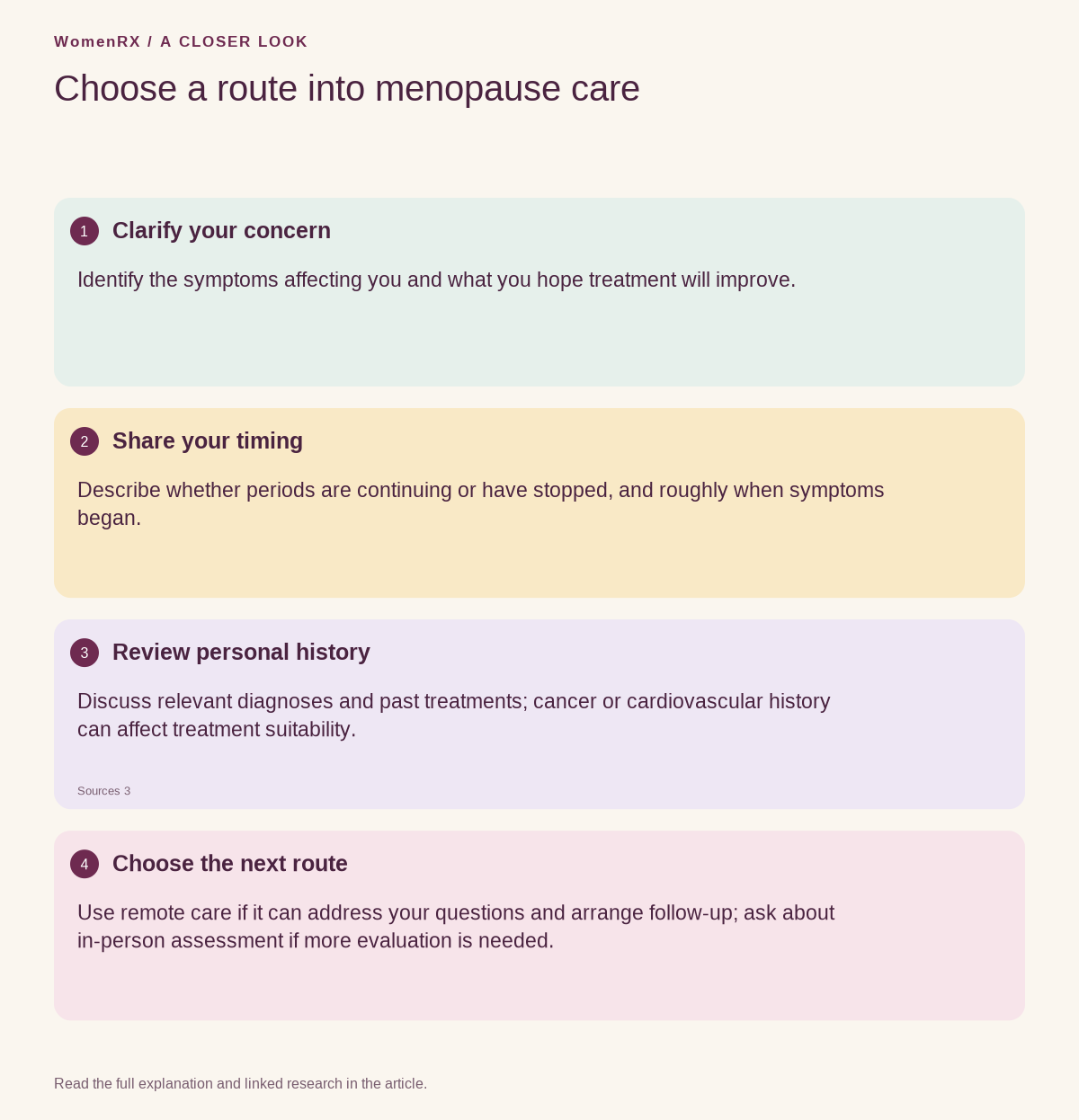
Choose a route into menopause care
Clarify your concern: Identify the symptoms affecting you and what you hope treatment will improve.
Share your timing: Describe whether periods are continuing or have stopped, and roughly when symptoms began.
Review personal history: Discuss relevant diagnoses and past treatments; cancer or cardiovascular history can affect treatment suitability.3
Choose the next route: Use remote care if it can address your questions and arrange follow-up; ask about in-person assessment if more evaluation is needed.
Read the figure as text
Use this flow to organize what you need from the next conversation. It does not determine whether hormone therapy is appropriate.- Clarify your concern: Identify the symptoms affecting you and what you hope treatment will improve.
- Share your timing: Describe whether periods are continuing or have stopped, and roughly when symptoms began.
- Review personal history: Discuss relevant diagnoses and past treatments; cancer or cardiovascular history can affect treatment suitability.3
- Choose the next route: Use remote care if it can address your questions and arrange follow-up; ask about in-person assessment if more evaluation is needed.
More questions, answered
What if I’m still having periods?
Describe the symptoms you want help with and any changes in your periods. The menopause position statement’s comparison by age and time since menopause onset does not, by itself, answer which treatment fits someone who is still having periods. 2
What if vaginal or urinary symptoms are my main concern?
If you don’t have an indication for systemic hormone therapy and over-the-counter options haven’t helped, the menopause position statement recommends discussing low-dose vaginal estrogen or other therapies. 2
Sources you can check
- BIJUVA (ESTRADIOL AND PROGESTERONE) CAPSULE [MAYNE PHARMA] | US prescribing information and patient instructionsAccessed 2026-09-25Return to first citation
- The 2022 hormone therapy position statement of The North American Menopause Society.“The 2022 Hormone Therapy Position Statement of The North American Menopause Society” Advisory Panel. · Menopause (New York, N.Y.) · 2022Return to first citation
- The 2023 nonhormone therapy position statement of The North American Menopause Society.Menopause (New York, N.Y.) · 2023Return to first citation