Menopause and Insomnia: Finding the Right Treatment
Sleep trouble around menopause can have several overlapping causes, so care works best when it targets the pattern you’re experiencing.
Insomnia means regularly struggling to fall asleep or stay asleep, often with tiredness or other effects during the day. Around perimenopause and after menopause, hot flashes may be one contributor, but mood symptoms, pain, urinary symptoms, medicines, and other sleep disorders can matter too. Assessment usually starts with your sleep history and a physical exam; treatment depends on which factors are involved. 1 7
Start with the sleep pattern, not the menopause label
A rough night now and then isn’t the same as ongoing insomnia. Insomnia involves regularly having trouble falling asleep, staying asleep, or both, with sleep that may not feel restorative. It can also affect daytime energy, mood, focus, or alertness. 1 2
In perimenopause, changing symptoms may coincide with sleep problems, but not every awakening has the same cause. After menopause, sleep disruption can continue, and contributors may still include hot flashes, mood symptoms, pain, urinary symptoms, or sleep-disordered breathing. Research describes sleep problems in both stages, while the underlying mechanisms remain incompletely understood. 6 7
A useful first distinction is whether awakenings seem closely tied to night sweats or hot flashes, or whether difficulty sleeping continues even when those symptoms aren’t happening. That pattern doesn’t diagnose the cause, but it can help focus the conversation. Menopausal symptoms and sleep histories vary from woman to woman. 7
What an assessment can look at
A clinician can ask about when the problem began, whether you struggle to fall asleep or wake during the night, how often it happens, and what it changes during the day. A sleep history and physical exam can help identify medical conditions or other factors that may be contributing. Medicines and substances such as caffeine, tobacco, and alcohol can also affect sleep. A sleep study may be recommended when another sleep disorder is a concern. 1
The broader picture matters. Hot flashes can interrupt sleep; anxiety or depression can contribute to insomnia, and insomnia can also affect mood. Pain and urinary symptoms may cause awakenings, while sleep-disordered breathing is another possible contributor. These causes can overlap, so identifying one doesn’t rule out another. 1 7
If you’re very sleepy during the day, mention that too. Insomnia can impair attention and alertness, including while driving. 1
Match care to what is disrupting sleep
When insomnia persists, ask about CBT-I. Cognitive behavioral therapy for insomnia (CBT-I) addresses thoughts and behaviors that keep sleep problems going. A 2026 systematic review and meta-analysis of trials in peri- and postmenopausal women found that non-drug treatments improved sleep-quality and insomnia-severity measures overall; the authors described CBT-I among the more robust first-line options. The review did not find improvement in total sleep time, a reminder that feeling less distressed by insomnia and sleeping longer are not always the same outcome. 2 5
One small randomized pilot trial tested a CBT program adapted for menopausal insomnia in 43 perimenopausal or postmenopausal women with insomnia and nighttime hot flashes. Compared with menopause education, the program improved insomnia severity and hot-flash interference after treatment, with some improvements still seen at follow-up. It’s promising evidence for women with both problems, not proof that the same program suits everyone. 6
If hot flashes are a major disruptor, discuss treating them as well. Menopausal hormone therapy is the most effective treatment for vasomotor symptoms, but that does not make it the right choice for every woman or establish it as a universal insomnia treatment. Its benefits and risks depend on individual factors, and decisions should be individualized and revisited over time. 3 Nonhormonal medicines are also recommended options for vasomotor symptoms in the North American Menopause Society’s evidence review; these target hot flashes, rather than insomnia in general. 4
If another cause is suspected, address that target. For example, persistent low mood, pain, urinary symptoms, a medicine effect, or possible sleep-disordered breathing may call for a different approach than insomnia alone. Treating an underlying contributor, when possible, is part of insomnia care. 1 7
Prescription sleep medicines may be considered in some situations, but menopause-specific trial evidence needs longer and better-designed studies to establish long-term benefits and safety. A recent review found improvements on some sleep-quality measures with drug treatments, but not total sleep time. That makes it reasonable to discuss expected benefits, downsides, and other contributors rather than assuming a sleep medicine will address the whole problem. 5
A practical next step
If sleep trouble is persistent, affects your days, or hasn’t improved with changes to your sleep habits, bring the pattern to a clinician. You might describe whether you have trouble falling asleep, staying asleep, or both; whether hot flashes wake you; and whether mood, pain, urinary symptoms, or daytime sleepiness are part of the picture. The goal is not to prove that menopause is the cause. It’s to find the factors worth treating and choose care that fits them. 1 2 7
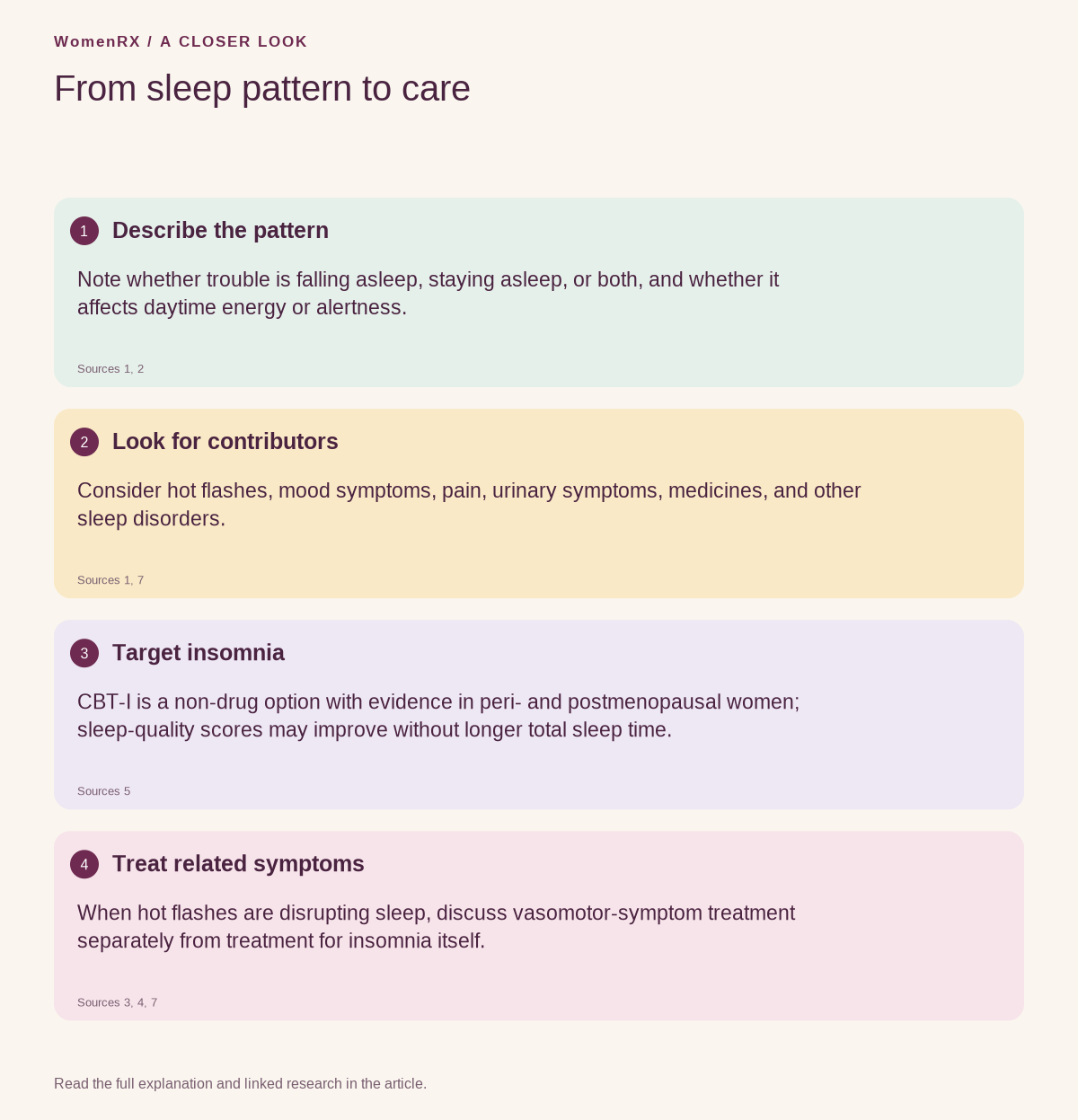
From sleep pattern to care
Describe the pattern: Note whether trouble is falling asleep, staying asleep, or both, and whether it affects daytime energy or alertness.12
Look for contributors: Consider hot flashes, mood symptoms, pain, urinary symptoms, medicines, and other sleep disorders.17
Target insomnia: CBT-I is a non-drug option with evidence in peri- and postmenopausal women; sleep-quality scores may improve without longer total sleep time.5
Treat related symptoms: When hot flashes are disrupting sleep, discuss vasomotor-symptom treatment separately from treatment for insomnia itself.347
Read the figure as text
Use the pattern of sleep trouble to identify what a clinician may assess and which treatment discussion could fit.- Describe the pattern: Note whether trouble is falling asleep, staying asleep, or both, and whether it affects daytime energy or alertness.12
- Look for contributors: Consider hot flashes, mood symptoms, pain, urinary symptoms, medicines, and other sleep disorders.17
- Target insomnia: CBT-I is a non-drug option with evidence in peri- and postmenopausal women; sleep-quality scores may improve without longer total sleep time.5
- Treat related symptoms: When hot flashes are disrupting sleep, discuss vasomotor-symptom treatment separately from treatment for insomnia itself.347
More questions, answered
Does hormone therapy treat insomnia?
Hormone therapy is the most effective treatment for menopausal hot flashes, which may disrupt sleep. Its benefits for sleep itself are less consistent, so it’s better understood as an option to discuss when vasomotor symptoms are part of the problem, not a treatment for every kind of insomnia. 3 7
When should I bring sleep problems up with a clinician?
Consider discussing them when the trouble is ongoing, affects your daytime functioning, or hasn’t improved with changes to your sleep habits. A clinician can review your sleep history, medicines, and possible medical or sleep-related contributors. 1 2
Sources you can check
- Insomnia | MedlinePlusAccessed 2026-09-25Return to first citation
- Insomnia - NHSAccessed 2026-09-25Return to first citation
- The 2022 hormone therapy position statement of The North American Menopause Society.“The 2022 Hormone Therapy Position Statement of The North American Menopause Society” Advisory Panel. · Menopause (New York, N.Y.) · 2022Return to first citation
- The 2023 nonhormone therapy position statement of The North American Menopause Society.Menopause (New York, N.Y.) · 2023Return to first citation
- Pharmacological and non-pharmacological treatments for chronic insomnia in perimenopausal and postmenopausal women: a systematic review and meta-analysis.Bruyneel M, Rozenberg S, Sanida C, Demaeyer N, Castermans E, Bruyneel AV. · Sleep medicine · 2026Return to first citation
- Cognitive behavioral therapy for menopausal insomnia in perimenopausal and postmenopausal women with insomnia and nocturnal hot flashes: a randomized-controlled pilot trial.Arentson-Lantz EJ, Muench A, Kokonda M, Meers JM, Swartz M, Manber R, Thurston RC, Nowakowski S. · Menopause (New York, N.Y.) · 2026Return to first citation
- Sleep Disturbances during Menopause: Mechanisms and Management Approaches.Terauchi M. · Journal of menopausal medicine · 2026Return to first citation