Why Sleep Can Change During Perimenopause
Night sweats may be part of the picture, but stress, schedules, medicines, and sleep disorders can matter too.
Sleep can become harder during perimenopause, especially if hot flashes or night sweats wake you. But a new sleep problem doesn’t show that hormones are the only cause. Stress or mood changes, shift work, some medicines and substances, and other sleep disorders may also contribute. Notice what happens on difficult nights and how you feel during the day, then share that pattern at an appointment. 1 2 4 5
Start with what is happening at night
Perimenopause can coincide with sleep disruption, and hot flashes or night sweats may be one reason you wake. Hormone changes have also been associated with sleep disturbance. Still, sleep problems can have more than one contributor, and disruption is reported during both perimenopause and postmenopause. A restless night by itself can’t identify the cause or tell you which reproductive stage you’re in. 4 5
Try describing the sleep problem more specifically: Is it hard to fall asleep, do you wake during the night, or do you wake too early? Note whether you feel rested in the morning and whether tiredness affects your energy, mood, or concentration. Those details give a clearer picture than “I’m sleeping badly.” 1 2
Match the clues to useful questions
You wake hot or sweaty. Note whether a hot flash or night sweat happens around the awakening. Vasomotor symptoms can contribute to nighttime waking, but not every awakening during perimenopause is caused by them. If heat or sweating seems connected to the sleep problem, describe both together. 4 5
Your mind feels busy, or your mood has changed. Stress, anxiety, and depression can contribute to insomnia. Poor sleep can also leave you anxious, irritable, or low on energy, so these experiences may overlap. It can help to notice whether worry or mood changes seem to come before the sleep trouble, follow it, or occur alongside it. 1 2
Your schedule or habits have shifted. Shift work, travel, caffeine, tobacco, and alcohol can all be relevant to insomnia. If one may fit, note its timing and whether it lines up with difficult nights. That can help you explain whether sleep trouble appears linked to a schedule or substance pattern, or happens regardless. 1 2
There’s no clear clue, or the problem persists. Insomnia can be related to medicines, medical conditions, or another sleep disorder. A review of sleep during the menopausal transition also discusses conditions such as obstructive sleep apnea and restless legs syndrome. A sleep pattern alone can’t diagnose one of these conditions, but persistent trouble is a reason to raise the possibility of another cause. 1 4
Keep a short record, not a perfect one
For a few representative nights, note when you went to bed, whether the difficulty was falling asleep or waking, and what you noticed when you woke. Add hot flashes or night sweats, stress or mood changes, work or travel shifts, and caffeine, tobacco, or alcohol if they seem relevant. Include how you felt the next day. If your periods are changing, you can note cycle timing too. A sleep history is part of insomnia assessment, and a cycle diary can help show when symptoms occur. 1 3
You don’t need to prove a cause with your notes. A useful question might be: “Could night sweats be waking me, or should we consider another reason?” You can also ask what options fit if the problem is ongoing insomnia.
When sleep trouble deserves attention
Bring recurring sleep trouble up with a clinician, especially if it leaves you tired, irritable, or unable to concentrate during the day. Don’t drive when you feel drowsy. If ongoing insomnia is part of the picture, ask whether cognitive behavioral therapy for insomnia, or CBT-I, might be appropriate. A review protocol describes CBT-I as a recommended treatment for insomnia in adults and cites earlier studies reporting improvements in insomnia symptoms among women transitioning through menopause. The protocol itself is not the completed review’s results. 1 2 5
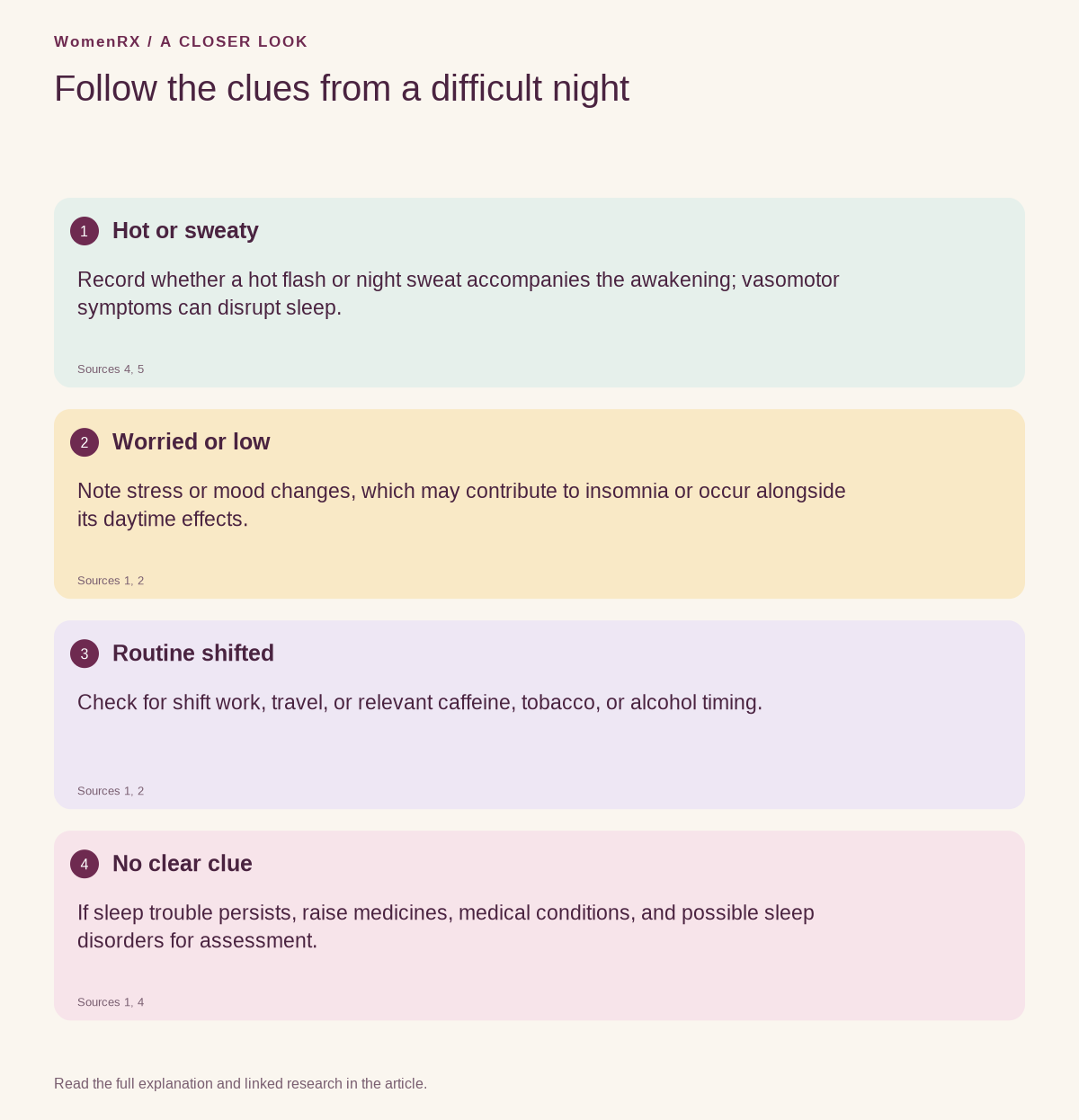
Follow the clues from a difficult night
Hot or sweaty: Record whether a hot flash or night sweat accompanies the awakening; vasomotor symptoms can disrupt sleep.45
Worried or low: Note stress or mood changes, which may contribute to insomnia or occur alongside its daytime effects.12
Routine shifted: Check for shift work, travel, or relevant caffeine, tobacco, or alcohol timing.12
No clear clue: If sleep trouble persists, raise medicines, medical conditions, and possible sleep disorders for assessment.14
Read the figure as text
Notice what accompanies the awakening, then use the pattern to guide what you record and raise. None of these clues confirms a diagnosis.- Hot or sweaty: Record whether a hot flash or night sweat accompanies the awakening; vasomotor symptoms can disrupt sleep.45
- Worried or low: Note stress or mood changes, which may contribute to insomnia or occur alongside its daytime effects.12
- Routine shifted: Check for shift work, travel, or relevant caffeine, tobacco, or alcohol timing.12
- No clear clue: If sleep trouble persists, raise medicines, medical conditions, and possible sleep disorders for assessment.14
More questions, answered
Does waking at night mean I’m in perimenopause?
No. Sleep disruption can occur during perimenopause, but waking at night alone doesn’t establish its cause or identify a reproductive stage. Stress, schedule changes, substances, medicines, medical conditions, and sleep disorders may also contribute. 1 4
Should I track my menstrual cycle as well as sleep?
If your periods are changing, noting cycle timing alongside sleep may help you describe when symptoms occur. A cycle diary records timing; it doesn’t prove that a particular cycle phase caused a sleep problem. 3
Sources you can check
- Insomnia | MedlinePlusAccessed 2026-09-25Return to first citation
- Insomnia - NHSAccessed 2026-09-25Return to first citation
- Period problems - NHSAccessed 2026-09-25Return to first citation
- Sleep Disruption in the Menopausal Transition and Postmenopause: A Narrative Review.Lyu AC, Kravitz HM. · Obstetrics and gynecology · 2026Return to first citation
- Cognitive behavioural therapeutics for insomnia symptoms in the perimenopause through to the early postmenopausal period.Breitinger-Blatt D, Lee J, Ribeiro Pereira SI, Smith C, Gavriloff D, Sekaran S. · The Cochrane database of systematic reviews · 2026Return to first citation