Sleep Supplements in Perimenopause: What the Evidence Shows
A few supplements have been studied, but evidence for improving sleep specifically in perimenopause is limited and uneven.
There isn’t strong evidence that any supplement reliably treats perimenopause-related sleep problems. One small trial in perimenopausal women tested a supplement combined with B vitamins and reported better sleep, but it can’t show which ingredient helped. Ashwagandha studies mostly involved adults not selected for perimenopause, while omega-3 trials in menopausal women didn’t improve sleep. Check a product’s ingredients and safety with a pharmacist before trying it. 1 4 6
Sleep can get harder during perimenopause for different reasons, including night sweats or other symptoms that interrupt sleep. That distinction matters: a supplement that changes menopause symptoms hasn’t necessarily been shown to treat insomnia itself.
What the studies say about specific supplements
| Supplement studied | What was measured or reported | What that means for perimenopause sleep |
|---|---|---|
| Ashwagandha extracts | A small number of short trials in adults, including men and women, reported improvements in measures such as sleep quality and sleep time. Some studies included people with insomnia, but the participants were not specifically perimenopausal women. Trials used different extracts, so results don’t identify one proven product. | Possible signal, but indirect evidence for your situation. It doesn’t establish that ashwagandha treats perimenopause-related sleep problems. 1 |
| Amberen combined with a B-vitamin complex | A randomized, placebo-controlled trial enrolled 106 perimenopausal women with mild-to-moderate symptoms. The study abstract reported improved sleep along with changes in other symptom and well-being measures. | This is directly relevant to perimenopause, but the two products were used together. The report doesn’t establish which ingredient contributed or how much sleep improved on its own. 4 |
| Omega-3 supplements | A review of three randomized trials in 483 menopausal women found no difference from placebo in insomnia severity or sleep quality. The review reported a possible effect on night sweats, but not on sleep outcomes. | A change in night sweats shouldn’t be taken as proof of better sleep. These trials didn’t show a sleep benefit. 6 |
| Other herbal supplements | A systematic review found very different herbs, study methods, and outcome measures across trials. It couldn’t draw a clear overall conclusion about effectiveness. | Evidence for one herb can’t be assumed to apply to another, and broad “menopause support” claims don’t establish a sleep benefit. 5 |
These aren’t head-to-head comparisons, so they don’t tell us which supplement works best. The studies also don’t establish that results from general adult samples apply to perimenopause. For example, the ashwagandha sleep research included men and women with self-reported sleep problems or insomnia, rather than a perimenopause-specific group. 1
A separate distinction: the North American Menopause Society’s 2023 statement does not recommend supplements or herbal remedies for treating menopause-related hot flashes and night sweats. That statement addresses vasomotor symptoms, not every supplement’s effect on insomnia, so it shouldn’t be read as a direct ruling on all sleep outcomes. 3
Before you try one
Start by identifying what you hope the supplement will change: trouble falling asleep, waking during the night, or waking because of night sweats. A study showing improvement in a general menopause symptom score is less informative than one measuring sleep directly.
Then check the full ingredient list, not just the product name. The studies above do not establish the safety of every formulation, or provide a dependable list of interactions for an individual person. Ask a pharmacist to review the exact product alongside your medicines and health conditions. Mention if pregnancy is possible; don’t assume that a supplement is appropriate in that situation just because it’s sold without a prescription.
For ashwagandha in particular, studies used different extracts and standardization methods, making it difficult to identify a specific preparation supported by the research. A trial result for one extract should not be treated as proof that another product will have the same effect. 1
If sleep problems come with disruptive night sweats, it may be useful to discuss the symptoms themselves rather than relying on a supplement aimed at general sleep. Menopause guidance treats options for vasomotor symptoms as a separate question, and treatment choices depend on a person’s circumstances and preferences. 2 3
A practical bottom line
The most directly relevant supplement study tested a combination and reported sleep improvement, but it doesn’t show that either component works alone. Ashwagandha has some sleep research in adults, not proof specific to perimenopause. Omega-3 trials did not show better sleep. If you’re considering a product, take its complete ingredient list to a pharmacist and ask about your medicines, health conditions, and possible pregnancy.
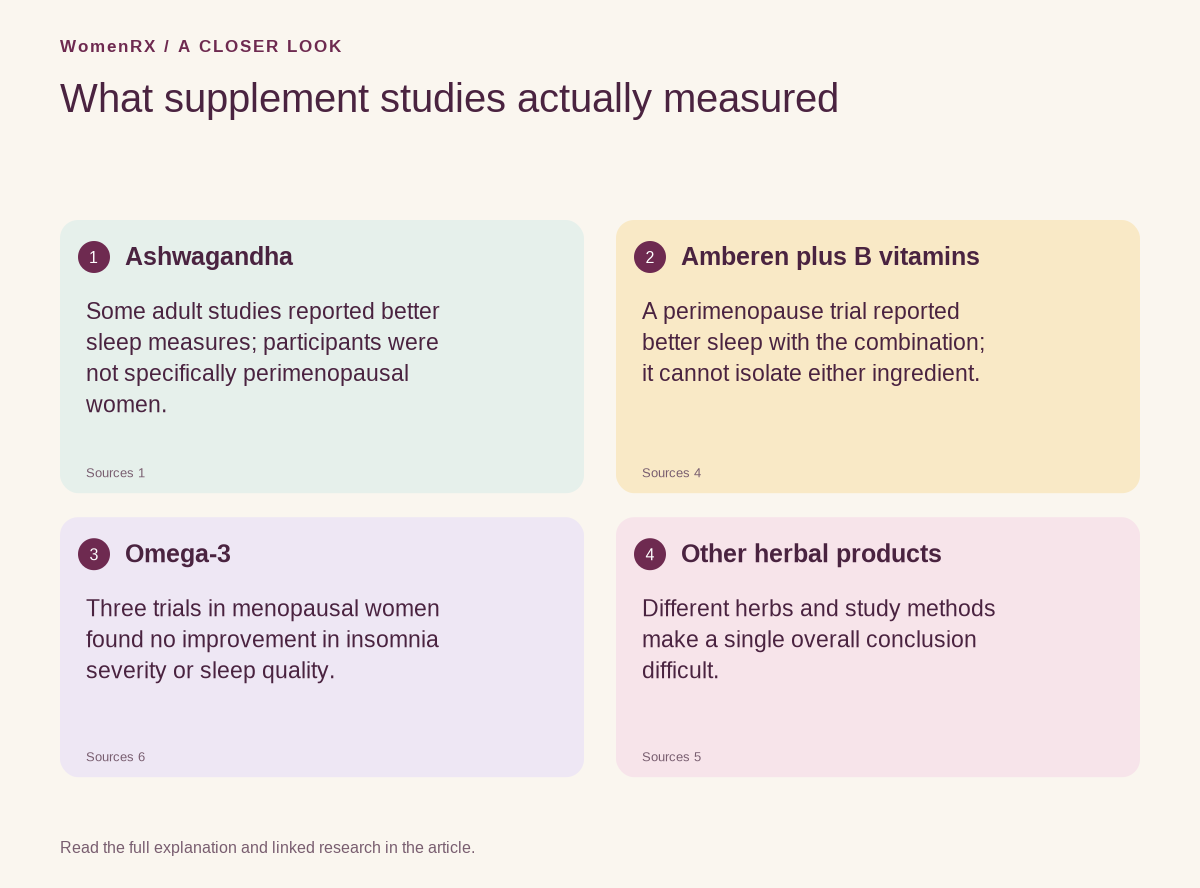
What supplement studies actually measured
Ashwagandha: Some adult studies reported better sleep measures; participants were not specifically perimenopausal women.1
Amberen plus B vitamins: A perimenopause trial reported better sleep with the combination; it cannot isolate either ingredient.4
Omega-3: Three trials in menopausal women found no improvement in insomnia severity or sleep quality.6
Other herbal products: Different herbs and study methods make a single overall conclusion difficult.5
Read the figure as text
These findings differ in population and outcome, so they are not a ranking of products.- Ashwagandha: Some adult studies reported better sleep measures; participants were not specifically perimenopausal women.1
- Amberen plus B vitamins: A perimenopause trial reported better sleep with the combination; it cannot isolate either ingredient.4
- Omega-3: Three trials in menopausal women found no improvement in insomnia severity or sleep quality.6
- Other herbal products: Different herbs and study methods make a single overall conclusion difficult.5
More questions, answered
Does a supplement that helps hot flashes also help sleep?
Not necessarily. A menopause symptom score or change in night sweats is not the same as a measured improvement in sleep. In the omega-3 review, sleep quality and insomnia severity did not improve even though the review reported a possible change in night sweats. 6
What should I ask a pharmacist about a sleep supplement?
Bring the exact product or a clear photo of its full ingredient list. Ask whether its ingredients are suitable alongside your medicines and health conditions, and mention if pregnancy is possible. The studies summarized here don’t provide a complete interaction or pregnancy-safety guide for every product.
Sources you can check
- Ashwagandha: Is it helpful for stress, anxiety, or sleep? - Health Professional Fact SheetAccessed 2026-09-25Return to first citation
- The 2022 hormone therapy position statement of The North American Menopause Society.“The 2022 Hormone Therapy Position Statement of The North American Menopause Society” Advisory Panel. · Menopause (New York, N.Y.) · 2022Return to first citation
- The 2023 nonhormone therapy position statement of The North American Menopause Society.Menopause (New York, N.Y.) · 2023Return to first citation
- Clinical Evaluation of Effectiveness and Safety of Combined Use of Dietary Supplements Amberen® and Smart B® in Women with Climacteric Syndrome in Perimenopause.Kachko VA, Shulman LP, Kuznetsova IV, Uspenskaya YB, Burchakov DI. · Advances in therapy · 2024Return to first citation
- The Effectiveness of Non-Soy Oral Herbal Supplements for Menopausal Symptoms: A Systematic Review.Jing G, Keane CM, Reynolds CM. · Nutrients · 2026Return to first citation
- Effect of omega-3 supplements on vasomotor symptoms in menopausal women: A systematic review and meta-analysis.Mohammady M, Janani L, Jahanfar S, Mousavi MS. · European journal of obstetrics, gynecology, and reproductive biology · 2018Return to first citation