Perimenopause Sleep and Supplements: Start With What Wakes You
A supplement studied for general sleep may not help night sweats, and a menopause trial may not tell you which ingredient made a difference.
Before choosing a supplement, notice what’s disrupting your sleep: waking hot or damp, feeling anxious or low, or lying awake without an obvious trigger. The evidence differs by pattern. One trial tested a supplement combination in perimenopause, but studies of ashwagandha and omega-3s don’t establish a reliable sleep benefit specifically for this stage. Check the exact product and possible medication interactions before trying one. 124
First, notice what is waking you
Waking hot or damp points toward night sweats as a possible reason for interrupted sleep. Night sweats around menopause can occur alongside sleep and mood disturbances, but not every restless night has the same cause. 6 If you’re not waking sweaty, consider whether anxiety, low mood, or a health change might be part of the picture rather than assuming menopause explains it all.
In a survey of 3,000 Korean women aged 45 to 64, poor sleep was associated with depression, chronic illness, and at-risk drinking, among other factors. The survey can’t tell you what caused any one person’s sleep problem. It does show why focusing only on hot flashes or supplements could miss something relevant. 5
What the supplement studies actually tested
A combination during perimenopause: A randomized, placebo-controlled trial enrolled 106 perimenopausal women up to age 50 with mild-to-moderate menopausal symptoms. It tested Amberen together with a vitamin B complex and reported improvement in sleep and other symptoms. Because the products were given together, the trial can’t tell you what either one would do alone. The size of a sleep benefit compared with placebo is also unclear, so this isn’t a basis for expecting a particular improvement from that combination, let alone from supplements generally. 2
Ashwagandha for general sleep: The NIH Office of Dietary Supplements summarizes a small number of short studies in adults suggesting that some ashwagandha extracts may improve sleep. Those findings aren’t specific to perimenopause, and the studies used different preparations. A bottle with the same plant name isn’t necessarily the extract that was studied. Long-term safety is unknown, and ashwagandha may interact with sedatives, medicines for diabetes or high blood pressure, and immunosuppressants. 1
Omega-3s for night sweats versus sleep: A review of three randomized trials involving 483 menopausal women found no improvement in insomnia severity or sleep quality compared with placebo. It did report less frequent and less severe night sweats in the omega-3 groups, while concluding that better trials were needed. A possible effect on night sweats is not the same as a demonstrated sleep benefit, and these results don’t establish an effect specifically in perimenopause. 4
Herbs aren’t one treatment: A systematic review identified 19 different herbal interventions for menopausal symptoms. Products, study methods, and outcomes varied enough that the reviewers could not draw a firm overall conclusion. A result for one extract shouldn’t be treated as proof that another product, or herbs as a group, will help you sleep. 3
Choose a next step that fits the problem
If you’re repeatedly waking hot or damp, make the sweats themselves part of the conversation. A recent review describes hormone therapy as the most effective treatment for vasomotor symptoms, including hot flashes and night sweats. Whether it’s an option for you depends on your situation and preferences. The useful distinction is that treating night sweats and trying to induce sleep are different approaches. 7
If sweats aren’t waking you, or if anxiety, low mood, or another health issue stands out, that deserves attention in its own right. When poor sleep keeps affecting your days, an assessment can help look for contributors rather than sending you through a series of supplement switches.
If you do want to try a supplement, check the exact formulation, not just the ingredient name, against the research that interests you. Bring the product label and your medication list to a pharmacist or clinician for an interaction check. That’s particularly worthwhile with ashwagandha because of its possible medication interactions. 1 If pregnancy is possible, raise that before using a supplement: findings from perimenopausal or general-adult studies don’t establish safety during pregnancy.
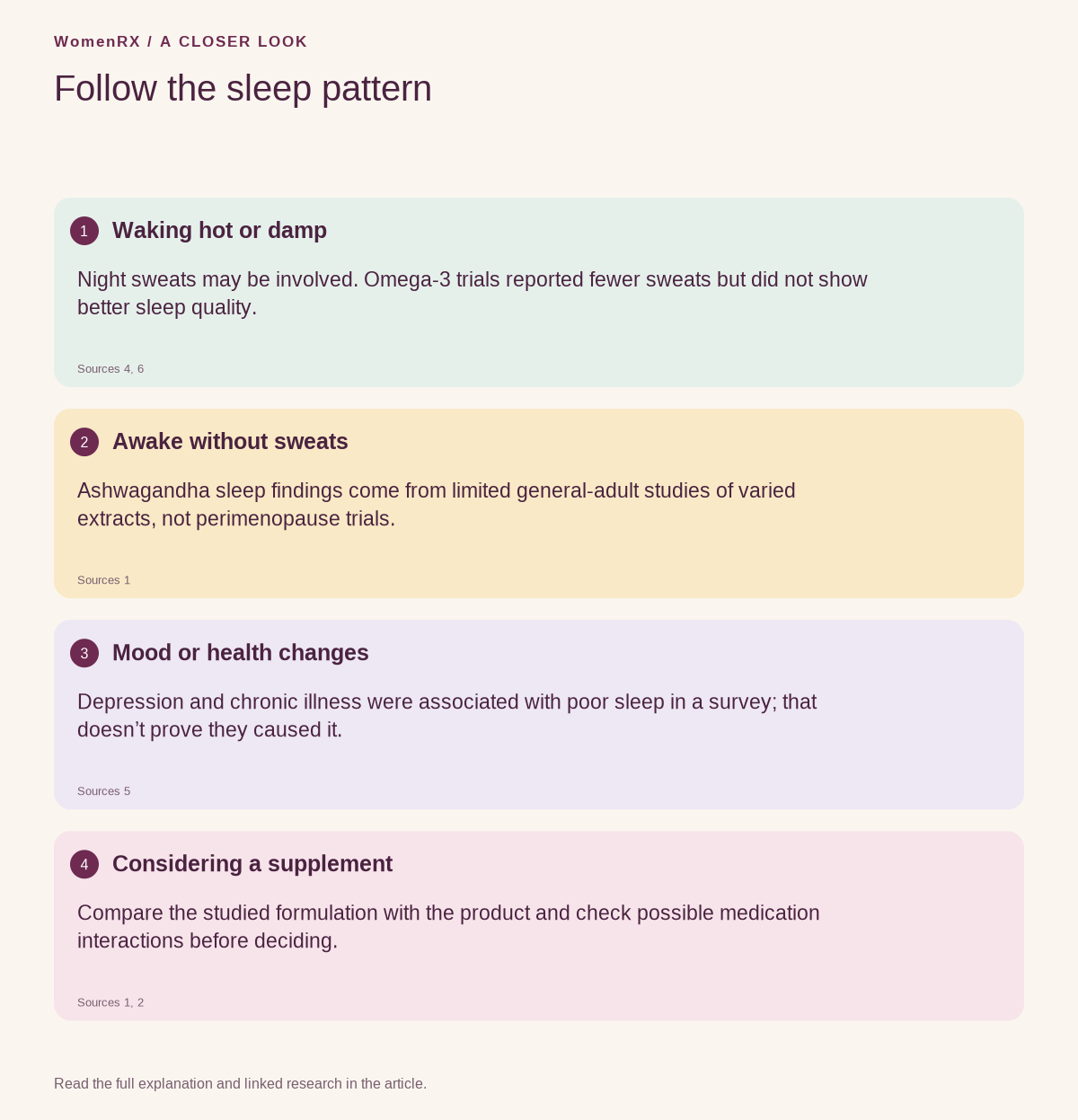
Follow the sleep pattern
Waking hot or damp: Night sweats may be involved. Omega-3 trials reported fewer sweats but did not show better sleep quality.46
Awake without sweats: Ashwagandha sleep findings come from limited general-adult studies of varied extracts, not perimenopause trials.1
Mood or health changes: Depression and chronic illness were associated with poor sleep in a survey; that doesn’t prove they caused it.5
Considering a supplement: Compare the studied formulation with the product and check possible medication interactions before deciding.12
Read the figure as text
Start with what disrupts sleep, then consider which evidence and care options fit that pattern.- Waking hot or damp: Night sweats may be involved. Omega-3 trials reported fewer sweats but did not show better sleep quality.46
- Awake without sweats: Ashwagandha sleep findings come from limited general-adult studies of varied extracts, not perimenopause trials.1
- Mood or health changes: Depression and chronic illness were associated with poor sleep in a survey; that doesn’t prove they caused it.5
- Considering a supplement: Compare the studied formulation with the product and check possible medication interactions before deciding.12
More questions, answered
Does a study in menopausal women apply to perimenopause?
Not automatically. The omega-3 review did not establish a sleep benefit specifically in perimenopause. The trial of Amberen with a vitamin B complex did enroll perimenopausal women, but it cannot show what either product would do alone. 24
Sources you can check
- Ashwagandha: Is it helpful for stress, anxiety, or sleep? - Health Professional Fact SheetAccessed 2026-09-25Return to first citation
- Clinical Evaluation of Effectiveness and Safety of Combined Use of Dietary Supplements Amberen® and Smart B® in Women with Climacteric Syndrome in Perimenopause.Kachko VA, Shulman LP, Kuznetsova IV, Uspenskaya YB, Burchakov DI. · Advances in therapy · 2024Return to first citation
- The Effectiveness of Non-Soy Oral Herbal Supplements for Menopausal Symptoms: A Systematic Review.Jing G, Keane CM, Reynolds CM. · Nutrients · 2026Return to first citation
- Effect of omega-3 supplements on vasomotor symptoms in menopausal women: A systematic review and meta-analysis.Mohammady M, Janani L, Jahanfar S, Mousavi MS. · European journal of obstetrics, gynecology, and reproductive biology · 2018Return to first citation
- Sleep Quality and Associated Factors in Premenopausal, Perimenopausal, and Postmenopausal Women in Korea: Findings from the K-Stori 2016.Hwang JH, Lee K, Choi E, Cho HN, Park B, Rhee Y, Choi KS. · Nature and science of sleep · 2021Return to first citation
- Psychosocial and socioeconomic burden of vasomotor symptoms in menopause: a comprehensive review.Utian WH. · Health and quality of life outcomes · 2005Return to first citation
- Integrative approaches to perimenopause.Kennard A, Saunders KT. · The American journal of medicine · 2026Return to first citation