Which Sleep Supplements Have Evidence Behind Them?
Ashwagandha has limited evidence for sleep, magnesium results are inconsistent, and melatonin findings depend heavily on who was studied.
If you have trouble falling or staying asleep, ashwagandha has shown small benefits in short-term adult trials, while magnesium hasn’t shown consistent enough results to be a routine insomnia treatment. Melatonin findings in people receiving hemodialysis don’t establish a benefit for ordinary insomnia. For ongoing insomnia, CBT-I is a behavioral treatment evaluated in randomized trials; the supplement findings here are limited or tied to specific populations.1759
A supplement label may promise “better sleep,” but that can mean several different things: falling asleep sooner, waking less often, sleeping longer, or feeling more rested the next day. The useful question is whether an ingredient improved your particular sleep problem in people reasonably like you.
First, name the problem you want to change
If you’re lying awake at the start of the night, look for research on sleep onset latency, the time it takes to fall asleep. If you wake repeatedly, a result about falling asleep faster may not help much. And if you have enough time in bed but feel unrefreshed, a study based only on a sleep-quality questionnaire won’t necessarily tell you why. Insomnia can involve difficulty falling asleep, staying asleep, or both, and it can affect energy, concentration, and mood during the day.3
The pattern may also point beyond the supplement aisle. Stress, shift work, medicines, caffeine, alcohol, and other health or sleep conditions can contribute to insomnia. Menopause is another possible context for disrupted sleep; that doesn’t mean a supplement studied in a general adult group has been shown to treat menopause-related waking.34
How three commonly discussed ingredients compare
Ashwagandha: a possible small benefit, with important safety questions. In a review of five trials conducted in India, 372 adults who were healthy or had insomnia took an ashwagandha extract or placebo for 6 to 12 weeks. Across the studies, the sleep benefit compared with placebo was small and appeared more pronounced in participants with insomnia. Individual trials assessed outcomes including reported sleep quality and wrist-monitor estimates of time to fall asleep, time asleep, and time awake after sleep onset.1
That’s a reason to take the finding seriously, not a reason to treat every ashwagandha bottle as equivalent. Trials used different root extracts and a root-and-leaf extract. Their results don’t establish that an unstudied preparation works the same way, or that years of use are safe. Two sleep trials described in detail included men and women; a separate sleep benefit for women was not reported.1
Ashwagandha may affect thyroid function and may interact with thyroid hormone medicines, sedatives, medicines for diabetes or blood pressure, and immunosuppressants. Liver injury has been reported in people taking products containing it, although the contents of every product involved were not independently verified. Experts advise against its use during pregnancy or breastfeeding. Those questions matter more than whether a product is marketed as “natural.”1
Magnesium: check the sleep claim separately from nutritional needs. A systematic review of randomized trials found inconsistent sleep results across different adult populations, magnesium formulations, treatment lengths, and ways of measuring sleep. The reviewers judged the evidence low to very low certainty and concluded that it does not support oral magnesium as a routine insomnia treatment, though some adults may see modest improvement in certain self-reported outcomes.7
Magnesium is still a nutrient your body needs. Foods such as legumes, nuts, seeds, whole grains, and leafy greens provide it. But meeting a nutrient need and treating insomnia are different goals. If you’re comparing supplement labels, the stated amount of elemental magnesium is the magnesium amount, not the weight of the whole compound. Different forms also differ in absorption; better absorption alone does not establish better sleep.27
High amounts of supplemental magnesium can cause diarrhea and stomach cramps, and impaired kidney function raises the risk of magnesium toxicity. Magnesium supplements can also reduce absorption of certain antibiotics, including doxycycline and ciprofloxacin, and oral osteoporosis medicines such as alendronate. If one of those medicines is part of your routine, the interaction is a reason to check the combination before adding magnesium.2
Melatonin: the reason for poor sleep changes what a study can tell you. In a review of five randomized trials involving 323 adults receiving hemodialysis, melatonin improved reported sleep quality compared with placebo, but the authors judged certainty limited. That result concerns a specific medical population, not adults with insomnia in general.5 Another review, involving adults with irritable bowel syndrome, found no significant difference in overall sleep quality between melatonin and placebo.6 Neither finding supplies a general recommendation about melatonin formulation or timing for your sleep concern.
What to consider instead of, or alongside, a supplement
For a short spell of poor sleep, habits are worth examining in context: for example, whether changing work hours are shifting your sleep schedule or whether caffeine or alcohol may be contributing. Addressing a cause is different from trying to sleep through it with a supplement.34
If difficulty falling or staying asleep keeps recurring and affects your days, ask about the underlying cause and treatment rather than cycling through products. CBT-I is a structured behavioral treatment for chronic insomnia, not simply a list of bedtime tips. An American Academy of Sleep Medicine review evaluated randomized trials of behavioral and psychological insomnia treatments, including CBT-I. A later guideline suggests CBT-I plus insomnia medication over medication alone, but does not suggest that combination over CBT-I alone; those recommendations concern CBT-I with or without insomnia medication, not supplements.98
Don’t wait to address sleepiness that makes driving unsafe. And if sleep trouble persists despite changes you can make, a conversation about medicines, health conditions, and other sleep disorders can uncover something a supplement comparison cannot.34
Pregnancy and postpartum sleep deserve their own context. These adult supplement findings do not establish a sleep benefit for those life stages, and the ashwagandha safety concerns are especially relevant during pregnancy and breastfeeding.1 During menopause, disrupted sleep may have more than one contributor. It’s more useful to identify what is waking you than to assume a general sleep-supplement result applies to menopause-related insomnia.4
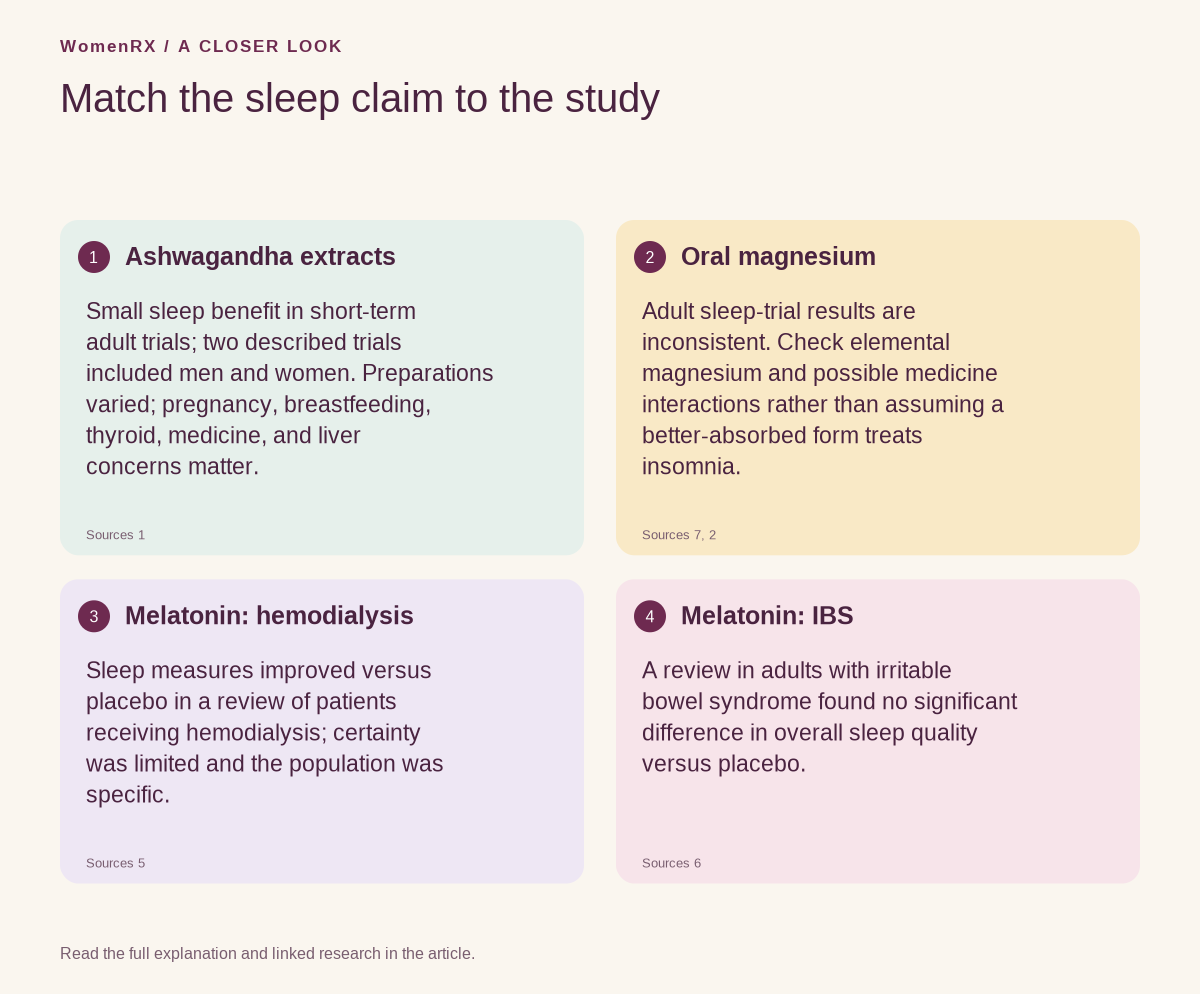
Match the sleep claim to the study
Ashwagandha extracts: Small sleep benefit in short-term adult trials; two described trials included men and women. Preparations varied; pregnancy, breastfeeding, thyroid, medicine, and liver concerns matter.1
Oral magnesium: Adult sleep-trial results are inconsistent. Check elemental magnesium and possible medicine interactions rather than assuming a better-absorbed form treats insomnia.72
Melatonin: hemodialysis: Sleep measures improved versus placebo in a review of patients receiving hemodialysis; certainty was limited and the population was specific.5
Melatonin: IBS: A review in adults with irritable bowel syndrome found no significant difference in overall sleep quality versus placebo.6
Read the figure as text
A quick comparison of what each ingredient's evidence addresses and what it leaves unresolved.- Ashwagandha extracts: Small sleep benefit in short-term adult trials; two described trials included men and women. Preparations varied; pregnancy, breastfeeding, thyroid, medicine, and liver concerns matter.1
- Oral magnesium: Adult sleep-trial results are inconsistent. Check elemental magnesium and possible medicine interactions rather than assuming a better-absorbed form treats insomnia.72
- Melatonin: hemodialysis: Sleep measures improved versus placebo in a review of patients receiving hemodialysis; certainty was limited and the population was specific.5
- Melatonin: IBS: A review in adults with irritable bowel syndrome found no significant difference in overall sleep quality versus placebo.6
More questions, answered
Does a magnesium form that absorbs better work better for sleep?
Not necessarily. Some magnesium forms are absorbed more completely than others, but adult sleep trials have used varied formulations and produced inconsistent results. Absorption and a demonstrated insomnia benefit are different claims.27
Sources you can check
- Ashwagandha: Is it helpful for stress, anxiety, or sleep? - Health Professional Fact SheetAccessed 2026-09-25Return to first citation
- Magnesium - Health Professional Fact SheetAccessed 2026-09-25Return to first citation
- Insomnia | MedlinePlusAccessed 2026-09-25Return to first citation
- Insomnia - NHSAccessed 2026-09-25Return to first citation
- The Effect of Melatonin on Sleep Quality in Hemodialysis Patients: A Systematic Review and Meta-Analysis of Randomized Controlled Trials.da Silva AGS, Silva MVE, de Oliveira BC, Wagner F, Vilela MAD, de Aquino LF, de Oliveira CMC. · Therapeutic apheresis and dialysis : official peer-reviewed journal of the International Society for Apheresis, the Japanese Society for Apheresis, the Japanese Society for Dialysis Therapy · 2026Return to first citation
- Melatonin Supplementation in the Management of Irritable Bowel Syndrome: An Updated Systematic Review and Meta-Analysis.Mahdi GA, Abotaiban N, Gadelmawla AF, Alfartaj M, Almutairi SM, Alenezi FE, Alshammari KM, Alsubaiei AA, Alharran AM. · Journal of gastroenterology and hepatology · 2026Return to first citation
- Magnesium Supplementation for Sleep in Adults: A Systematic Review of Randomized Controlled Trials.Lopresti AL, Smith SJ, Drummond PD. · Journal of dietary supplements · 2026Return to first citation
- Combination treatment for chronic insomnia disorder in adults: an American Academy of Sleep Medicine clinical practice guideline.Buysse DJ, Arnedt JT, Buenaver L, Chang JL, Fernandez-Mendoza J, Patel SI, Zhou ES, Falck-Ytter Y, Hyer S, Kazmi U, Singh M, Wickwire EM. · Journal of clinical sleep medicine : JCSM : official publication of the American Academy of Sleep Medicine · 2026Return to first citation
- Behavioral and psychological treatments for chronic insomnia disorder in adults: an American Academy of Sleep Medicine systematic review, meta-analysis, and GRADE assessment.Edinger JD, Arnedt JT, Bertisch SM, Carney CE, Harrington JJ, Lichstein KL, Sateia MJ, Troxel WM, Zhou ES, Kazmi U, Heald JL, Martin JL. · Journal of clinical sleep medicine : JCSM : official publication of the American Academy of Sleep Medicine · 2021Return to first citation