How to Evaluate Supplements for Sleep, Stress, or Mood
Choose one goal first, then check whether the research matches the ingredient, formula, and people it’s meant for.
A supplement marketed for sleep, stress, and mood isn’t automatically supported for all three. Pick the change you want, then look for human research on the same ingredient and form, measuring that outcome in a relevant group. Compare the full label, and review it with a pharmacist or clinician if you take medicines or have a health condition. Pregnancy and breastfeeding matter for some ingredients, including ashwagandha. 1
Start with the change you want
“Sleep, stress, and mood” can sit together on a label, but they’re separate outcomes. A study that measures sleep quality doesn’t establish a mood benefit. A change in perceived stress doesn’t show that a supplement treats ongoing anxiety or depression.
Name your main goal in everyday terms. For example, “I want to fall asleep more easily” is more useful for comparing evidence than “I want to feel better.” Then ask whether the study measured that same outcome. If a product promises to help with several things, look for evidence for each claim rather than letting one result stand in for all of them.
Match the study to the product
Check three things: the ingredient and its form, the outcome measured, and the people studied. A result in adults with insomnia may not apply to someone who occasionally has a restless night. Research on a specific extract also may not apply to a product using a different part of the plant or a blend of ingredients.
Ashwagandha is a useful example. A meta-analysis summarized by the NIH Office of Dietary Supplements included five studies and 372 adults in India, some healthy and some with insomnia. It found a small overall improvement in sleep compared with placebo. The studies used different preparations, and the fact sheet says those differences make it difficult to identify a specific extract that should work for everyone. 1
Stress and sleep findings should also stay in their own lanes. The same NIH fact sheet describes small, short-term trials in which participants taking ashwagandha reported improvements in stress or anxiety measures, but it notes that studies used varied preparations and doses. That evidence doesn’t mean every ashwagandha product has the same effect, or that it treats a mood disorder. 1
A review of 12 studies involving 917 shift workers found pooled improvements in sleep-quality scores and daytime function among people taking supplements. It did not find statistically significant pooled improvements in depression or anxiety. Because the review combined different supplements and did not report women-specific results, it can’t tell you whether a particular product helps mood or whether the findings apply specifically to women. 3
Read the whole label, not just the promise
Compare the studied form with the actual ingredient list. Note whether the product uses a root extract or a root-and-leaf extract, for example, and whether it combines the ingredient with others. If a study tested one extract by itself, it doesn’t establish how a different extract or a multi-ingredient blend will work. Ashwagandha studies have used varied preparations, which limits product-to-product comparisons. 1
A review describes reports of pharmaceutical drugs being illegally added to some plant-based products marketed for sleep, mood, or cognitive enhancement. The review doesn’t establish how common this is across products or identify what’s in any particular bottle. Still, a confident marketing claim is not proof of a product’s contents or effect. 4
Make safety part of the decision
If you take prescription or over-the-counter medicines, have a health condition, or are pregnant or breastfeeding, show the exact product label to a pharmacist or clinician before starting it. Ask about the full formula, not just its headline ingredient. This is a practical way to review your specific situation; it doesn’t mean every supplement has the same risks.
For ashwagandha, the NIH Office of Dietary Supplements says long-term safety is not known and notes potential liver and thyroid effects. It also says ashwagandha might not be safe during pregnancy or breastfeeding. Those cautions apply to ashwagandha, not automatically to every ingredient. 1
Know when product research isn’t enough
If stress symptoms are severe and last two weeks or more, MedlinePlus advises seeking help. Examples include trouble getting out of bed because of mood, difficulty focusing, or eating changes that cause unwanted weight changes. Those are reasons to address the symptoms directly rather than making supplement selection the whole plan. 2
A useful comparison ends with a clear answer to four questions: What one outcome am I targeting? Does human research match that outcome and ingredient form? Does the label match the product that was studied? Have I reviewed the actual formula for safety in my situation? If you can’t answer one of these, you have a specific reason to pause and find out more before choosing.
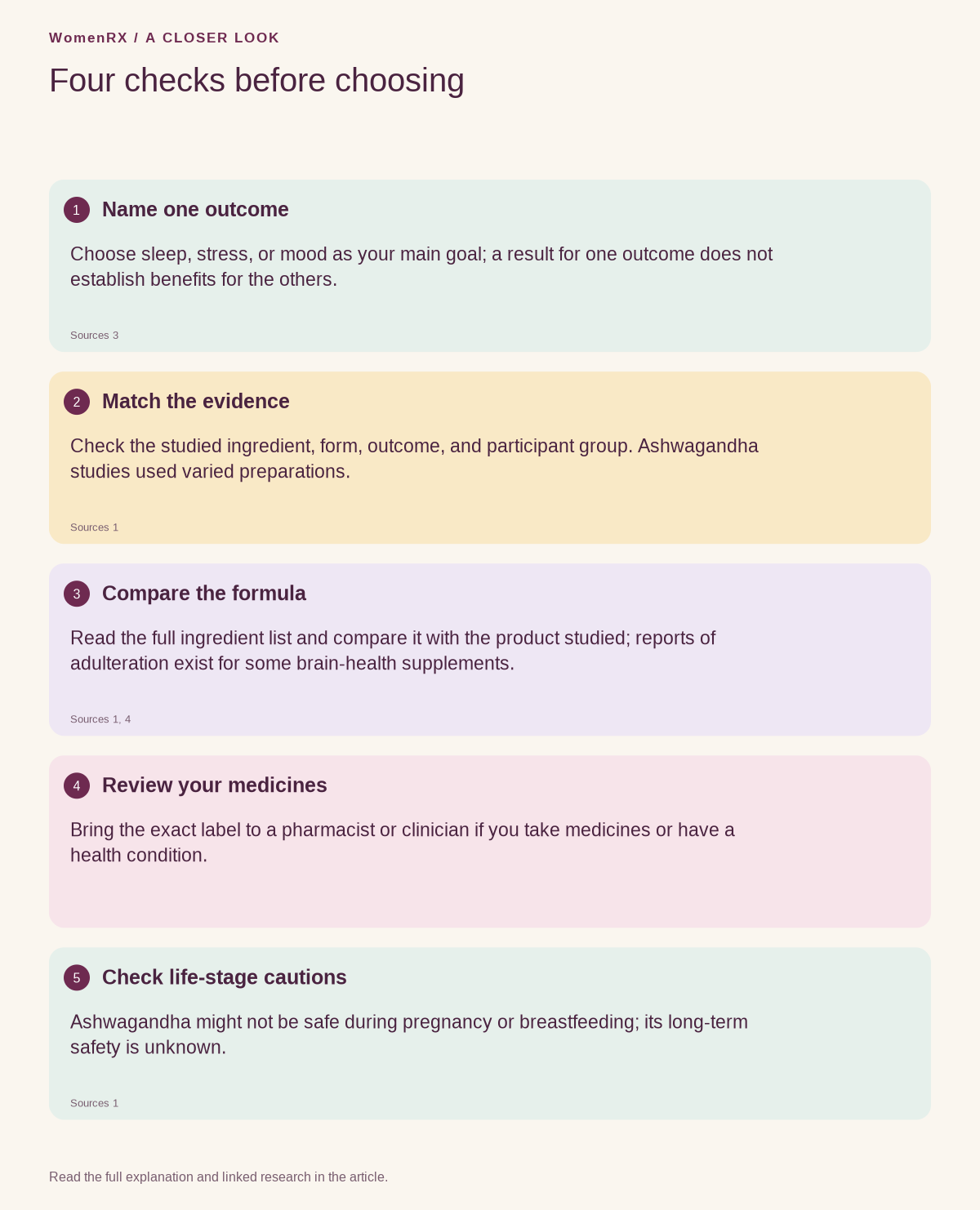
Four checks before choosing
Name one outcome: Choose sleep, stress, or mood as your main goal; a result for one outcome does not establish benefits for the others.3
Match the evidence: Check the studied ingredient, form, outcome, and participant group. Ashwagandha studies used varied preparations.1
Compare the formula: Read the full ingredient list and compare it with the product studied; reports of adulteration exist for some brain-health supplements.14
Review your medicines: Bring the exact label to a pharmacist or clinician if you take medicines or have a health condition.
Check life-stage cautions: Ashwagandha might not be safe during pregnancy or breastfeeding; its long-term safety is unknown.1
Read the figure as text
Use these checks to see whether a supplement’s claim, research, formula, and safety fit your goal and circumstances.- Name one outcome: Choose sleep, stress, or mood as your main goal; a result for one outcome does not establish benefits for the others.3
- Match the evidence: Check the studied ingredient, form, outcome, and participant group. Ashwagandha studies used varied preparations.1
- Compare the formula: Read the full ingredient list and compare it with the product studied; reports of adulteration exist for some brain-health supplements.14
- Review your medicines: Bring the exact label to a pharmacist or clinician if you take medicines or have a health condition.
- Check life-stage cautions: Ashwagandha might not be safe during pregnancy or breastfeeding; its long-term safety is unknown.1
More questions, answered
Does a supplement that helps sleep also help mood?
Not necessarily. In a review of trials in shift workers, pooled results favored supplements for sleep quality and daytime function, but not for depression or anxiety. The review combined different supplements, so it can’t establish the mood effect of a particular product. 3
What should I do if sleep, stress, and mood symptoms overlap?
Choose the symptom that most needs attention, but don’t assume one supplement will address all three. For severe stress symptoms lasting two weeks or more, including difficulty focusing or trouble getting out of bed because of mood, MedlinePlus advises seeking help. 2
Sources you can check
- Ashwagandha: Is it helpful for stress, anxiety, or sleep? - Health Professional Fact SheetAccessed 2026-09-25Return to first citation
- Stress: MedlinePlusAccessed 2026-09-25Return to first citation
- Efficacy of Dietary Supplements on Sleep Quality and Daytime Function of Shift Workers: A Systematic Review and Meta-Analysis.Wu Y, Huang X, Zhong C, Wu T, Sun D, Wang R, Zhan Q, Luo H. · Frontiers in nutrition · 2022Return to first citation
- Adulteration of Brain Health (Cognitive, Mood, and Sleep Enhancement) Food Supplements by the Addition of Pharmaceutical Drugs: A Comprehensive Review of Analytical Approaches and Trends.Paiva R, Correia M, Delerue-Matos C, Amaral JS. · Foods (Basel, Switzerland) · 2024Return to first citation