Are Supplements Worth Trying for Anxiety or Stress?
Some ashwagandha trials report short-term improvement in perceived stress, but that’s different from showing reliable treatment for an anxiety disorder.
It depends on what you want help with. Small, short ashwagandha trials suggest some adults may report less stress or anxiety, but they don’t establish reliable treatment for an anxiety disorder. A postpartum trial found no anxiety benefit from zinc or magnesium. If worry is persistent or disrupting daily life, don’t let a supplement trial delay support. 134
Stress after a demanding week and anxiety that keeps interfering with your life are different problems, even when they feel similar. Supplements have some evidence for changes in how people rate stress, but that isn’t the same as showing that a product treats an anxiety disorder.
Start with the outcome you want to change
Stress is the brain and body’s response to a challenge or demand. Anxiety can be a normal reaction to stress, too. With an anxiety disorder, fear or worry doesn’t go away and can interfere with everyday activities such as work and relationships. 23
That distinction matters when interpreting studies. A lower score on a perceived-stress questionnaire may mean participants felt less stressed. It doesn’t, on its own, show that a supplement treated a diagnosed disorder. If your main goal is feeling less stressed during a tough stretch, perceived stress may be a relevant outcome. If worry is persistent, worsening, or limiting what you can do, a stress-score result answers a much smaller question.
What the ingredient studies can tell you
Ashwagandha has the most directly relevant research among these ingredients. A 2021 review summarized seven randomized trials involving 491 adults in India. Participants had self-reported high stress or anxiety, or a diagnosed anxiety disorder, and took ashwagandha or a placebo for six to eight weeks. Overall, the trials reported improved stress and anxiety rating scores compared with placebo. 1
Those results are worth noticing, but they don’t settle whether ashwagandha reliably treats an anxiety disorder. The trials were generally small and short, and used different preparations. A later trial among adults experiencing fatigue found no reduction in perceived stress compared with placebo, another reminder that results may not carry over from one group or product to another. 1
A taskforce provisionally recommended specific daily doses of ashwagandha root extract for generalized anxiety disorder, while saying it couldn’t make a stronger recommendation without more data. That is a cautious position, not an endorsement of every ashwagandha product or a reason to replace established care. The variation in extracts and preparations also makes it difficult to identify a particular product to recommend from these trials. 1
Some ashwagandha trials included both men and women, but the research summary does not report women-specific results. Findings in mixed adult groups therefore don’t establish a benefit specific to women or to a particular life stage. 1
Zinc and magnesium after childbirth: In a randomized trial of 99 postpartum women in Iran, participants received zinc, magnesium, or placebo for eight weeks. The study found no significant difference between groups in state or trait anxiety scores. It doesn’t answer every question about these minerals, but it doesn’t support taking them specifically to reduce postpartum anxiety. 4
A combination supplement during perimenopause: A randomized trial enrolled 106 perimenopausal women with mild-to-moderate climacteric symptoms and tested a succinate-based supplement together with a vitamin B complex. Its abstract reported improvements in anxiety measures. Because the two products were taken together, the result can’t show which component contributed to the change. Nor does it establish that the combination treats an anxiety disorder or that other products will have the same effect. 5
Keep safety and care in the decision
These findings don’t establish whether ashwagandha is safe or effective during pregnancy or breastfeeding. The postpartum mineral trial is limited to the products and outcomes it tested; it doesn’t settle questions about other ingredients or combinations. If you’re pregnant, breastfeeding, or taking prescription medicine, have a pharmacist or clinician check the exact product and your medication list before adding it. The studies above aren’t an interaction guide. 14
For ongoing anxiety, an assessment can include talking through your symptoms and medical history and checking whether another health problem could be contributing. Treatment options can include therapy, medication, and stress-management techniques. You don’t have to decide that your symptoms are hormonal, or try a supplement first, to ask for help. 3
If severe stress symptoms last two weeks or more, MedlinePlus advises seeking help. And if anxiety is getting in the way of work, relationships, or daily activities, that’s a meaningful reason to seek support rather than waiting to see whether a supplement helps. 23
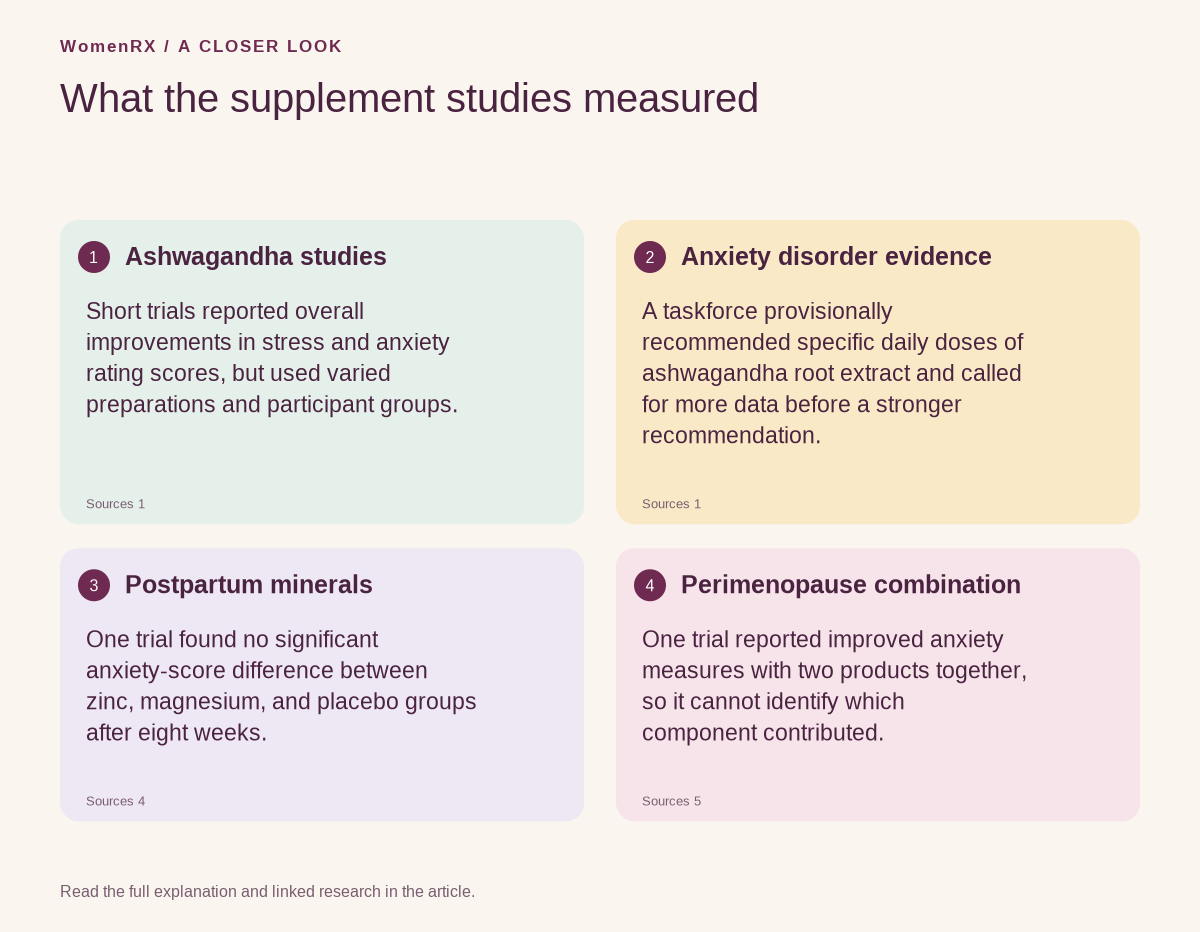
What the supplement studies measured
Ashwagandha studies: Short trials reported overall improvements in stress and anxiety rating scores, but used varied preparations and participant groups.1
Anxiety disorder evidence: A taskforce provisionally recommended specific daily doses of ashwagandha root extract and called for more data before a stronger recommendation.1
Postpartum minerals: One trial found no significant anxiety-score difference between zinc, magnesium, and placebo groups after eight weeks.4
Perimenopause combination: One trial reported improved anxiety measures with two products together, so it cannot identify which component contributed.5
Read the figure as text
The population, product, and outcome shape what each finding can tell you about stress or anxiety.- Ashwagandha studies: Short trials reported overall improvements in stress and anxiety rating scores, but used varied preparations and participant groups.1
- Anxiety disorder evidence: A taskforce provisionally recommended specific daily doses of ashwagandha root extract and called for more data before a stronger recommendation.1
- Postpartum minerals: One trial found no significant anxiety-score difference between zinc, magnesium, and placebo groups after eight weeks.4
- Perimenopause combination: One trial reported improved anxiety measures with two products together, so it cannot identify which component contributed.5
Sources you can check
- Ashwagandha: Is it helpful for stress, anxiety, or sleep? - Health Professional Fact SheetAccessed 2026-09-25Return to first citation
- Stress: MedlinePlusAccessed 2026-09-25Return to first citation
- Anxiety: MedlinePlusAccessed 2026-09-25Return to first citation
- Effects of zinc and magnesium supplements on postpartum depression and anxiety: A randomized controlled clinical trial.Fard FE, Mirghafourvand M, Mohammad-Alizadeh Charandabi S, Farshbaf-Khalili A, Javadzadeh Y, Asgharian H. · Women & health · 2017Return to first citation
- Clinical Evaluation of Effectiveness and Safety of Combined Use of Dietary Supplements Amberen® and Smart B® in Women with Climacteric Syndrome in Perimenopause.Kachko VA, Shulman LP, Kuznetsova IV, Uspenskaya YB, Burchakov DI. · Advances in therapy · 2024Return to first citation