PMS Self-Care: What’s Worth Trying?
Regular movement and relaxation are reasonable places to start, but research is still too limited to promise that any self-care approach will work for everyone.
Exercise and relaxation are the most practical self-care options to consider first: small studies in women with PMS found symptom improvements, though they don’t show how well these approaches work for everyone or over the long term. Track symptoms alongside your cycle to spot a recurring pattern. If symptoms disrupt daily life, feel unusually intense, or include suicidal thoughts, seek clinical support rather than relying on self-care alone. 1 2 3
Start with approaches you can sustain
PMS can involve physical, emotional, or behavioral symptoms in the weeks before a period, and the pattern can vary from month to month. Self-care may help, but the research doesn’t identify one reliable routine that works for everyone. A useful starting point is to choose a manageable change, then notice whether it makes a difference in your own cycle. 1
Movement has some encouraging, but limited, evidence. In a randomized study of students, an eight-week program combining Pilates and text-message support reduced reported PMS symptoms compared with no intervention. Because the program combined exercise with support, the study can’t tell us how much benefit came from Pilates alone. A separate small trial found that web-based lifestyle support improved some outcomes, but its 68 participants were divided among three groups and follow-up lasted only four weeks. 2 3
You don’t have to choose a particular workout based on these studies. A practical example is to try a form of regular movement you can fit into your routine, and record how symptoms and daily functioning compare across cycles. The studies are promising, not proof that exercise will relieve your symptoms.
Relaxation is another reasonable trial. In the same small web-based trial, progressive muscle relaxation was associated with improvements in reported PMS symptoms and some measures of well-being compared with a control group. That’s a reason to try a relaxation practice if it suits you, not evidence that a specific technique or online program is a proven treatment for all PMS. 2
Treat diet claims and supplements more cautiously
There’s less certainty around advice to cut out particular foods or add a supplement. A cross-sectional study of college students found associations between PMS reports and some food habits, but that kind of study cannot show that a food caused symptoms or that avoiding it will improve them. In another randomized study, vitamin D, online counseling, and lifestyle training were compared without an untreated control group; improvements in those groups don’t establish that vitamin D itself treats PMS. 4 5
The NHS describes the evidence for complementary therapies and dietary supplements as limited and advises checking with a doctor or pharmacist before taking regular supplements if you also use medicines. “Natural” doesn’t mean risk-free, and current research doesn’t support a blanket supplement recommendation. 1
Use a short cycle-and-symptom record
For the next cycles, make a brief daily note of symptoms, when bleeding starts, and how symptoms affect work, school, relationships, or everyday tasks. You might also jot down a self-care change you’re trying, such as regular movement or a relaxation practice. This is a practical way to see whether symptoms repeatedly build before a period and ease afterward, and whether a change seems useful for you. It isn’t a diagnostic test.
If you use hormonal contraception, keep that in the record too. These studies don’t tell us whether the same self-care findings apply to people using hormonal contraception, or whether they apply equally to people with regular cycles. That leaves room for your own pattern to matter, without assuming the research answers those questions.
When self-care isn’t enough
If symptoms affect your daily life or lifestyle changes haven’t helped, it’s reasonable to seek clinical support. PMS symptoms can vary, but symptoms that are much more intense and substantially interfere with everyday life may need assessment for premenstrual dysphoric disorder (PMDD) or another concern. Self-care can still be part of a plan, but it shouldn’t be the only response to severe impairment. 1
If you have PMS-like symptoms and feel suicidal, seek immediate emergency help. Don’t wait to see whether a self-care approach helps. 1
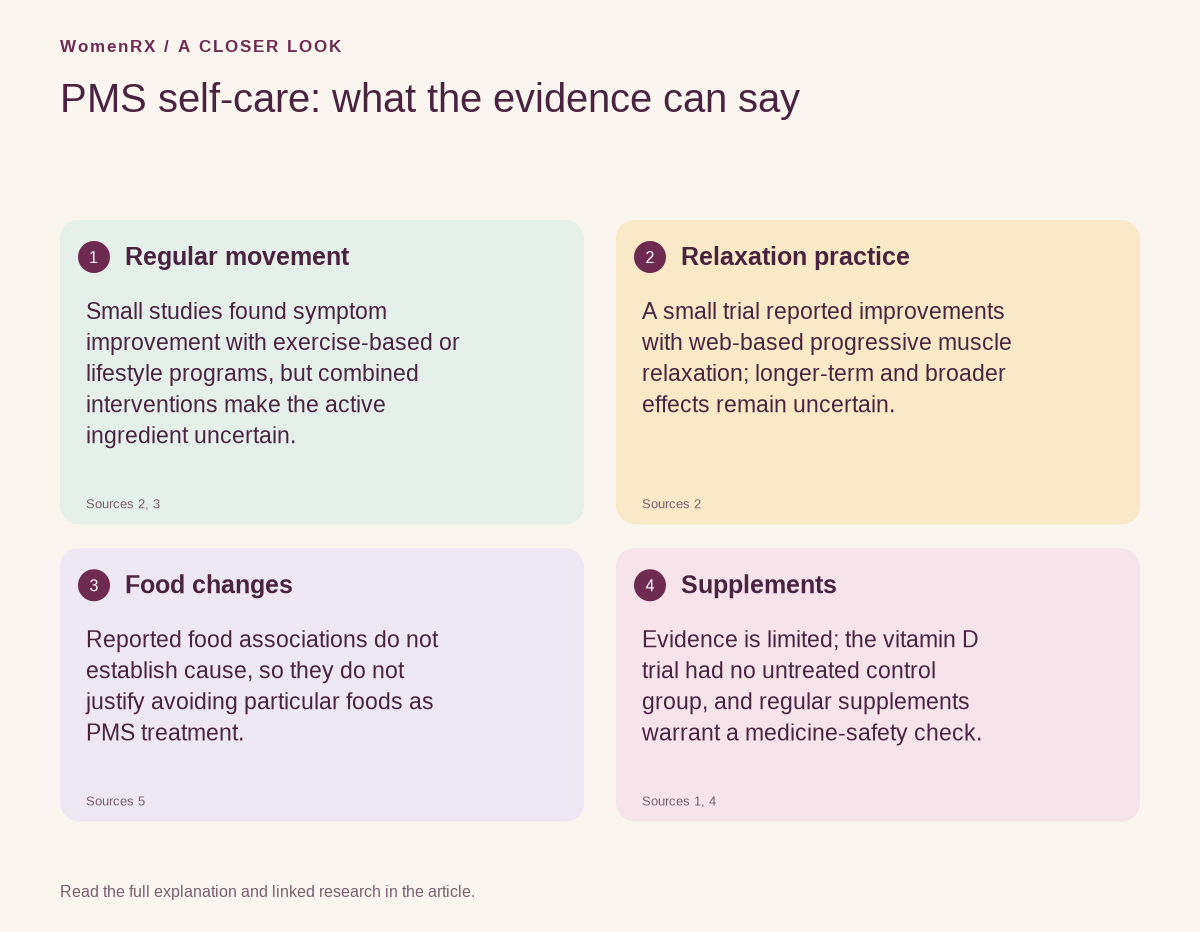
PMS self-care: what the evidence can say
Regular movement: Small studies found symptom improvement with exercise-based or lifestyle programs, but combined interventions make the active ingredient uncertain.23
Relaxation practice: A small trial reported improvements with web-based progressive muscle relaxation; longer-term and broader effects remain uncertain.2
Food changes: Reported food associations do not establish cause, so they do not justify avoiding particular foods as PMS treatment.5
Supplements: Evidence is limited; the vitamin D trial had no untreated control group, and regular supplements warrant a medicine-safety check.14
Read the figure as text
A quick comparison of practical options, what studies suggest, and where the evidence is too limited for a confident promise.- Regular movement: Small studies found symptom improvement with exercise-based or lifestyle programs, but combined interventions make the active ingredient uncertain.23
- Relaxation practice: A small trial reported improvements with web-based progressive muscle relaxation; longer-term and broader effects remain uncertain.2
- Food changes: Reported food associations do not establish cause, so they do not justify avoiding particular foods as PMS treatment.5
- Supplements: Evidence is limited; the vitamin D trial had no untreated control group, and regular supplements warrant a medicine-safety check.14
More questions, answered
Does this advice apply if I use hormonal contraception?
The studies summarized here don’t establish whether their findings apply to people using hormonal contraception. Note contraception changes alongside symptoms and bleeding so you can describe the pattern when seeking care.
When should I seek help for PMS?
Seek clinical support if symptoms affect daily life or self-care changes haven’t helped. Symptoms that are unusually intense and interfere substantially with everyday functioning may need assessment for PMDD. Suicidal thoughts call for immediate emergency help. 1
Sources you can check
- PMS (premenstrual syndrome) - NHSAccessed 2026-09-25Return to first citation
- Effect of web-based progressive muscle relaxation and lifestyle interventions on psychological well-being, occupational performance, and quality of life in women with premenstrual syndrome: A randomized controlled trial with 4-week follow-up.Karakus A, Akyurek G. · Journal of affective disorders · 2026Return to first citation
- The effect of pilates and a WhatsApp-based health intervention program on symptoms of premenstrual syndrome (PMS): A randomized controlled study.Balmumcu A, Ozturk N. · Health care for women international · 2024Return to first citation
- Online positive-oriented counseling, taking vitamin D3 tablet, online lifestyle modification training on premenstrual syndrome: a 3-armed randomized clinical trial.Mahmoodi M, Farajkhoda T, Nadjarzadeh A, Zareei Mahmoodabadi H. · Scientific reports · 2023Return to first citation
- Linkages between lifestyle practices, dietary habits, and premenstrual syndrome among college students.Huwaikem M. · PLOS global public health · 2026Return to first citation