PMS Mood Changes: What Helps on Harder Days
Small changes can make a difficult day easier to manage, while the timing and impact of symptoms can tell you when to seek more help.
If irritability, low mood, or mood swings tend to show up before your period, start with manageable support: protect sleep, eat regular balanced meals, and make room for movement you enjoy. A brief record of symptoms and their impact can help you spot a pattern, even with irregular periods. Seek an assessment if symptoms are intense or disrupt daily life. 1 5
Make the difficult day a little easier
Premenstrual mood changes can include irritability, feeling low, and mood swings. They’re not the same for everyone, and your symptoms may change from month to month. PMS may be related to hormonal changes during the menstrual cycle, but its cause isn’t fully understood. 1
On a hard day, aim to reduce friction rather than do everything perfectly. For example, if you’re more easily irritated, you might take a quiet break before a demanding conversation or move a nonessential task to another day. If you feel low, choosing one manageable task instead of judging the whole day by your usual to-do list may help you get through it. These are ways to respond to what you’re feeling, not treatments proven to stop PMS.
The basics are worth making easier, too. Regular exercise, enough sleep, and balanced meals are steps recommended for easing PMS symptoms. You could choose a walk or another kind of movement you like, make a simple meal plan for a busy evening, or leave more time for sleep when possible. A review of physical-activity studies suggests exercise may help PMS symptoms, including mood, but it can’t promise relief for any one person. 1 5
Sleep deserves attention without becoming another thing to blame yourself for. In a cross-sectional study of 252 young women, poorer sleep quality was associated with premenstrual anger, anxiety, and depressed mood. That finding doesn’t show whether poor sleep caused those symptoms or whether improving sleep would resolve them. It does make sleep a useful part of your plan if it’s something you can protect. 4
Plan for patterns, not a perfect calendar
If you’ve noticed that certain days are often harder, think ahead about what would lighten the load. As an example, you might keep an evening free of optional plans, prepare an easy meal, or tell someone close to you that you may need more quiet time. Keep plans flexible: PMS symptoms can vary month to month, so you don’t need to organize your life around a predicted bad day. 1
A short daily note can help you see whether there’s a pattern. Record when bleeding starts, a few words about your mood, and whether symptoms affected work, school, relationships, or ordinary tasks. If your periods are irregular, note what happens as it happens instead of relying on an app’s predicted dates. Premenstrual symptoms typically recur before a period and ease by the end of menstruation; the point of the record is to see whether that description fits your experience, not to diagnose yourself. 1 3
Know when self-management isn’t enough
You don’t have to prove that your symptoms are severe before asking for help. Arrange an assessment if mood changes repeatedly interfere with daily life, feel intense, or haven’t eased with practical changes. PMDD involves more intense premenstrual symptoms that can have a much greater effect on everyday life; it deserves assessment, not a more elaborate self-care routine. 1
Mention low mood or other symptoms that continue well beyond your period, too. A typical premenstrual pattern eases by the end of menstruation, but symptoms matter even when they don’t fit that pattern. 3
If you’re thinking about harming yourself or don’t feel safe, seek urgent help now. Don’t wait to see whether your mood changes when your period starts. 1 6
Be cautious about a supplement that promises a quick fix. Evidence for complementary therapies and supplements for PMS is limited. In one small placebo-controlled pilot study of a multi-ingredient supplement, improvements seen within the supplement group did not translate into a statistically significant difference between groups. That isn’t a reason to replace an assessment of disruptive mood symptoms with a product. 1 2
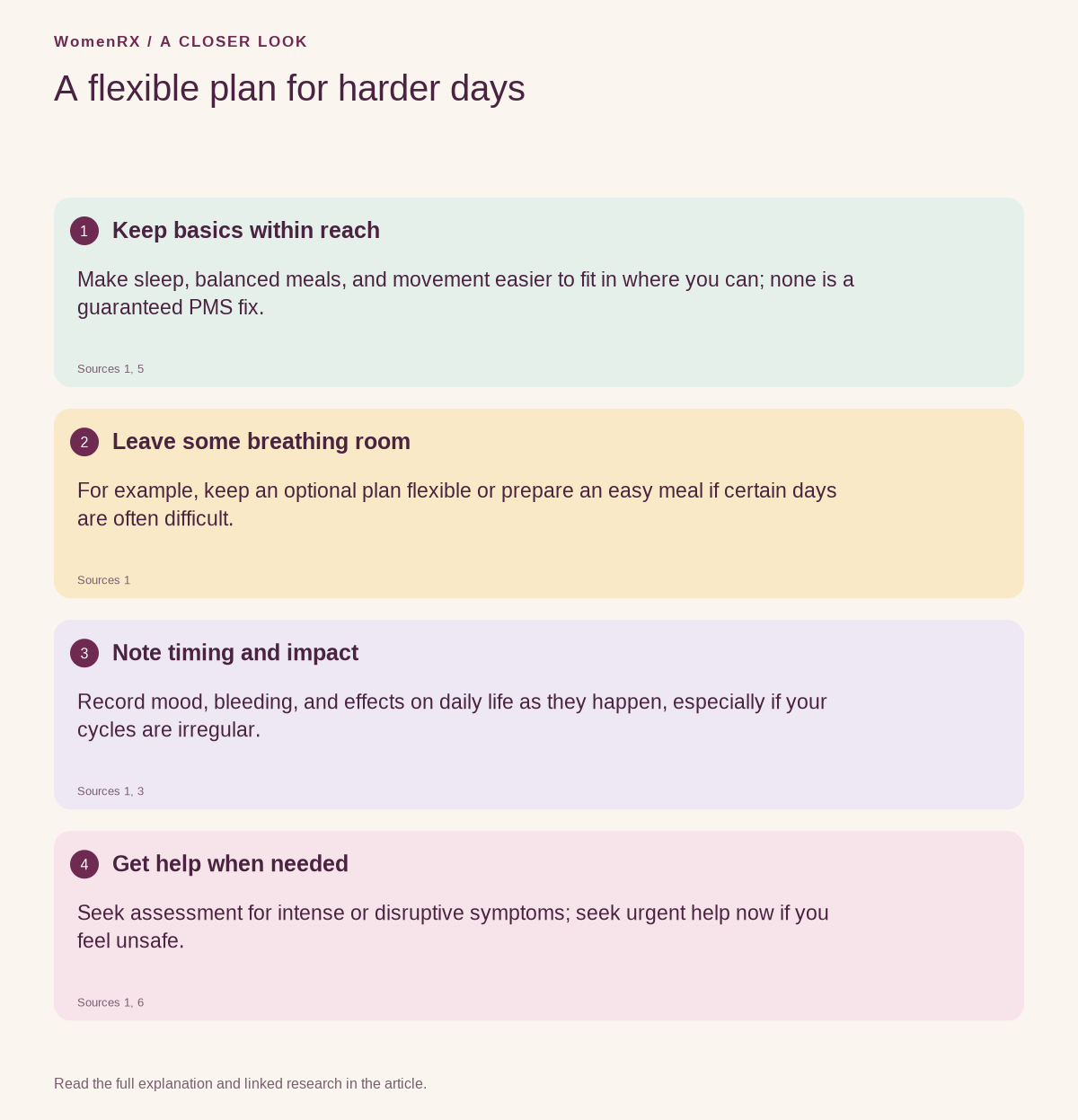
A flexible plan for harder days
Keep basics within reach: Make sleep, balanced meals, and movement easier to fit in where you can; none is a guaranteed PMS fix.15
Leave some breathing room: For example, keep an optional plan flexible or prepare an easy meal if certain days are often difficult.1
Note timing and impact: Record mood, bleeding, and effects on daily life as they happen, especially if your cycles are irregular.13
Get help when needed: Seek assessment for intense or disruptive symptoms; seek urgent help now if you feel unsafe.16
Read the figure as text
Use these prompts to make room for support and notice whether symptoms need more attention. This isn’t a diagnostic checklist.- Keep basics within reach: Make sleep, balanced meals, and movement easier to fit in where you can; none is a guaranteed PMS fix.15
- Leave some breathing room: For example, keep an optional plan flexible or prepare an easy meal if certain days are often difficult.1
- Note timing and impact: Record mood, bleeding, and effects on daily life as they happen, especially if your cycles are irregular.13
- Get help when needed: Seek assessment for intense or disruptive symptoms; seek urgent help now if you feel unsafe.16
Sources you can check
- PMS (premenstrual syndrome) - NHSAccessed 2026-09-25Return to first citation
- Effects of the PREMEN-CALM® in the Management of the Premenstrual Syndrome: A Randomized, Double-Blind, Placebo-Controlled Pilot Study.Herrera A, Al Adib M, Rodríguez AB, Carrasco C. · Journal of dietary supplements · 2024Return to first citation
- Gonadotropin-releasing hormone (GnRH) analogues for premenstrual syndrome (PMS).Naheed B, Kuiper JH, O'Mahony F, O'Brien PM. · The Cochrane database of systematic reviews · 2025Return to first citation
- Association between sleep quality and premenstrual syndrome in young women in a cross-sectional study.Mighani S, Taghizadeh Shivyari F, Razzaghi A, Amerzadeh M, Ranjbaran M, Samavat M, Javadi M. · Scientific reports · 2025Return to first citation
- The Effect of Physical Activity on Premenstrual Syndrome: A Systematic Review.Ayyub S, Agrawal M, Sharma V, Aravind A. · Annals of neurosciences · 2025Return to first citation
- The behavioral and physiological correlates of affective mood switching in premenstrual dysphoric disorder.Brown RD, Bondy E, Prim J, Dichter G, Schiller CE. · Frontiers in psychiatry · 2024Return to first citation