Saffron for Mood or PMS: What Trials Measured
Mood studies have reassessed people after four to twelve weeks, while the PMS trial tested a multi-ingredient supplement over two months.
Trials don’t establish one timeline for saffron. In mood studies, researchers measured outcomes after four, eight, or twelve weeks, using particular saffron extracts and mood questionnaires. The PMS trial reassessed symptoms after one and two months, but its supplement contained many ingredients, so its results can’t show whether saffron itself helped. Trial schedules aren’t a prediction of when, or whether, you’ll notice a change. 2 3 4 5
The PMS and mood findings aren’t interchangeable
The key difference is what researchers tested. For mood, several randomized trials tested saffron preparations on their own in adults reporting low mood or subclinical depressive symptoms. For PMS, researchers tested PMSoff, a blend containing saffron and ten other ingredients. That study can speak to the blend, not to saffron’s individual effect. 2 3 4 5
This matters if you’re comparing a saffron-only product with a multi-ingredient PMS supplement. They’re not the same intervention, and results from one can’t be assumed to apply to the other.
What the mood trials measured, and when
In a four-week trial, 128 adults who reported low mood but didn’t have a depression diagnosis received one of two amounts of the standardized extract Affron or a placebo. Researchers measured mood at the start and end using questionnaires including the Profile of Mood States (POMS). They reported an improvement on one POMS mood score with the higher amount, but not the lower one. This was a short study in adults with self-reported low mood, not evidence about every saffron preparation or about treating diagnosed depression. 3
A separate eight-week study tested 30 mg of standardized saffron extract in 56 healthy adults with subclinical low mood, anxiety, or stress. Participants completed mood questionnaires, including POMS, and those taking saffron reported lower depression scores at the end of the study. The study included men and women; it doesn’t establish a women-specific effect. 5
In a larger, twelve-week trial, 202 adults with subclinical depressive symptoms received 28 mg of Affron or placebo. At the end, the saffron group had a greater average improvement on the DASS-21 depression score than the placebo group. There was no evidence of a difference between groups on the other reported secondary outcomes. The result is about that extract, population, questionnaire, and study period, not a guarantee of benefit for an individual. 2
Taken together, the studies show when researchers checked their measures, not a reliable countdown to feeling better. They used different participants, extracts, scales, and study lengths. A result measured at four weeks in one group doesn’t tell you what you’ll experience at four weeks, or how a different product will perform.
What the PMS trial can and can’t tell you
The PMS study enrolled women ages 14 to 30 diagnosed with PMS and tested PMSoff, a blend containing saffron, spirulina, whey protein, calcium citrate, vitamin B1, and several herbs. Participants recorded symptom severity using the Daily Record of Severity of Problems (DRSP). The researchers assessed symptoms before treatment and after one and two months. The blend group had a statistically significant reduction in DRSP scores compared with placebo after one month, with a stronger statistical difference reported after two months. The figures presented in the abstract show statistical significance but don’t give the size of the symptom change, so they don’t show how noticeable the difference was for an individual. 4
Because PMSoff contained many ingredients, the trial can’t identify saffron as the cause of the findings. Nor does it establish that a saffron-only supplement works for PMS or PMDD. The authors also called for further research on longer-term effects and broader applicability. 4
Pregnancy- and breastfeeding-specific safety findings aren’t reported in these trial abstracts
Pregnancy: The mood and PMS trial reports described here don’t provide pregnancy-specific safety findings. They therefore don’t establish whether saffron supplements are safe during pregnancy. 2 3 4 5
Breastfeeding: These reports also don’t provide breastfeeding-specific safety findings. They don’t establish whether saffron supplements are safe while breastfeeding. 2 3 4 5
For PMS symptoms that affect your daily life, a supplement trial shouldn’t have to be your only next step. PMS has different symptoms for different people, and treatments can be discussed when symptoms interfere with everyday activities. 1
The practical takeaway
Check the exact preparation and the population before using a trial to set expectations. A mood study of a standardized saffron extract isn’t a PMS study; a PMS study of a multi-ingredient blend isn’t proof for saffron alone. And a study’s reassessment date tells you when researchers measured an outcome, not when you personally should expect a response.
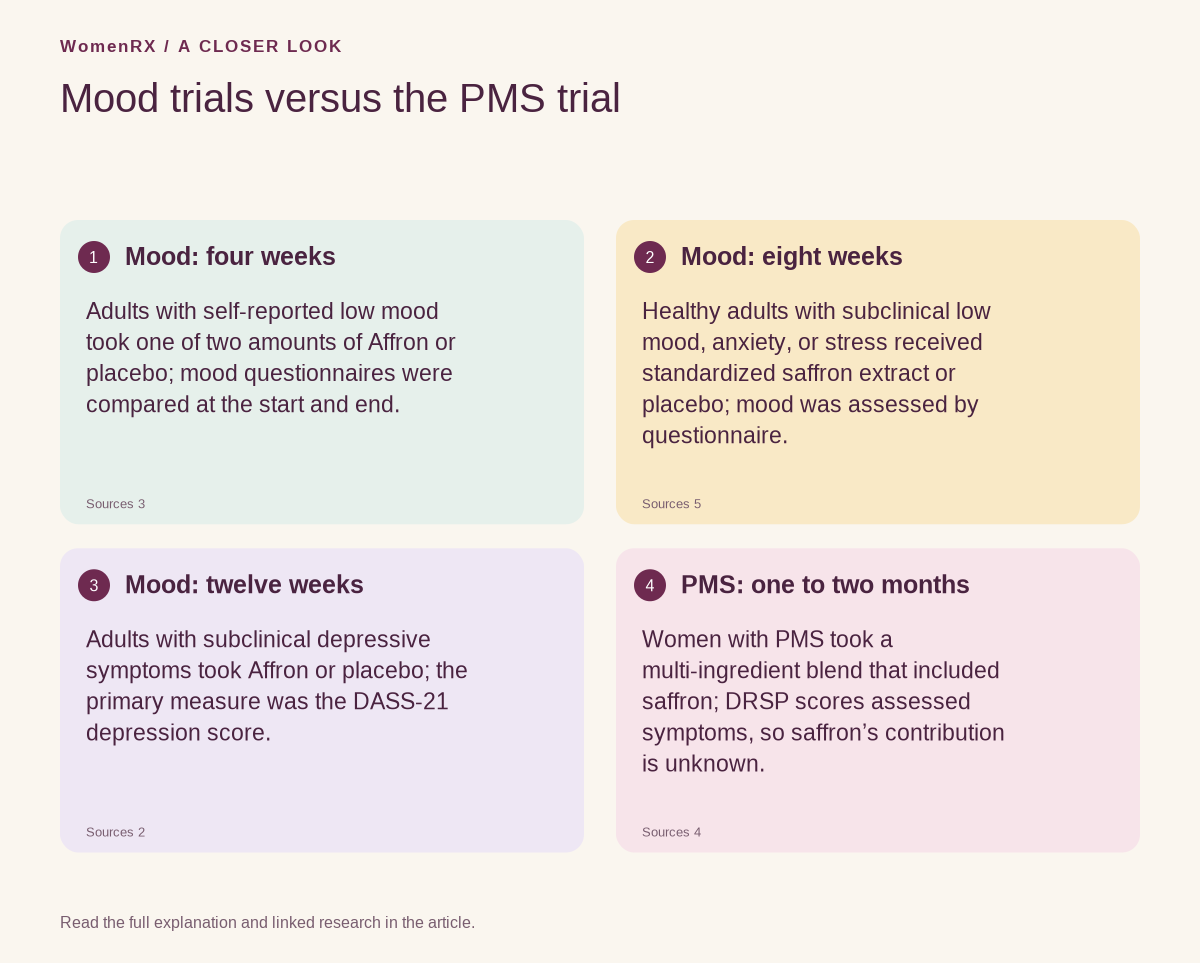
Mood trials versus the PMS trial
Mood: four weeks: Adults with self-reported low mood took one of two amounts of Affron or placebo; mood questionnaires were compared at the start and end.3
Mood: eight weeks: Healthy adults with subclinical low mood, anxiety, or stress received standardized saffron extract or placebo; mood was assessed by questionnaire.5
Mood: twelve weeks: Adults with subclinical depressive symptoms took Affron or placebo; the primary measure was the DASS-21 depression score.2
PMS: one to two months: Women with PMS took a multi-ingredient blend that included saffron; DRSP scores assessed symptoms, so saffron’s contribution is unknown.4
Read the figure as text
These studies asked different questions. Compare who took part, what was tested, and when symptoms or mood were measured.- Mood: four weeks: Adults with self-reported low mood took one of two amounts of Affron or placebo; mood questionnaires were compared at the start and end.3
- Mood: eight weeks: Healthy adults with subclinical low mood, anxiety, or stress received standardized saffron extract or placebo; mood was assessed by questionnaire.5
- Mood: twelve weeks: Adults with subclinical depressive symptoms took Affron or placebo; the primary measure was the DASS-21 depression score.2
- PMS: one to two months: Women with PMS took a multi-ingredient blend that included saffron; DRSP scores assessed symptoms, so saffron’s contribution is unknown.4
More questions, answered
Does a two-month PMS result mean saffron takes two months to work?
No. The PMS trial tested a blend containing saffron and ten other ingredients, not saffron by itself. Its two-month assessment describes when researchers measured the blend’s effect; it doesn’t establish a saffron-specific timeline. 4
Did the mood trials study women specifically?
The eight-week study included both men and women, but its abstract doesn’t report a women-specific result. The other mood findings described here are also not evidence of a distinct effect in women. 2 3 5
Sources you can check
- PMS (premenstrual syndrome) - NHSAccessed 2026-09-25Return to first citation
- An Examination into the Effects of a Saffron Extract (Affron) on Mood and General Wellbeing in Adults Experiencing Low Mood: A Randomized, Double-Blind, Placebo-Controlled Trial.Lopresti AL, Smith SJ, Marx W, Díez-Municio M, Morán-Valero MI. · The Journal of nutrition · 2025Return to first citation
- affron® a novel saffron extract (Crocus sativus L.) improves mood in healthy adults over 4 weeks in a double-blind, parallel, randomized, placebo-controlled clinical trial.Kell G, Rao A, Beccaria G, Clayton P, Inarejos-García AM, Prodanov M. · Complementary therapies in medicine · 2017Return to first citation
- Natural relief for premenstrual syndrome (PMS): a double-blind clinical trial on the efficacy and safety of PMSoff.Saghafi F, Zare P, Hatamizadeh N, Malmir M, Sahebnasagh A. · Journal of pharmaceutical health care and sciences · 2025Return to first citation
- Effects of Saffron Extract Supplementation on Mood, Well-Being, and Response to a Psychosocial Stressor in Healthy Adults: A Randomized, Double-Blind, Parallel Group, Clinical Trial.Jackson PA, Forster J, Khan J, Pouchieu C, Dubreuil S, Gaudout D, Moras B, Pourtau L, Joffre F, Vaysse C, Bertrand K, Abrous H, Vauzour D, Brossaud J, Corcuff JB, Capuron L, Kenned... · Frontiers in nutrition · 2020Return to first citation