Saffron Supplements: Does the Time of Day Matter?
Human studies have tested saffron on daily schedules, but they haven’t compared morning with evening use.
There’s no evidence here that saffron works better at a particular time of day: the studies didn’t compare morning, evening, or taking it with food. Instead, they tested specific preparations taken daily over several weeks. Results for low mood are promising but vary by study, and they don’t establish saffron as a treatment for depression or premenstrual symptoms. 1 2 4
What the studies actually tested
Saffron research isn’t one uniform test of one interchangeable supplement. Studies have used different preparations, participant groups, and outcomes. For example, a four-week trial in adults who reported low mood but didn’t have diagnosed depression tested a standardized saffron extract called affron at two daily amounts. The higher-amount group showed a difference from placebo on the main mood measure; the lower-amount group did not. 1
A larger, 12-week trial tested 28 mg daily of affron in 202 adults with subclinical depressive symptoms. Compared with placebo, the saffron group improved more on the study’s primary depression-symptom measure. But the groups didn’t differ on the other reported secondary outcomes, and substantial improvement also occurred in the placebo group. That makes the result encouraging, not a guarantee of benefit for an individual. 2
Other trials used different products and populations. One eight-week study gave 30 mg daily of a standardized extract to 56 healthy adults with low mood, anxiety, or stress; it reported improvement in depressive feelings, but not every outcome improved. A separate six-week study in physically active adults found no significant overall differences between groups, and reported no significant benefit in its female subgroup. These studies shouldn’t be treated as interchangeable proof for every saffron product or purpose. 4 5
A study schedule isn’t an ideal-time finding
The trials above studied repeated use over weeks. They did not compare taking saffron in the morning versus at night, with food versus without, or at different times relative to symptoms. One study also examined a single dose around a laboratory stress test, but that design doesn’t establish a best everyday time. 1 2 4
So if you’re weighing a supplement, the more evidence-based question is whether the preparation and intended use resemble a studied trial, not whether you’ve picked the “right” hour. A daily schedule in a study describes how researchers tested that product; it doesn’t prove that schedule is superior to another one.
Mood evidence is not PMS evidence
Some saffron trials have studied mood, including low mood and depressive symptoms. That does not show that saffron relieves premenstrual syndrome (PMS): the trials described here did not test PMS symptoms as their target outcome. Nor do the low-mood studies establish saffron as a stand-alone treatment for diagnosed depression. 1 2 4
One small pilot trial did test crocin, a saffron constituent, as an add-on to antidepressant medication in 40 adults with major depressive disorder. It reported greater improvement on several symptom scales over four weeks in the crocin group than in the placebo group. Because it was a small, short adjunctive trial of a constituent, it does not show that a saffron supplement can replace prescribed treatment. 3
What safety findings can, and can’t, tell you
In the 12-week affron trial, no serious adverse reactions were reported. That is useful information about the people and product studied, but it doesn’t establish long-term safety or safety for every formulation or group of people. 2
The studies summarized here do not establish whether saffron supplements are safe during pregnancy or breastfeeding. They also don’t answer whether a particular supplement is suitable alongside an individual’s medicines. If you take medication for depression, the crocin study is not a reason to change or stop it: that study tested crocin alongside medication, not as a replacement. 3
If you’re considering saffron, check whether the product identifies a specific extract or constituent and whether that matches the preparation in the evidence you’re relying on. Similar names don’t mean the products have been tested as equivalents.
What saffron trials tested
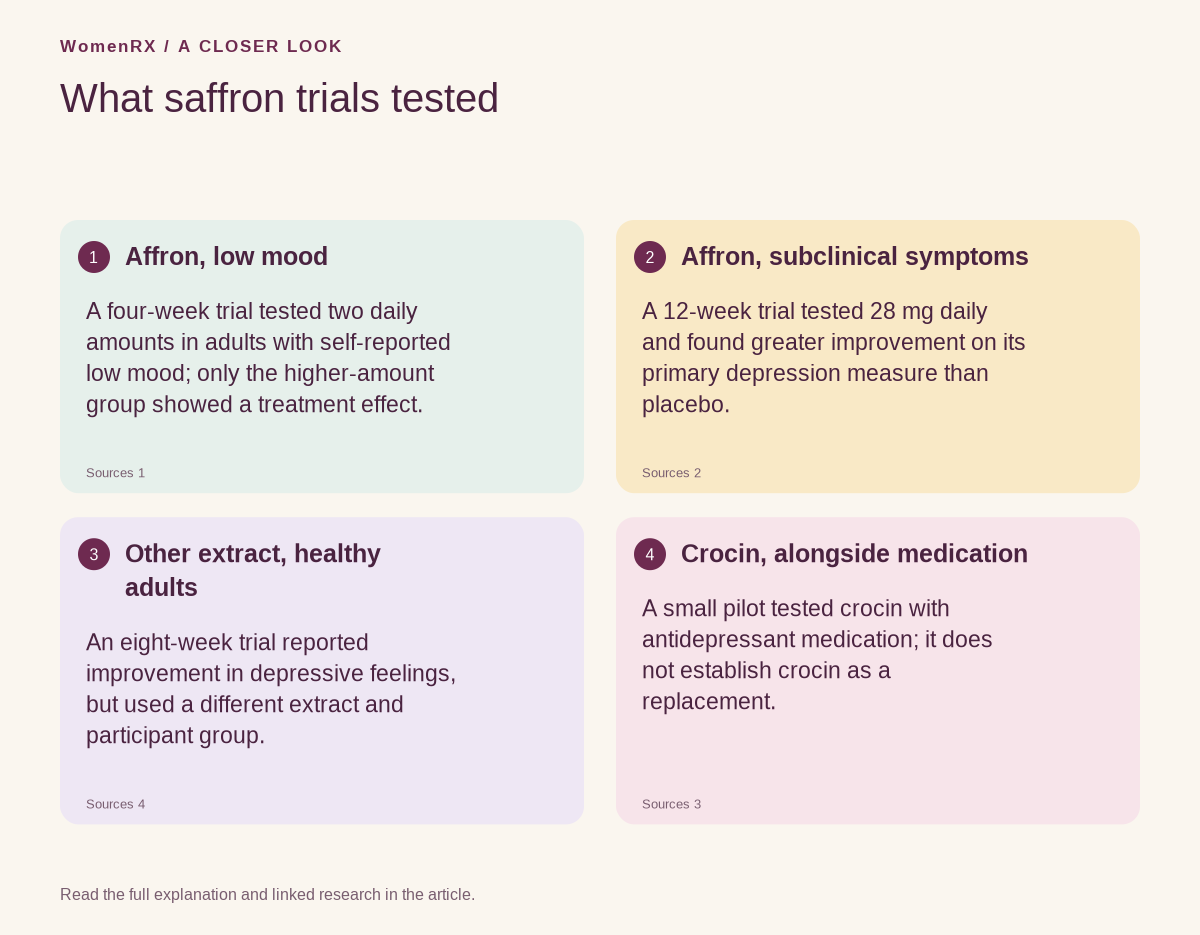
Affron, low mood: A four-week trial tested two daily amounts in adults with self-reported low mood; only the higher-amount group showed a treatment effect.1
Affron, subclinical symptoms: A 12-week trial tested 28 mg daily and found greater improvement on its primary depression measure than placebo.2
Other extract, healthy adults: An eight-week trial reported improvement in depressive feelings, but used a different extract and participant group.4
Crocin, alongside medication: A small pilot tested crocin with antidepressant medication; it does not establish crocin as a replacement.3
Read the figure as text
These examples show why a study schedule, product, or mood outcome shouldn’t be assumed to apply to every supplement or intended use.- Affron, low mood: A four-week trial tested two daily amounts in adults with self-reported low mood; only the higher-amount group showed a treatment effect.1
- Affron, subclinical symptoms: A 12-week trial tested 28 mg daily and found greater improvement on its primary depression measure than placebo.2
- Other extract, healthy adults: An eight-week trial reported improvement in depressive feelings, but used a different extract and participant group.4
- Crocin, alongside medication: A small pilot tested crocin with antidepressant medication; it does not establish crocin as a replacement.3
More questions, answered
Is saffron proven to help with PMS?
The mood trials discussed here did not test PMS as an outcome, so they can’t establish that saffron helps premenstrual symptoms. Evidence about low mood in other groups isn’t a substitute for a PMS study.
Do these studies show saffron is safe during pregnancy or breastfeeding?
No. The studies summarized here don’t establish safety during pregnancy or breastfeeding, so they can’t answer whether a supplement is safe in those situations.
Sources you can check
- affron® a novel saffron extract (Crocus sativus L.) improves mood in healthy adults over 4 weeks in a double-blind, parallel, randomized, placebo-controlled clinical trial.Kell G, Rao A, Beccaria G, Clayton P, Inarejos-García AM, Prodanov M. · Complementary therapies in medicine · 2017Return to first citation
- An Examination into the Effects of a Saffron Extract (Affron) on Mood and General Wellbeing in Adults Experiencing Low Mood: A Randomized, Double-Blind, Placebo-Controlled Trial.Lopresti AL, Smith SJ, Marx W, Díez-Municio M, Morán-Valero MI. · The Journal of nutrition · 2025Return to first citation
- Crocin, the main active saffron constituent, as an adjunctive treatment in major depressive disorder: a randomized, double-blind, placebo-controlled, pilot clinical trial.Talaei A, Hassanpour Moghadam M, Sajadi Tabassi SA, Mohajeri SA. · Journal of affective disorders · 2015Return to first citation
- Effects of Saffron Extract Supplementation on Mood, Well-Being, and Response to a Psychosocial Stressor in Healthy Adults: A Randomized, Double-Blind, Parallel Group, Clinical Trial.Jackson PA, Forster J, Khan J, Pouchieu C, Dubreuil S, Gaudout D, Moras B, Pourtau L, Joffre F, Vaysse C, Bertrand K, Abrous H, Vauzour D, Brossaud J, Corcuff JB, Capuron L, Kenned... · Frontiers in nutrition · 2020Return to first citation
- An examination into the mental and physical effects of a saffron extract (affron®) in recreationally-active adults: A randomized, double-blind, placebo-controlled study.Lopresti AL, Smith SJ. · Journal of the International Society of Sports Nutrition · 2022Return to first citation