Are Mood Changes Part of Perimenopause?
Mood changes can accompany perimenopause, but their timing alone can’t tell you whether hormones are the cause or whether you’re experiencing depression.
Yes. Irritability, anxiety, or low mood can occur during perimenopause, sometimes alongside changing periods, sleep disruption, or hot flashes. But mood changes aren’t proof of a hormone problem: prior depression, stress, health conditions, and other factors matter too. If low mood or loss of interest is persistent or affecting daily life, don’t wait for it to pass before seeking help. 123
Mood changes can be part of the transition
Perimenopause can bring changes in mood, including irritability, anxiety, and depressive symptoms. These may show up alongside hot flashes, sleep disturbance, or other changes. But the transition doesn’t affect everyone the same way: a review of the evidence describes many women’s depressive symptoms as stable, while particular groups may be more vulnerable. A mood shift during midlife, by itself, can’t establish that perimenopause is the cause. 3
The context around your mood matters. A history of depression, current life stressors, chronic health conditions, sleep disturbance, and other menopause symptoms have all been associated with depressive symptoms during the transition. Those associations don’t mean any one factor explains what’s happening for you. 3
Notice the pattern without treating it as a diagnosis
Irregular periods are more common as menopause approaches, but they don’t prove that a mood change is hormonal. Other things, including some medical conditions and medicines, can cause symptoms that resemble depression. 12
For a useful picture to discuss with a clinician, jot down when your period starts, when mood changes occur, how you’re sleeping, and whether you’re also having symptoms such as hot flashes. Note major stressors and whether the change is interfering with work, relationships, or everyday tasks. This is a way to notice what’s happening, not a validated test or a way to diagnose the cause. Tracking periods can help you see changes in your cycle. 2
A pattern that repeatedly coincides with cycle or sleep changes may be useful context, but it doesn’t rule out depression or establish a hormonal cause. Mood symptoms can also continue independently of other transition symptoms. Share both the pattern and its impact rather than assuming one explains the other. 13
When low mood needs attention in its own right
Feeling irritable or sad for a few days isn’t the same as depression. MedlinePlus describes depression as symptoms that occur most of the day, nearly every day, for at least two weeks; one symptom must be depressed mood or loss of interest in most activities. Depression can also make everyday activities harder. These are reasons to seek an assessment, not a checklist for diagnosing yourself. 1
If low mood or loss of interest is persistent, worsening, or interfering with daily life, reach out to a healthcare or mental-health provider rather than waiting for your periods to settle. An assessment can consider both the menopause transition and other possible contributors. Depression is treatable, and the right support depends on what’s driving your symptoms. 13
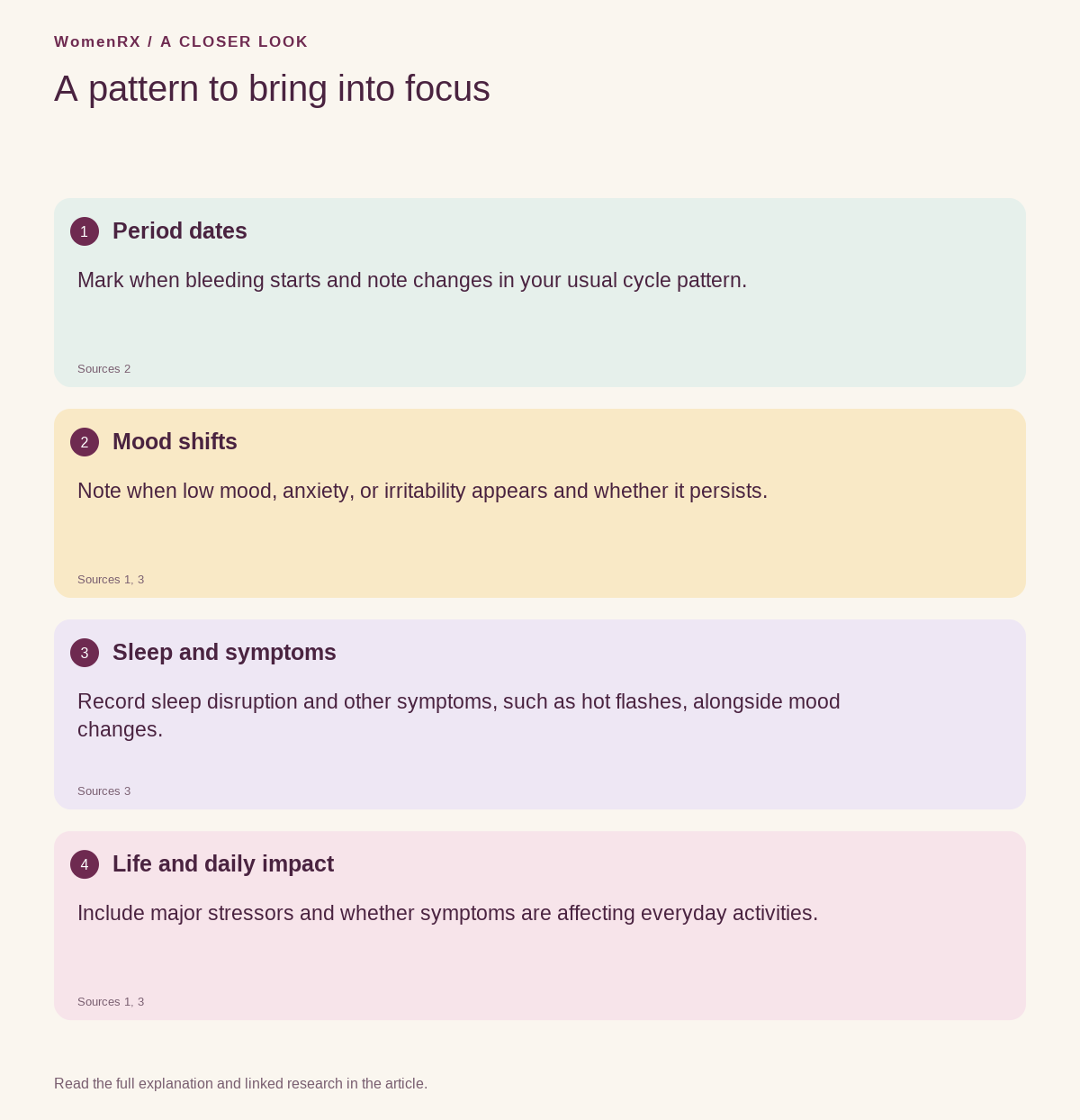
A pattern to bring into focus
Period dates: Mark when bleeding starts and note changes in your usual cycle pattern.2
Mood shifts: Note when low mood, anxiety, or irritability appears and whether it persists.13
Sleep and symptoms: Record sleep disruption and other symptoms, such as hot flashes, alongside mood changes.3
Life and daily impact: Include major stressors and whether symptoms are affecting everyday activities.13
Read the figure as text
Compare these observations over time to describe what you’re experiencing. They can provide context for a conversation, but they don’t diagnose perimenopause or depression.- Period dates: Mark when bleeding starts and note changes in your usual cycle pattern.2
- Mood shifts: Note when low mood, anxiety, or irritability appears and whether it persists.13
- Sleep and symptoms: Record sleep disruption and other symptoms, such as hot flashes, alongside mood changes.3
- Life and daily impact: Include major stressors and whether symptoms are affecting everyday activities.13
More questions, answered
Does having irregular periods mean my mood changes are from perimenopause?
No. Periods may become irregular as menopause approaches, but that timing doesn’t establish the cause of a mood change. Other medical conditions or medicines can also produce symptoms that resemble depression. 12
Should I wait two weeks before asking for help?
No. Two weeks is part of the symptom pattern used to assess depression, not a reason to delay help. If your mood is affecting everyday life or you’re concerned, you can seek an assessment sooner. 1
Sources you can check
- Depression: MedlinePlusAccessed 2026-09-25Return to first citation
- Irregular periods - NHSAccessed 2026-09-25Return to first citation
- FIGO best practice recommendations for the mental health of women at menopausal age.Khadilkar S, Divakar H, Benedetto C, Genazzani A, Ramos D, Argale E, Deshpande G, Hicky M, Filho ALDS, Herrera E, Balkrishnan M. · International journal of gynaecology and obstetrics: the official organ of the International Federation of Gynaecology and Obstetrics · 2026Return to first citation