Fatigue in Your 40s: Could Perimenopause Play a Part?
Changes in your periods, night sweats, and broken sleep can put fatigue in context, but tiredness has other possible causes too.
Yes, perimenopause could be part of the picture, especially if your periods are changing and new hot flashes or night sweats are disrupting your sleep. Fatigue alone can’t tell you whether hormones are involved. Poor sleep, anemia, thyroid disease, pregnancy, mood concerns, and other conditions can also leave you exhausted. Look at the pattern rather than assuming one cause. 561
Start with what changed together
If you’re in your 40s and newly exhausted, the useful question isn’t simply, “Is this hormonal?” It’s “What else changed around the time I started feeling this way?” Perimenopause often changes the pattern of your periods: they may come more or less often, and bleeding may become lighter or heavier. Recently started hot flashes or night sweats alongside a cycle change make perimenopause a more useful possibility to discuss than fatigue does on its own. 65
For example, suppose your periods have become less predictable, you’ve started waking up sweaty, and the next day you struggle to concentrate. That pattern gives you a plausible route from menopause symptoms to daytime tiredness: night sweats can worsen sleep, and poor sleep can affect how you feel and function the next day. It still doesn’t prove that every bit of your fatigue comes from perimenopause. 6
You don’t need to have hot flashes for your tiredness to deserve attention. Without them, though, fatigue and a changed cycle leave more questions open. And if you use hormonal contraception, your bleeding pattern may not be a clear guide to where you are in the transition. 56
Follow the sleep trail, then look beyond it
Try separating time in bed from restful sleep. Are you waking with sweats? Lying awake for another reason? Sleeping through the night but still feeling drained? These are different stories to bring to a visit. Menopause-related sleep problems may be worse with night sweats, while fatigue can also come from sleep disorders such as sleep apnea. 61
Your bleeding pattern matters for another reason, too. Perimenopause can bring heavier periods, while anemia is a possible cause of fatigue. If your bleeding has become heavier rather than simply less predictable, mention both changes instead of treating the bleeding as just another expected part of your 40s. 61
Other possibilities deserve the same space in the conversation. MedlinePlus lists pregnancy, thyroid disease, diabetes, infection, depression, anxiety, and too little sleep among potential causes of fatigue. Pregnancy remains possible during perimenopause. Medicines can be relevant as well: for example, clonidine, a medicine sometimes used for night sweats, can cause drowsiness. None of these possibilities can be sorted out by a symptom list alone, but they show why “it’s probably hormones” can be too quick an answer. 162
If the nights are the problem, there are options
If hot flashes or night sweats are repeatedly waking you, describe that problem specifically. The Menopause Society’s 2022 position statement identifies hormone therapy as the most effective treatment for hot flashes and night sweats, with treatment decisions depending on an individual’s circumstances. Menopause-specific cognitive behavioral therapy is another option to discuss for sleep problems associated with these symptoms. Neither is a blanket treatment for unexplained fatigue. 35
There is some direct research on perimenopausal fatigue, but it doesn’t make fatigue a hormone test. In a small randomized pilot study of regularly cycling women with at least one symptom, fatigue scores improved more with transdermal estradiol plus a levonorgestrel intrauterine system than with the intrauterine system alone over the study’s treatment period. Sleep-quality scores were not associated with estradiol use. That finding supports taking fatigue seriously as part of a symptom conversation, not assuming estrogen is the answer to any tiredness in your 40s. 4
Bring a pattern, not a self-diagnosis
A short record can make the conversation more productive. Note when fatigue started and whether it’s steady or varies by time of day. Add changes in period timing or bleeding, nights disrupted by sweats or other waking, and any new symptoms or medicines. MedlinePlus suggests a fatigue diary to spot daily patterns; this one adds the cycle and sleep details that may help put fatigue in context. It isn’t a diagnostic checklist. 156
If you’ve felt tired for weeks, particularly if it isn’t getting better, arrange a healthcare visit rather than waiting to find a perfect pattern. Share how the fatigue affects your usual activities, too. The next step may involve questions about sleep and daily life, an examination, or tests chosen around your particular symptoms. 1
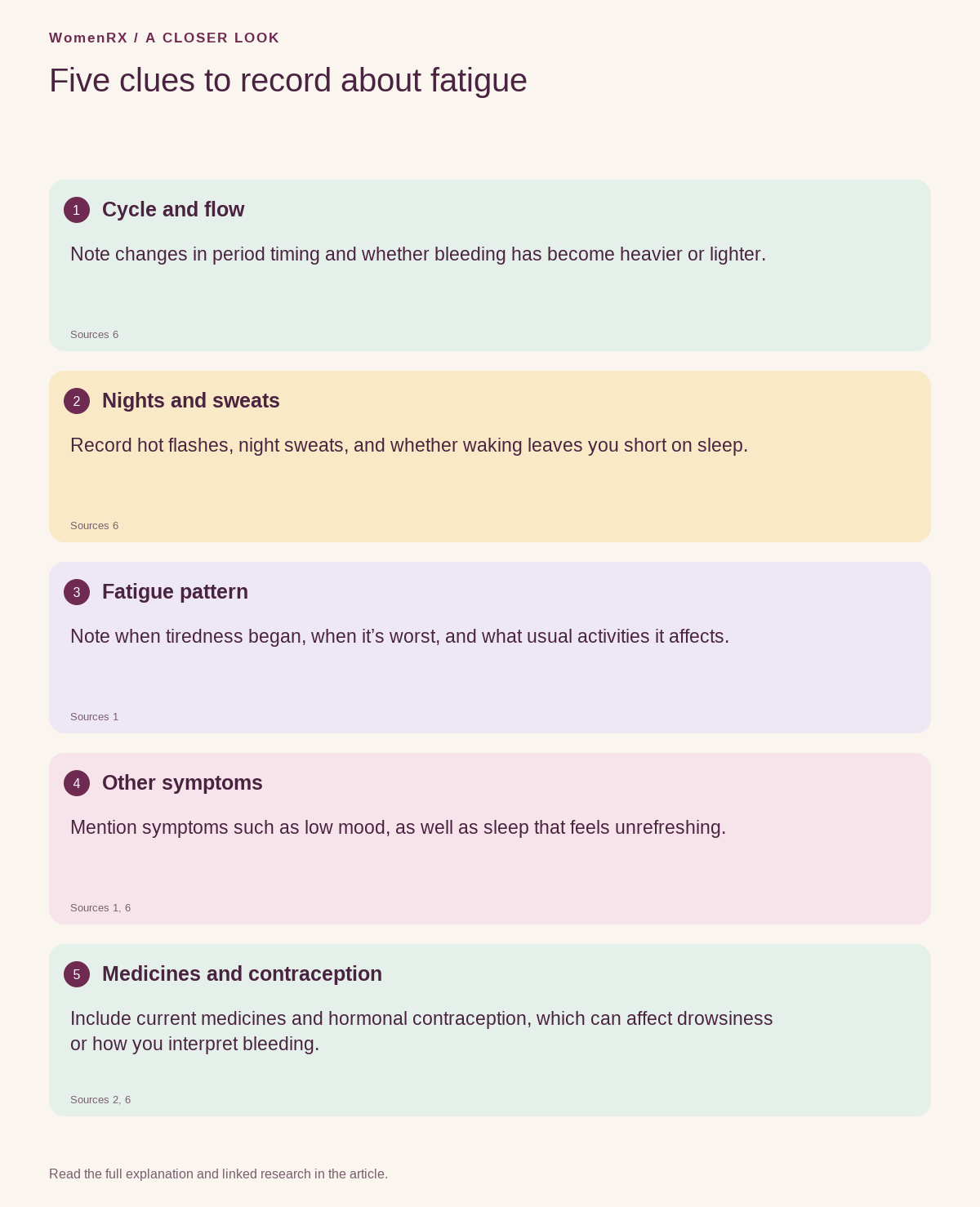
Five clues to record about fatigue
Cycle and flow: Note changes in period timing and whether bleeding has become heavier or lighter.6
Nights and sweats: Record hot flashes, night sweats, and whether waking leaves you short on sleep.6
Fatigue pattern: Note when tiredness began, when it’s worst, and what usual activities it affects.1
Other symptoms: Mention symptoms such as low mood, as well as sleep that feels unrefreshing.16
Medicines and contraception: Include current medicines and hormonal contraception, which can affect drowsiness or how you interpret bleeding.26
Read the figure as text
These details can help describe your fatigue and its possible contributors. They do not add up to a perimenopause diagnosis.- Cycle and flow: Note changes in period timing and whether bleeding has become heavier or lighter.6
- Nights and sweats: Record hot flashes, night sweats, and whether waking leaves you short on sleep.6
- Fatigue pattern: Note when tiredness began, when it’s worst, and what usual activities it affects.1
- Other symptoms: Mention symptoms such as low mood, as well as sleep that feels unrefreshing.16
- Medicines and contraception: Include current medicines and hormonal contraception, which can affect drowsiness or how you interpret bleeding.26
More questions, answered
Can it be perimenopause if I still get periods?
Yes. Periods can continue while their timing or flow changes during perimenopause. If you use hormonal contraception, it may be harder to interpret those changes because contraception itself can affect bleeding. 65
Does fatigue mean I need hormone therapy?
No. Treatment for hot flashes or night sweats is a different decision from finding the cause of fatigue. Hormone therapy is effective for those menopause symptoms, but tiredness can have causes that need a different approach. 31
Sources you can check
- Fatigue: MedlinePlusAccessed 2026-09-25Return to first citation
- Other medicines for menopause symptoms - NHSAccessed 2026-09-25Return to first citation
- The 2022 hormone therapy position statement of The North American Menopause Society.“The 2022 Hormone Therapy Position Statement of The North American Menopause Society” Advisory Panel. · Menopause (New York, N.Y.) · 2022Return to first citation
- Use of a levonorgestrel-containing intrauterine system with supplemental estrogen improves symptoms in perimenopausal women: a pilot study.Santoro N, Teal S, Gavito C, Cano S, Chosich J, Sheeder J. · Menopause (New York, N.Y.) · 2015Return to first citation
- Recommendations | Menopause: identification and management | Guidance | NICEAccessed 2026-09-25Return to first citation
- Symptoms of menopause and perimenopause - NHSAccessed 2026-09-25Return to first citation