Could Tirzepatide Be Behind Your Fatigue?
A change in appetite or food intake may be a useful clue, but fatigue during tirzepatide treatment can have other causes.
Possibly, but feeling tired after starting tirzepatide doesn’t establish that the medicine caused it. Tirzepatide reduces food intake in people with type 2 diabetes, so a marked change in eating is worth noticing. If you also use basal insulin, low blood glucose is another possibility to discuss. Sleep loss, anemia, iron deficiency, and thyroid disease can cause fatigue too. 2 1 3
What changed when the fatigue began?
If fatigue started soon after you began tirzepatide or after a dose change, that timing is worth mentioning. It can help you and your clinician look for a pattern, but it doesn’t prove the medicine is the cause. A large review of weight-loss medicines did not provide a tirzepatide-specific fatigue estimate in its reported findings, so it cannot tell you how likely the medicine is to be responsible. 4
In people with type 2 diabetes, tirzepatide reduces food intake. 2 If your appetite has dropped enough that meals are much smaller or you’re skipping them, consider whether the tiredness appeared alongside that change. It’s a useful clue to share, not a diagnosis: eating less during treatment doesn’t establish why you feel tired.
If you have type 2 diabetes and also use basal insulin, there’s a different treatment-related question to consider. Low blood glucose occurred in the Mounjaro trials that added tirzepatide to basal insulin. If you’ve noticed glucose readings below your usual range around the times you feel unwell, bring those readings to the clinician managing your diabetes. This distinction doesn’t apply in the same way to someone who isn’t using insulin. 2
Look beyond the medication
Has your sleep changed, even if treatment and fatigue began around the same time? Lack of sleep is another possible cause. MedlinePlus also lists anemia, thyroid disease, infections, depression, anxiety, and some medicines among the many possible causes of fatigue. These possibilities matter especially if the tiredness persists rather than easing. 1
If you menstruate, pay attention to unusually heavy bleeding. Menstrual blood loss can contribute to iron deficiency, and iron deficiency can be associated with fatigue even when anemia hasn’t developed. A review of research on iron deficiency in adults describes fatigue in people with iron deficiency without anemia and reports that iron treatment reduced self-reported fatigue in trials. That doesn’t mean iron is the cause of your symptoms; it makes heavy bleeding and possible iron deficiency relevant details to discuss when considering whether iron status should be assessed. 3
Make a short, useful record
Jot down when the fatigue began relative to treatment changes and when it’s strongest during the day. Add any clear changes in meals, fluids, sleep, or menstrual bleeding. If you use basal insulin, include any glucose readings that coincide with feeling unwell. You don’t need a perfect diary. The point is to make the pattern easier to describe, not to diagnose yourself; a fatigue diary can help show how tiredness varies across the day. 1 2
If fatigue continues for weeks or is interfering with your usual activities, contact your clinician to discuss possible causes and whether an assessment or tests are appropriate. Don’t assume persistent fatigue is simply part of weight loss. 1
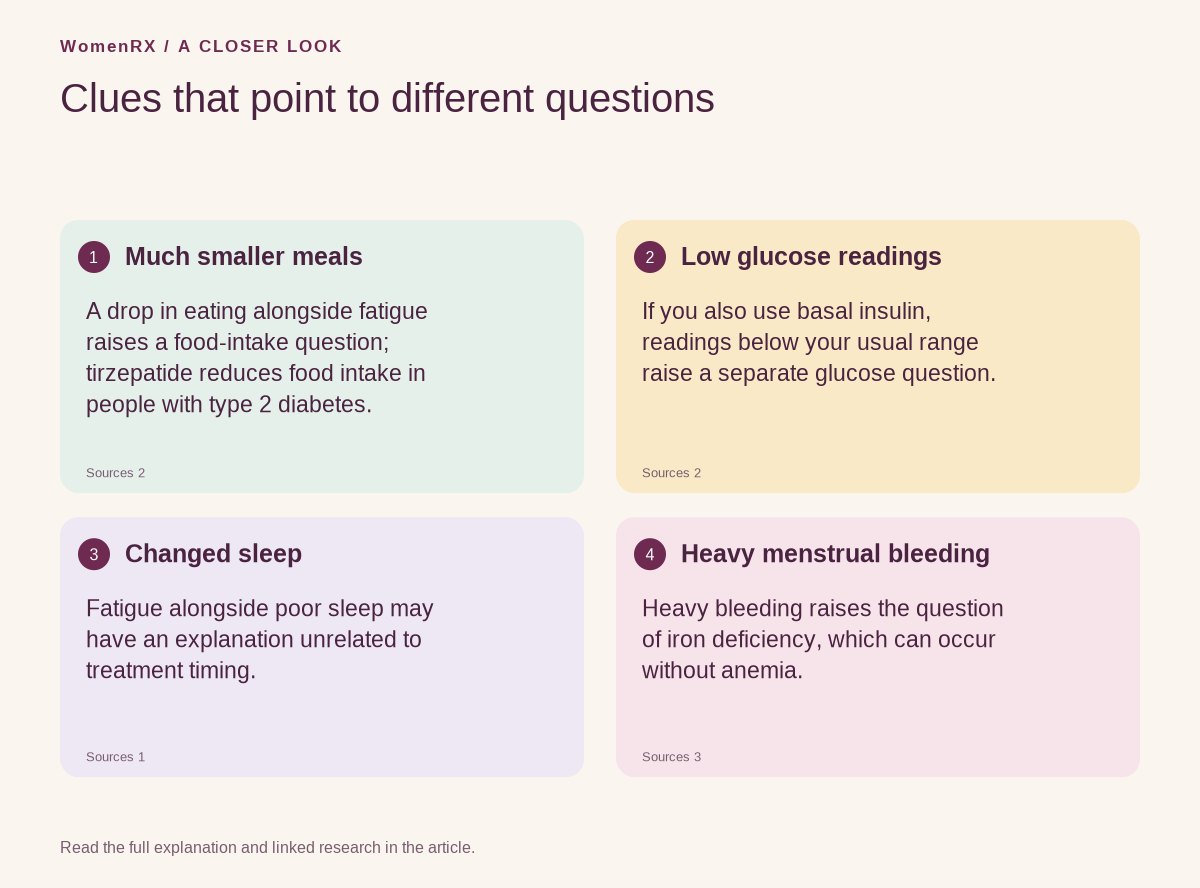
Clues that point to different questions
Much smaller meals: A drop in eating alongside fatigue raises a food-intake question; tirzepatide reduces food intake in people with type 2 diabetes.2
Low glucose readings: If you also use basal insulin, readings below your usual range raise a separate glucose question.2
Changed sleep: Fatigue alongside poor sleep may have an explanation unrelated to treatment timing.1
Heavy menstrual bleeding: Heavy bleeding raises the question of iron deficiency, which can occur without anemia.3
Read the figure as text
Changes that happen alongside fatigue can help focus a clinical discussion. None identifies the cause by itself.- Much smaller meals: A drop in eating alongside fatigue raises a food-intake question; tirzepatide reduces food intake in people with type 2 diabetes.2
- Low glucose readings: If you also use basal insulin, readings below your usual range raise a separate glucose question.2
- Changed sleep: Fatigue alongside poor sleep may have an explanation unrelated to treatment timing.1
- Heavy menstrual bleeding: Heavy bleeding raises the question of iron deficiency, which can occur without anemia.3
More questions, answered
Can iron deficiency cause fatigue without anemia?
Yes. Iron deficiency can occur before anemia is present, and a review of adult research describes fatigue in people with iron deficiency without anemia. If you have heavy menstrual bleeding, mention it when discussing whether iron status should be assessed. 3
Sources you can check
- Fatigue: MedlinePlusAccessed 2026-09-25Return to first citation
- MOUNJARO (TIRZEPATIDE) INJECTION, SOLUTION MOUNJARO KWIKPEN (TIRZEPATIDE) INJECTION, SOLUTION [ELI LILLY AND COMPANY] | US prescribing information and patient instructionsAccessed 2026-09-25Return to first citation
- Iron deficiency without anemia: An underrecognized and undertreated clinical condition with special focus on colorectal cancer.Raja NP, Kandagari N. · Clinical hematology international · 2026Return to first citation
- Comparative effects of drugs for adults with overweight or obesity: systematic review and network meta-analysis.Nong K, Shi Q, Xie X, Wang Y, Agarwal A, Guyatt GH, Zhang H, Gao Y, Khunti K, Le Roux CW, Widyahening IS, Fan Q, Liu T, Mao Y, Florez ID, Du H, Pan X, Zou X, Wang C, Sun X, Li J, H... · BMJ (Clinical research ed.) · 2026Return to first citation