Fatigue on Mounjaro: What to Check First
Fatigue can show up during treatment, but timing alone can’t tell you whether Mounjaro, glucose changes, or something else is responsible.
Start by looking for a pattern: when the fatigue began, whether it follows an injection or a medicine change, and what your glucose readings show around those times. Low blood sugar is a particular check if you also use basal insulin. Tirzepatide can reduce food intake, but that does not prove reduced eating is causing fatigue. Bring sleep, eating, and other health changes into the same review. Thyroid dysfunction is another possibility to discuss, particularly if you also have palpitations; a case report does not establish that tirzepatide causes it. 123
Start with the pattern, not the assumption
Feeling tired while taking Mounjaro (tirzepatide) doesn’t by itself show that the medicine is the cause. In a retrospective weight-management program that included both tirzepatide and semaglutide, fatigue was listed among common initial side effects. Because the program was observational and included two medicines, it can’t show that tirzepatide caused the fatigue or tell us how often it happens among people taking Mounjaro for type 2 diabetes. 4
Write down when the fatigue started and whether it changes across the week, after an injection, or after a dose or other medicine change. Also note what it feels like: for example, sleepiness, weakness, or difficulty concentrating. This record can help your care team compare fatigue with glucose readings, eating, sleep, and treatment changes rather than guessing from timing alone.
Check glucose, especially with insulin
Tirzepatide lowers blood glucose. Low blood sugar deserves particular attention if you take Mounjaro with basal insulin: in a 40-week trial of adults with type 2 diabetes using basal insulin, with or without metformin, at least one episode of glucose below 54 mg/dL was reported by 13% of placebo recipients and 16%, 19%, and 14% of those taking the three studied Mounjaro doses. In the trial’s monotherapy group, the percentages reporting at least one such episode were 1% with placebo and 0% at each studied Mounjaro dose. These are trial results, not a prediction of what will happen to you. 1
If you already check your glucose, note readings around episodes of fatigue and any patterns your care team has asked you to watch for. Don’t change insulin or other diabetes medicines based on this article. Ask your care team whether your monitoring plan and combination of medicines should be reviewed. The trial results above concern Mounjaro added to basal insulin, with or without metformin, rather than every insulin regimen. 1
High readings are worth noting too. Diabetes involves glucose that can remain in the bloodstream rather than moving into cells for use as energy, and glucose monitoring is part of diabetes management. A reading near a tired spell doesn’t establish the cause, but a pattern gives your team something concrete to assess. 2
Consider eating, sleep, and other changes
Tirzepatide can decrease food intake. If you’re eating less than usual, or nausea, vomiting, or diarrhea are making it hard to eat, record that alongside the fatigue. Reduced intake is a possible part of the picture to discuss, not proof of a specific mechanism or a reason to assume the medicine is responsible. 13
Include sleep changes, recent illness, and other new symptoms in your notes. Bring a current list of your medicines, including diabetes medicines, and mark any recent starts or changes. That helps your care team consider explanations beyond tirzepatide as well as the possibility that more than one factor is contributing. Thyroid dysfunction is one possibility to discuss, especially if fatigue comes with palpitations. A case report described a woman with type 2 diabetes whose fatigue and palpitations during tirzepatide treatment were initially attributed to the drug but were later linked to Graves’ disease. That single case cannot show that tirzepatide caused the thyroid condition or explain fatigue in other patients. 3
Does fatigue differ for women?
The observational program included mostly women and used both tirzepatide and semaglutide. Its cited findings do not show whether fatigue differs by sex. 4
If relevant, tell your care team about heavy menstrual bleeding or possible anemia, pregnancy, changes after childbirth, or menopause. Ask whether any of these contexts merits consideration alongside your glucose readings and medicines rather than assuming one explains the fatigue.
A short record is more useful than a guess
Before a conversation with your care team, gather a few days of observations if you already have the information available: fatigue timing, glucose readings, meal or appetite changes, sleep, and any medicine changes. Include whether you take basal insulin. Ask how your glucose pattern fits with the fatigue, whether your medicine combination needs review, and whether another explanation should be considered. The goal isn’t to prove the cause on your own. It’s to make the next assessment more specific.
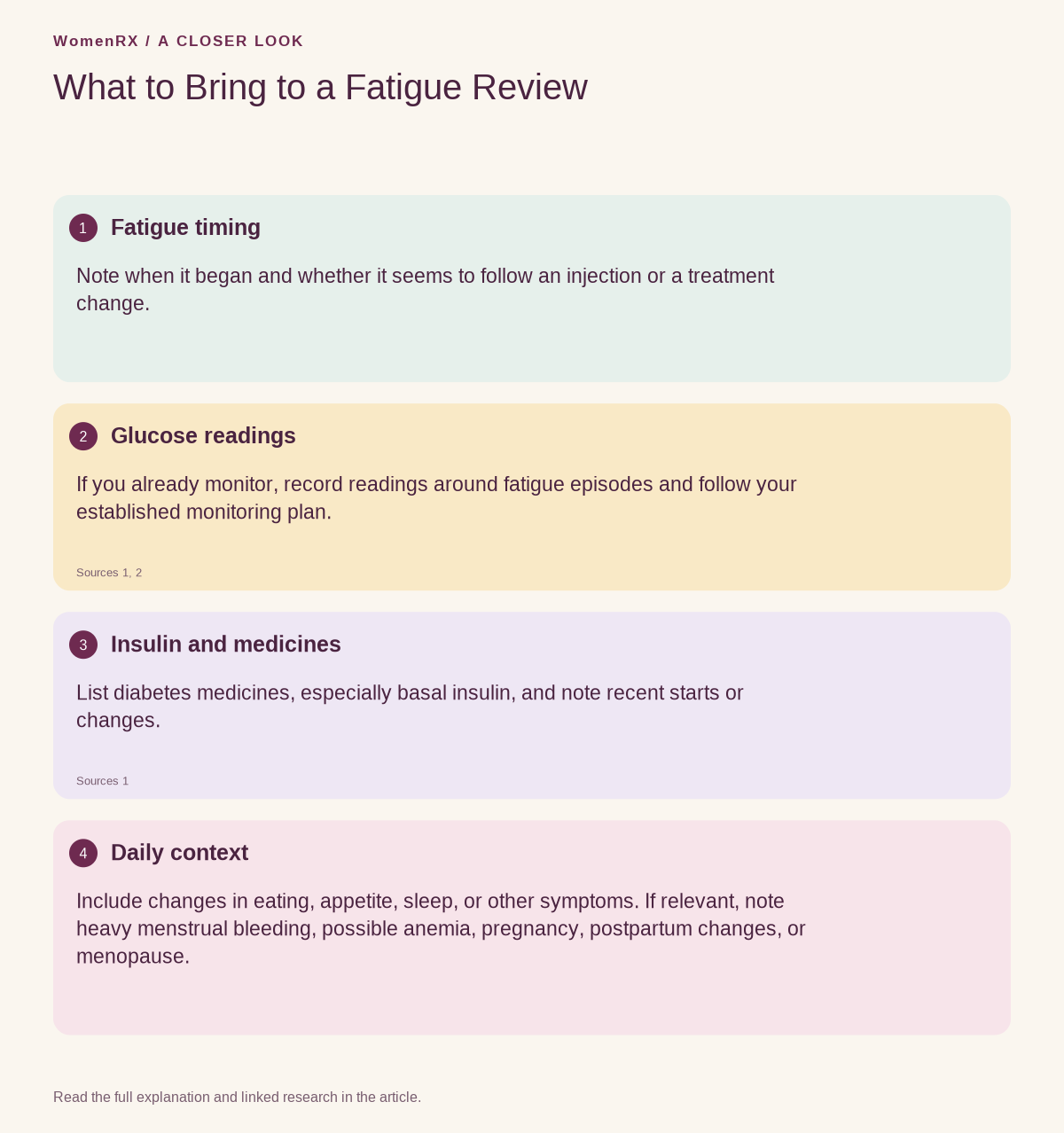
What to Bring to a Fatigue Review
Fatigue timing: Note when it began and whether it seems to follow an injection or a treatment change.
Glucose readings: If you already monitor, record readings around fatigue episodes and follow your established monitoring plan.12
Insulin and medicines: List diabetes medicines, especially basal insulin, and note recent starts or changes.1
Daily context: Include changes in eating, appetite, sleep, or other symptoms. If relevant, note heavy menstrual bleeding, possible anemia, pregnancy, postpartum changes, or menopause.
Read the figure as text
A brief record can help connect fatigue with glucose patterns, treatment changes, and day-to-day context without deciding the cause in advance.- Fatigue timing: Note when it began and whether it seems to follow an injection or a treatment change.
- Glucose readings: If you already monitor, record readings around fatigue episodes and follow your established monitoring plan.12
- Insulin and medicines: List diabetes medicines, especially basal insulin, and note recent starts or changes.1
- Daily context: Include changes in eating, appetite, sleep, or other symptoms. If relevant, note heavy menstrual bleeding, possible anemia, pregnancy, postpartum changes, or menopause.
More questions, answered
Does fatigue mean my blood sugar is low?
Not by itself. If you use basal insulin, low blood sugar is especially worth checking because in a basal-insulin add-on trial, a higher percentage of participants taking Mounjaro than placebo reported at least one episode of glucose below 54 mg/dL. Look at readings around symptoms if you already monitor, and ask your care team how to interpret the pattern. 1
Does fatigue differ for women taking Mounjaro?
The cited findings cannot tell. The observational weight-management program included mostly women and listed fatigue among initial side effects, but it included both tirzepatide and semaglutide. Its abstract provides no comparison of fatigue by sex. 4
Sources you can check
- MOUNJARO (TIRZEPATIDE) INJECTION, SOLUTION MOUNJARO KWIKPEN (TIRZEPATIDE) INJECTION, SOLUTION [ELI LILLY AND COMPANY] | US prescribing information and patient instructionsAccessed 2026-09-25Return to first citation
- Diabetes | Type 1 Diabetes | Type 2 Diabetes | MedlinePlusAccessed 2026-09-25Return to first citation
- Unilateral Graves' Disease Developing During Treatment With Tirzepatide in a Patient With Diabetes: A Case Report.Deto Y, Hasegawa R, Ino S, Shibata S, Ohno K, Itoh T, Matsumoto T, Miki T. · Case reports in endocrinology · 2026Return to first citation
- Semaglutide and Tirzepatide in a Remote Weight Management Program: 12-Month Retrospective Observational Study.Richards R, Lunt W, Whitman M, Spaltro G, Hall R. · JMIR formative research · 2025Return to first citation