Fatigue Around Menopause: What to Check First
A link between restless nights and low energy is worth noticing, but fatigue that lasts for weeks deserves a broader look.
If hot flashes or night sweats wake you, lost sleep may be contributing to next-day fatigue. But fatigue can also come from anemia, thyroid disease, sleep disorders, depression, anxiety, and other conditions. Notice when your energy dips, what happens overnight, and whether ordinary activities are getting harder. If fatigue lasts several weeks, arrange an evaluation rather than assuming it’s menopause. 1 3
Start with what happens before the tiredness
Low energy during perimenopause or after menopause can feel like one more symptom to put down to hormones. The more useful question is what accompanies it. Fatigue is a symptom, not a diagnosis, and possible contributors include too little sleep, stress, anemia, thyroid disease, depression, anxiety, and other sleep or medical conditions. 1
Use these clues to describe the pattern, not to decide the cause on your own:
| What you notice | What it helps you ask |
|---|---|
| Hot flashes or night sweats wake you, and you’re worn out the next day | Could interrupted sleep be contributing? Notice whether the pattern repeats, including on nights without those awakenings. Too little sleep can cause fatigue. 1 |
| You’re tired even after nights that seem restful | What else needs consideration? Fatigue can have medical, mental health, and sleep-related causes; a night that seems restful doesn’t settle the question. 1 |
| Low energy comes with stress or changes in mood | Could stress, anxiety, or depression be contributing alongside anything else? These are possible causes of fatigue, not conclusions to draw from one clue. 1 |
| Fatigue comes with new shortness of breath | Don’t automatically group both symptoms under menopause. A review of menopause and heart failure describes this overlap and the need to assess possible cardiac causes. 4 |
Sleep difficulties and fatigue are both reported around menopause, but their presence together doesn’t show that changing hormone levels directly cause fatigue. If you know a hot flash woke you and you slept poorly afterward, that gives you a specific, plausible contributor to discuss. The distinction matters in both perimenopause and postmenopause: addressing a disrupted night may help, while persistent low energy may need a separate explanation. 1 3
Give the sleep clue a useful follow-up
If awakenings are part of the picture, note what wakes you and how you feel the following day. A brief fatigue diary can reveal times when your energy is lower or higher. You don’t need a perfect record: a few notes about sleep, energy, and the effect on your usual activities can make a conversation more specific. Improving sleep habits is also a reasonable step while you work out what’s going on. 1
There are ways to address bothersome menopause symptoms rather than simply putting up with them. The North American Menopause Society identifies hormone therapy as the most effective treatment for hot flashes and night sweats, with benefits and risks that vary by individual circumstances. A systematic review of randomized trials involving women with menopausal symptoms also found that psychosocial approaches, particularly cognitive behavioral therapy, improved sleep outcomes. These findings support a conversation about the symptom that’s disturbing your nights; they don’t make either approach a direct treatment for every cause of fatigue. 2 3
When to look beyond the nighttime pattern
If fatigue lasts several weeks or keeps getting in the way of daily life, make time for an evaluation even if you’ve also been having menopause symptoms. You can say, for example, “My energy has been lower for several weeks, and I’m waking at night,” or “I feel worn out despite nights that seem restful.” Mention changes in mood, pain, activities, or breathing too. A clinician may ask about sleep, appetite, exercise, and daily activities, then consider an exam or lab tests based on your situation. 1 4
That leaves room for two things to be true at once: a difficult night may affect tomorrow’s energy, and another cause of fatigue may still need attention. The pattern helps you choose a useful starting question. It doesn’t have to carry the whole diagnosis.
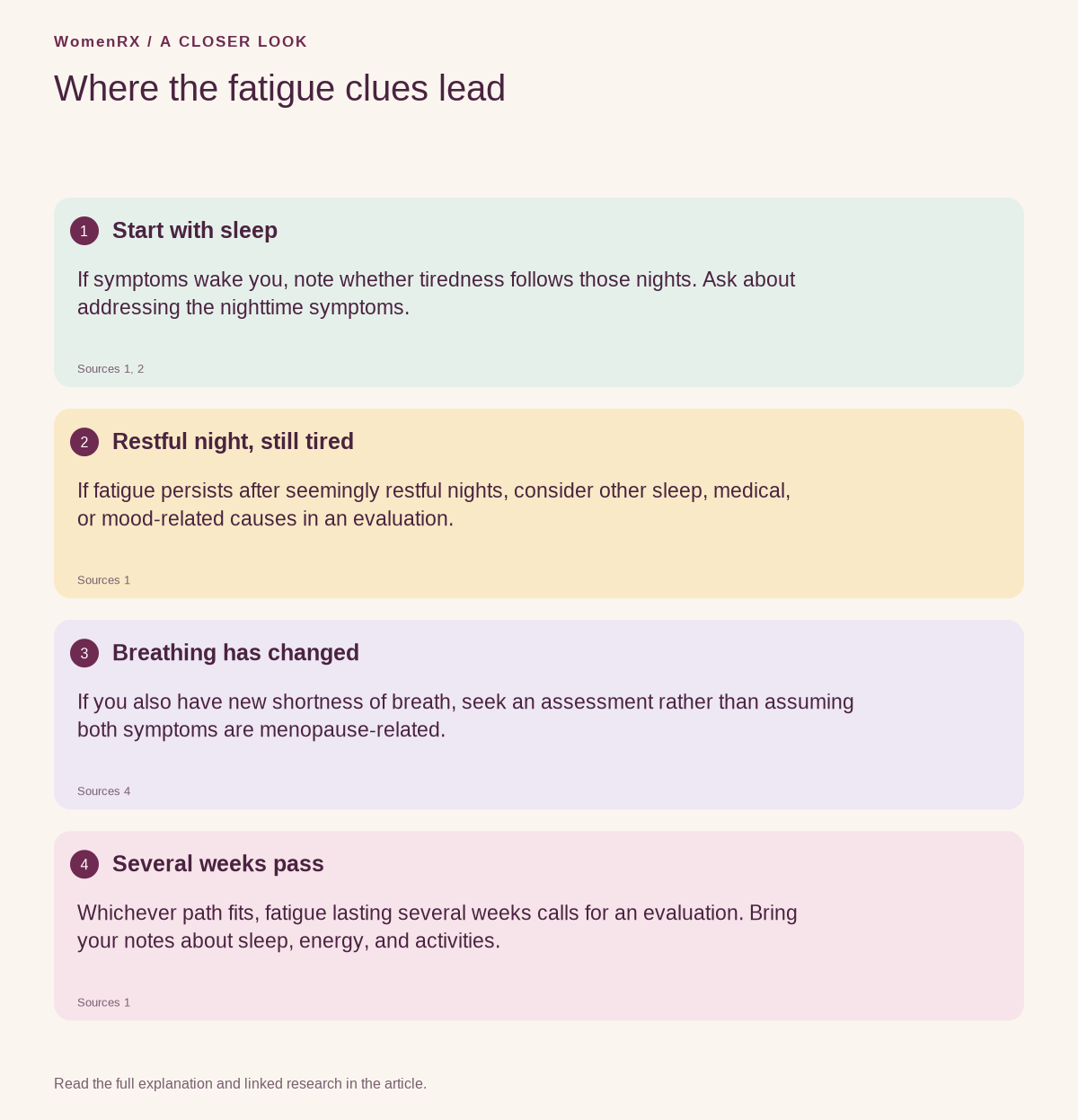
Where the fatigue clues lead
Start with sleep: If symptoms wake you, note whether tiredness follows those nights. Ask about addressing the nighttime symptoms.12
Restful night, still tired: If fatigue persists after seemingly restful nights, consider other sleep, medical, or mood-related causes in an evaluation.1
Breathing has changed: If you also have new shortness of breath, seek an assessment rather than assuming both symptoms are menopause-related.4
Several weeks pass: Whichever path fits, fatigue lasting several weeks calls for an evaluation. Bring your notes about sleep, energy, and activities.1
Read the figure as text
Start with what accompanies low energy, then choose a next question. These paths are prompts for assessment, not a diagnostic test.- Start with sleep: If symptoms wake you, note whether tiredness follows those nights. Ask about addressing the nighttime symptoms.12
- Restful night, still tired: If fatigue persists after seemingly restful nights, consider other sleep, medical, or mood-related causes in an evaluation.1
- Breathing has changed: If you also have new shortness of breath, seek an assessment rather than assuming both symptoms are menopause-related.4
- Several weeks pass: Whichever path fits, fatigue lasting several weeks calls for an evaluation. Bring your notes about sleep, energy, and activities.1
Sources you can check
- Fatigue: MedlinePlusAccessed 2026-09-25Return to first citation
- The 2022 hormone therapy position statement of The North American Menopause Society.“The 2022 Hormone Therapy Position Statement of The North American Menopause Society” Advisory Panel. · Menopause (New York, N.Y.) · 2022Return to first citation
- The effectiveness of psychosocial interventions on physiological symptoms of menopause: a systematic review and meta-analysis.Robinson K, Hardy R, Melville M, Saidel S, Desai R, Spector A. · BMC women's health · 2026Return to first citation
- Overlap Between Heart Failure and Menopause: Diagnostic Challenges and Clinical Implications.Kwan TN, Yan A, Jain P, Raju H, Muthiah K. · Heart, lung & circulation · 2026Return to first citation