Dizzy on Mounjaro? Check These Causes First
A glucose reading, your other medicines, and what happened just before the dizziness can help you decide what needs attention.
Dizziness on Mounjaro doesn’t automatically mean low blood sugar. If you can, check your glucose while you feel dizzy, especially if you also take insulin or a sulfonylurea. Then consider whether nausea, vomiting, diarrhea, or less food and fluid may be involved, and whether the feeling starts when you stand up. Repeated dizziness or trouble keeping fluids down deserves a call to your care team. 1234
First, get somewhere safe. Sit or lie down until the feeling passes, get up slowly, and don’t drive while you’re dizzy. Notice whether you feel faint, off-balance, or as though the room is spinning. Those descriptions aren’t a diagnosis, but they help separate the possibilities. 4
Check glucose during the episode
A glucose reading is more useful than guessing from the sensation. For many people with diabetes, a reading below 70 mg/dL is considered low, though your care team may have given you a different threshold. Dizziness can be a symptom of low glucose, but dizziness alone doesn’t establish that glucose is the cause. 23
The rest of your diabetes medicine list matters here. Mounjaro’s prescribing information warns that combining it with insulin or an insulin secretagogue, such as a sulfonylurea, raises the risk of hypoglycemia, including severe episodes. In a 40-week placebo-controlled trial of Mounjaro used alone, no participants in the Mounjaro groups had a recorded glucose reading below 54 mg/dL. That result should not be applied to someone also taking insulin. 12
If your reading is low and you can swallow safely, follow your established low-glucose plan. Carbohydrates can help treat mild or moderate hypoglycemia. If someone passes out or isn’t responding normally, don’t give them food or drink by mouth. Someone with them can give prescribed glucagon if it’s available and they know how to use it. Call emergency services if glucagon isn’t available, no one knows how to use it, or the person hasn’t recovered within 10 minutes after receiving it. Tell your diabetes team about repeated lows so they can review your treatment plan rather than changing medicine doses on your own. 236
If glucose isn’t low, look at intake and standing up
Mounjaro commonly causes gastrointestinal effects, including nausea, vomiting, and diarrhea. These were reported more often with Mounjaro than placebo in pooled adult trials, and most reports of nausea, vomiting, or diarrhea occurred during dose escalation. If those symptoms have made it hard to eat, that matters particularly when you take a medicine that can lower glucose. If vomiting or diarrhea has made it hard to drink or keep fluids down, volume depletion is another concern. Mounjaro’s prescribing information warns that dehydration associated with gastrointestinal effects can contribute to acute kidney injury. Contact your care team promptly about persistent vomiting or diarrhea or difficulty maintaining fluids. 13
Timing offers another clue. Feeling lightheaded just after standing can point toward a drop in blood pressure on standing, while a spinning sensation can suggest a different cause, such as an inner-ear problem. If you take blood-pressure medicine, note its name and when you took it, along with when the dizziness happens. That’s useful information for a medication review, not proof that the medicine or Mounjaro caused the episode. If you already check blood pressure at home, share relevant readings with your care team. 4
When the pattern needs a closer look
Don’t keep attributing recurring dizziness to Mounjaro without checking the pattern. Dizziness that persists or keeps returning, fainting, new vision changes, trouble speaking, or weakness or numbness calls for medical assessment. Persistent or severe gastrointestinal symptoms also warrant contact with your care team while taking Mounjaro. 14
Other causes may fit better than glucose or fluid loss. For example, dizziness accompanied by a spinning feeling or hearing changes may point toward an inner-ear problem. Iron-deficiency anemia is another possible cause of dizziness. If you have unusually heavy periods, mention that when discussing recurring dizziness with your care team; the dizziness alone can’t tell you whether anemia is involved. 4
If you’re pregnant or planning pregnancy, tell your diabetes care team you’re taking Mounjaro so you can discuss your treatment. That conversation matters independently of what’s causing the dizziness. 1
A meta-analysis of trials in people with type 2 diabetes found more reported dizziness with tirzepatide than with its trial comparators, but that result doesn’t identify the cause of an individual episode. The reported results do not establish whether dizziness risk differs by sex. The practical next move is to pair what you felt with a glucose reading, the medicines you take, any trouble eating or drinking, and whether standing brings it on. 5124
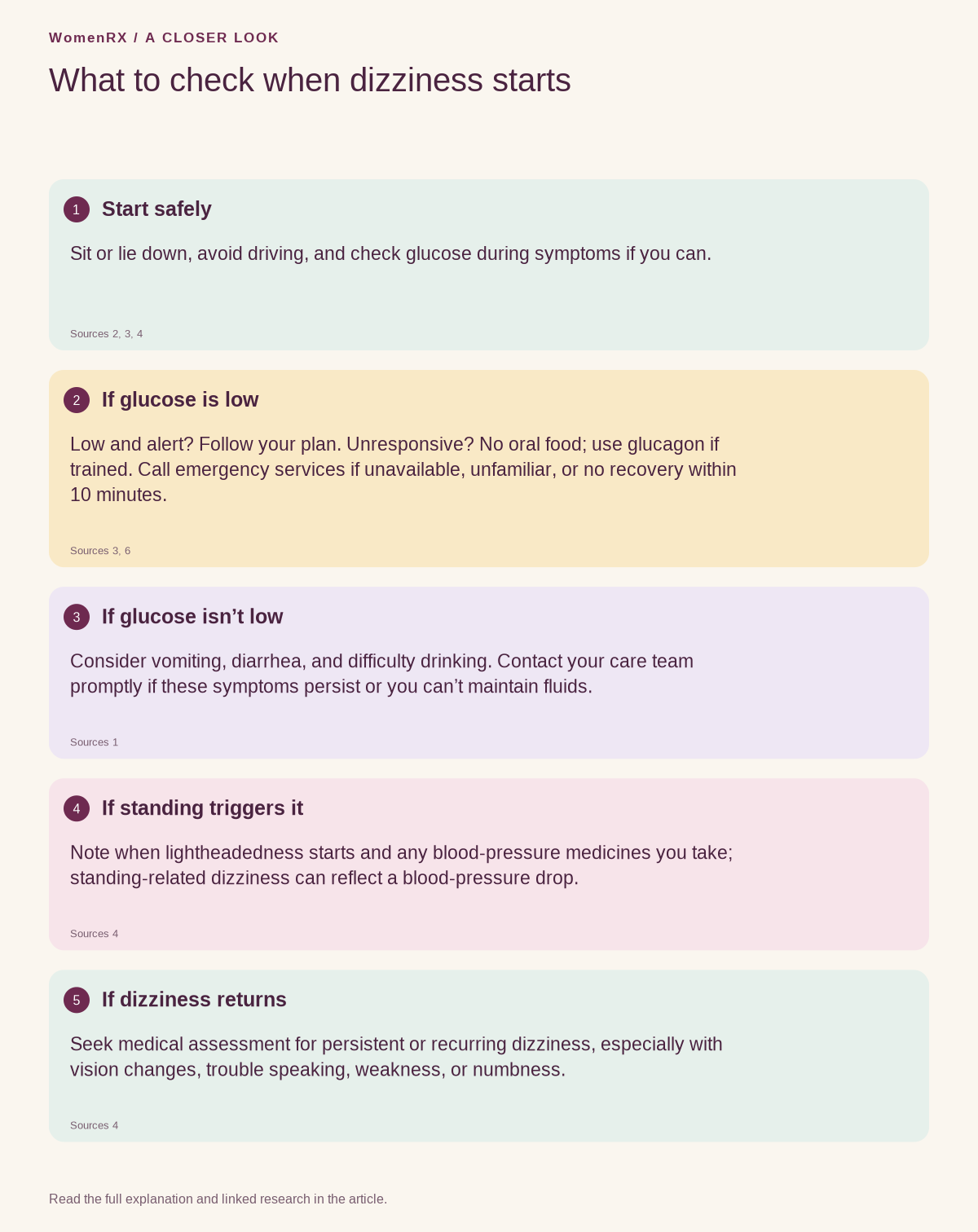
What to check when dizziness starts
Start safely: Sit or lie down, avoid driving, and check glucose during symptoms if you can.234
If glucose is low: Low and alert? Follow your plan. Unresponsive? No oral food; use glucagon if trained. Call emergency services if unavailable, unfamiliar, or no recovery within 10 minutes.36
If glucose isn’t low: Consider vomiting, diarrhea, and difficulty drinking. Contact your care team promptly if these symptoms persist or you can’t maintain fluids.1
If standing triggers it: Note when lightheadedness starts and any blood-pressure medicines you take; standing-related dizziness can reflect a blood-pressure drop.4
If dizziness returns: Seek medical assessment for persistent or recurring dizziness, especially with vision changes, trouble speaking, weakness, or numbness.4
Read the figure as text
Start with safety and a glucose reading, then use the result and symptom pattern to choose the next check.- Start safely: Sit or lie down, avoid driving, and check glucose during symptoms if you can.234
- If glucose is low: Low and alert? Follow your plan. Unresponsive? No oral food; use glucagon if trained. Call emergency services if unavailable, unfamiliar, or no recovery within 10 minutes.36
- If glucose isn’t low: Consider vomiting, diarrhea, and difficulty drinking. Contact your care team promptly if these symptoms persist or you can’t maintain fluids.1
- If standing triggers it: Note when lightheadedness starts and any blood-pressure medicines you take; standing-related dizziness can reflect a blood-pressure drop.4
- If dizziness returns: Seek medical assessment for persistent or recurring dizziness, especially with vision changes, trouble speaking, weakness, or numbness.4
More questions, answered
Can Mounjaro cause dizziness even if my glucose is normal?
Yes. Dizziness was reported more often with tirzepatide than with comparators in a meta-analysis of type 2 diabetes trials, but the finding doesn’t show why any one person feels dizzy. Gastrointestinal symptoms with fluid loss and a blood-pressure drop on standing are other possibilities to consider. 514
Sources you can check
- MOUNJARO (TIRZEPATIDE) INJECTION, SOLUTION MOUNJARO KWIKPEN (TIRZEPATIDE) INJECTION, SOLUTION [ELI LILLY AND COMPANY] | US prescribing information and patient instructionsAccessed 2026-09-25Return to first citation
- MOUNJARO (TIRZEPATIDE) INJECTION, SOLUTION [A-S MEDICATION SOLUTIONS] | US prescribing information and patient instructionsAccessed 2026-09-25Return to first citation
- Hypoglycemia: MedlinePlusAccessed 2026-09-25Return to first citation
- Dizziness - NHSAccessed 2026-09-25Return to first citation
- Effect of Tirzepatide on arrhythmic, major cardiovascular, and neurological outcomes in patients with type 2 diabetes: A systematic review and meta-analysis.Wu R, Xing B, Zhou Z, Yu L, Wang H. · Neurological sciences : official journal of the Italian Neurological Society and of the Italian Society of Clinical Neurophysiology · 2025Return to first citation
- Low blood sugar (hypoglycaemia) - NHSAccessed 2026-09-25Return to first citation