Dizziness on Ozempic: What to Check First
Start with your glucose reading if you have one, your other diabetes medicines, and whether you’ve been able to eat and drink.
Dizziness is reported with Ozempic, but a dizzy spell doesn’t tell you its cause. If you have diabetes and can check your glucose, do so, especially if you also take insulin or a sulfonylurea. Nausea, vomiting, or diarrhea can also leave you short on fluids. Note when the dizziness happens and seek help promptly if you pass out or can’t respond normally. 26
Start with the pattern, not the assumption
“Dizzy” can mean lightheaded, faint, off-balance, or as if the room is spinning. Those sensations have different possible causes. Low blood sugar is one possibility, but dizziness by itself doesn’t diagnose it. A sudden spell after standing, for example, can fit a drop in blood pressure; spinning or balance symptoms can have an inner-ear cause. A new medicine can also be relevant. 3
If you have diabetes and use a glucose meter or continuous glucose monitor, check your glucose during the episode when you can. For many people with diabetes, a reading below 70 mg/dL is considered low, but your personal threshold may differ. Without diabetes, low glucose is typically below 55 mg/dL, and a feeling of dizziness alone doesn’t establish that your glucose is low. 2
Your other diabetes medicines change the odds
The most useful medication question is whether you also take insulin or a sulfonylurea, a type of medicine that prompts the pancreas to release insulin. Ozempic’s prescribing information warns that combining it with insulin or a sulfonylurea can raise the risk of low blood sugar, including severe episodes. The label says the prescriber may consider lowering the other medicine’s dose; don’t change it on your own. 6
The trial figures help show why the combination matters. In 30-week placebo-controlled trials in adults with type 2 diabetes, documented symptomatic low glucose (defined there as glucose at or below 70 mg/dL) occurred in 0% of placebo recipients and 1.6% and 3.8% of people taking Ozempic at the two reported doses when used alone. In a separate trial where Ozempic was added to basal insulin, the corresponding rates were 15.2% with placebo and 16.7% or 29.8% with Ozempic. These are specific trial results, not a prediction of what will happen to you. 1
Metformin alone is a different combination from insulin or a sulfonylurea. A review of 10 studies of oral semaglutide plus metformin in people with type 2 diabetes and overweight or obesity found no significant difference in reported hypoglycemia between the treatment groups. That result doesn’t prove dizziness is harmless, and it doesn’t directly answer what happens with Ozempic injection or every medication combination. 4
Check meals, stomach symptoms, and timing
A missed meal or being sick and unable to eat enough can contribute to low glucose for someone taking insulin or certain diabetes medicines. Note whether dizziness follows a delayed or skipped meal, vomiting, or another spell when you couldn’t keep food down. This pattern is a clue to discuss, not proof that low glucose caused the symptom. 2
Ozempic’s prescribing information also reports dizziness as an adverse reaction. Nausea, vomiting, and diarrhea are reported with Ozempic and can cause fluid loss. If dizziness occurs alongside those stomach symptoms, dehydration is another possibility, not a diagnosis you can make from the timing alone. Tell your prescriber promptly if nausea, vomiting, or diarrhea doesn’t go away. 6
Also notice whether dizziness starts when you stand, after a medicine change, or with spinning or hearing changes. For example, dizziness mainly on standing points to a different possibility than a low reading on your glucose monitor. While you feel dizzy, sit or lie down, rise slowly, and avoid driving or other activities where a sudden spell could put you at risk. 3
Keep the product context straight
Ozempic is an injectable semaglutide product. The cited hypoglycemia trial data are from people with type 2 diabetes; the label separately warns that taking Ozempic with insulin or a sulfonylurea may increase hypoglycemia risk. 16 Wegovy is a distinct semaglutide product with a weight-management indication. A finding about one product, population, or treatment combination shouldn’t automatically be treated as a result for another. For instance, a poison-center study reported exposures across GLP-1 medicines, not a controlled estimate of dizziness risk for an individual taking Ozempic as prescribed. 567
The reported Ozempic trial table doesn’t separate hypoglycemia results by sex, so it can’t establish a women-specific dizziness risk. If you’re planning a pregnancy, bring that up in your Ozempic treatment discussion: its labeling says to stop Ozempic at least two months before a planned pregnancy. That guidance concerns treatment planning, not the cause of a dizzy spell. 6 If you have heavy menstrual bleeding, mention it when discussing recurrent dizziness, too. Iron-deficiency anemia is another possible cause of dizziness; heavy bleeding shouldn’t be assumed to be an Ozempic effect. 3
Choose your next step
Severe low blood glucose can cause passing out and may require another person’s help. If you pass out, cannot respond normally, or have a severe episode requiring someone else’s help, get emergency medical help. Prescribed glucagon can treat severe low glucose, but it isn’t a reason to delay getting help. 12
- You have diabetes and a glucose monitor: Check the reading during symptoms if possible. If it’s low and you’re alert and able to eat or drink safely, follow your low-glucose plan. If you don’t have one, eating or drinking carbohydrate, such as glucose tablets or juice, can help mild or moderate low glucose. Contact your prescriber if low readings recur. 2
- You take insulin or a sulfonylurea: Tell your prescriber about dizziness, especially if it occurs when you haven’t eaten normally. The Ozempic label specifically flags this combination as raising hypoglycemia risk. 6
- The reading is not low, or you don’t have diabetes: Don’t conclude that Ozempic caused the dizziness or that it must be low glucose. Recurrent or persistent symptoms merit medical assessment, particularly if they come with changes in pulse, hearing, or vision. 23
Call 911 for sudden dizziness with signs such as one-sided weakness, trouble speaking, sudden vision trouble, or sudden loss of balance. These can be stroke symptoms, even if you also take Ozempic. 8
The practical starting point is to record what the symptom feels like, when it happens, a glucose reading if you have one, what you were able to eat and drink, and your other medicines. That gives your prescriber a clearer basis for deciding whether to review glucose-lowering treatment or consider another cause.
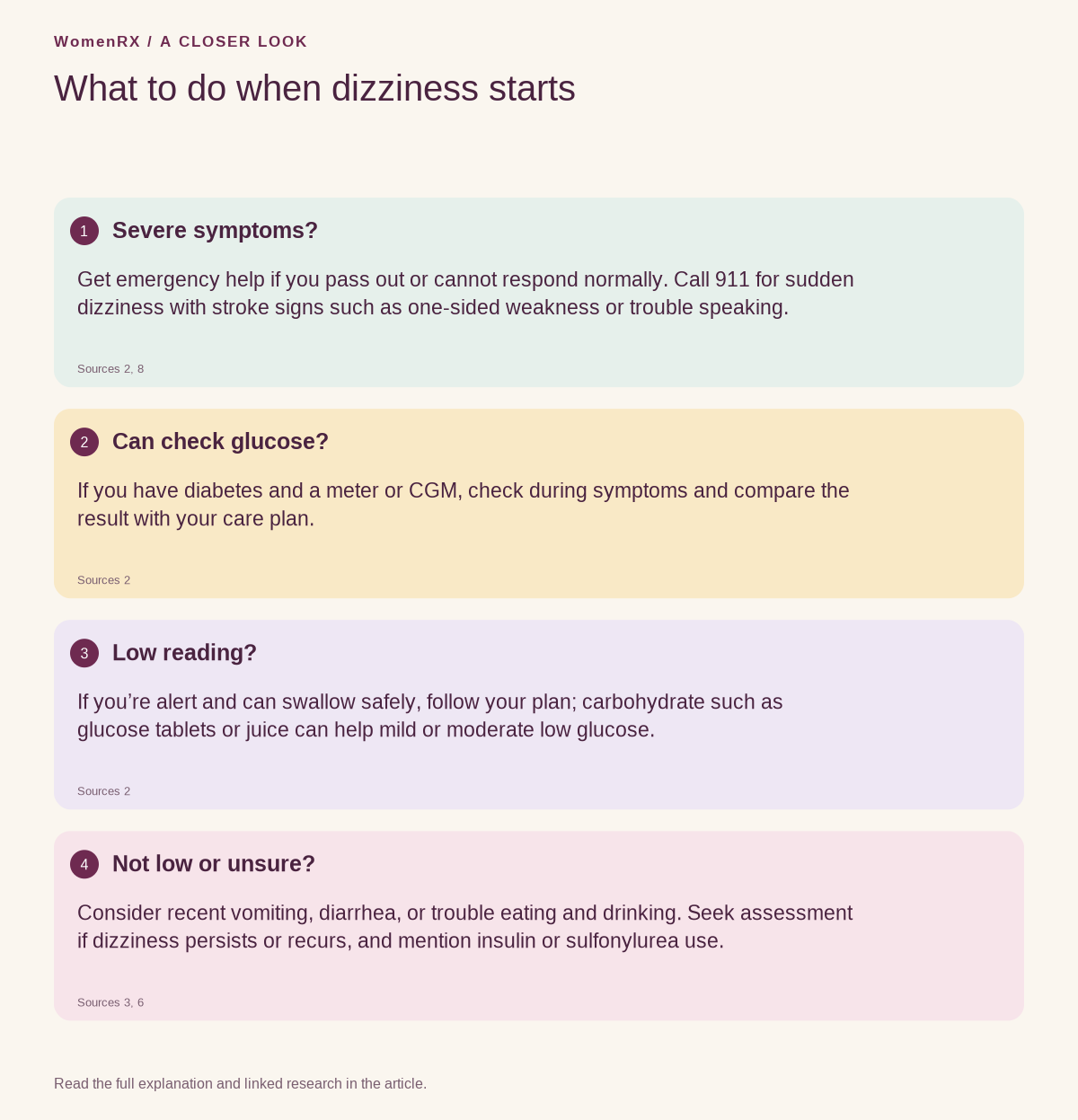
What to do when dizziness starts
Severe symptoms?: Get emergency help if you pass out or cannot respond normally. Call 911 for sudden dizziness with stroke signs such as one-sided weakness or trouble speaking.28
Can check glucose?: If you have diabetes and a meter or CGM, check during symptoms and compare the result with your care plan.2
Low reading?: If you’re alert and can swallow safely, follow your plan; carbohydrate such as glucose tablets or juice can help mild or moderate low glucose.2
Not low or unsure?: Consider recent vomiting, diarrhea, or trouble eating and drinking. Seek assessment if dizziness persists or recurs, and mention insulin or sulfonylurea use.36
Read the figure as text
Use the severity of your symptoms, a glucose reading if you have one, and your medication combination to choose a next step. 268- Severe symptoms?: Get emergency help if you pass out or cannot respond normally. Call 911 for sudden dizziness with stroke signs such as one-sided weakness or trouble speaking.28
- Can check glucose?: If you have diabetes and a meter or CGM, check during symptoms and compare the result with your care plan.2
- Low reading?: If you’re alert and can swallow safely, follow your plan; carbohydrate such as glucose tablets or juice can help mild or moderate low glucose.2
- Not low or unsure?: Consider recent vomiting, diarrhea, or trouble eating and drinking. Seek assessment if dizziness persists or recurs, and mention insulin or sulfonylurea use.36
More questions, answered
Does dizziness mean my blood sugar is low?
No. Dizziness has several possible causes, and a symptom alone can’t confirm low glucose. If you have diabetes and a meter or CGM, check the reading and compare it with the threshold in your care plan. 23
Which medicines make low blood sugar more likely with Ozempic?
The Ozempic prescribing information specifically warns about combining it with insulin or an insulin-releasing medicine such as a sulfonylurea. Ask your prescriber to review the combination rather than changing doses yourself. 6
Sources you can check
- OZEMPIC (SEMAGLUTIDE) INJECTION, SOLUTION [A-S MEDICATION SOLUTIONS] | US prescribing information and patient instructionsAccessed 2026-09-25Return to first citation
- Hypoglycemia: MedlinePlusAccessed 2026-09-25Return to first citation
- Dizziness - NHSAccessed 2026-09-25Return to first citation
- Efficacy and safety of semaglutide combined with metformin in treating T2DM with overweight or obesity: a systematic review and meta-analysis.Li J, Li K, Liu Z, Yu H, Zhang J. · American journal of translational research · 2024Return to first citation
- Changes in Glucagon-Like Peptide-1 Receptor Agonist (GLP-1 RA) Exposures Following Recent Demand for Weight Management: A Retrospective Review of California Poison Control System Data.Ho RY, Regelman H, Ma A, Lee SY, Sandhu S, Shapiro S, Lewis J, Tsutaoka B, Apollonio DE. · The Journal of pharmacy technology : jPT : official publication of the Association of Pharmacy Technicians · 2025Return to first citation
- OZEMPIC (SEMAGLUTIDE) INJECTION, SOLUTION [NOVO NORDISK PHARMACEUTICAL INDUSTRIES, LP] | US prescribing information and patient instructionsAccessed 2026-09-25Return to first citation
- WEGOVY (SEMAGLUTIDE) INJECTION, SOLUTION WEGOVY (SEMAGLUTIDE) TABLET [NOVO NORDISK PHARMACEUTICAL INDUSTRIES, LP] | US prescribing information and patient instructionsAccessed 2026-09-25Return to first citation
- Signs and Symptoms of Stroke | Stroke | CDCAccessed 2026-09-25Return to first citation