Feeling Tired on Ozempic? What to Check First
Fatigue may coincide with Ozempic treatment, but your other symptoms, glucose readings, and diabetes medicines offer more useful clues than timing alone.
Feeling tired while taking Ozempic doesn’t tell you what’s causing it. If you use insulin or a sulfonylurea, check whether the tiredness comes with a low glucose reading or symptoms such as dizziness or jitteriness. Also notice whether nausea, vomiting, or diarrhea has made eating or drinking difficult. Those details can help your diabetes care team assess what needs attention.12
Start with what’s happening alongside the fatigue
Ozempic is used in type 2 diabetes care, so fatigue deserves a closer look than “it must be the shot.” Glucose levels, other diabetes medicines, and stomach symptoms may all be relevant. A useful first question is whether you feel tired and have another change you can identify: a glucose reading outside your usual range, dizziness or jitteriness, trouble eating, or fluid loss from vomiting or diarrhea.12
A small randomized pilot study tracked asthenia during semaglutide treatment, although that finding cannot explain an individual’s fatigue. Among 104 people with type 2 diabetes followed for 26 weeks, asthenia was reported by 9.8% in a slower, flexible semaglutide dose-increase group and 24.5% in the standard dose-increase group. Both groups received semaglutide. The study compared dose-increase approaches, not semaglutide with no semaglutide, so it cannot tell you whether Ozempic caused your fatigue or what change would help you personally. It also doesn’t establish a different asthenia risk for women.3
If you take insulin or a sulfonylurea, look at glucose
Ozempic’s medication guide says the risk of low blood sugar may be higher when it’s used with insulin or a sulfonylurea. Dizziness, light-headedness, and feeling jittery are among the symptoms it lists. If fatigue arrives with those feelings, a glucose reading taken at the time is more informative than trying to judge by how you feel alone.1 Your diabetes care team can tell you how and when to check glucose as part of your care plan.2
Write down which diabetes medicines you take and whether a low reading or symptoms occurred around the time you felt unwell. If you already have a plan for treating low blood sugar, follow that plan. Don’t change prescribed doses on your own because of fatigue.
If eating or drinking has changed, say so
Nausea, vomiting, and diarrhea are another set of clues. Ozempic’s medication guide warns that these symptoms can cause dehydration and, in turn, kidney problems. It says to tell your healthcare provider right away if nausea, vomiting, or diarrhea doesn’t go away, and to report stomach problems that are severe or persistent.1
Notice whether you’re able to drink and eat as you normally would. For example, “I’ve felt wiped out since the nausea started, and I’m drinking much less” conveys more than “Ozempic makes me tired.” It describes a problem your care team can assess without assuming that fatigue itself has one cause.
Put the timing in context, not in charge
Note when the fatigue began relative to starting Ozempic or a change in treatment, but don’t treat that overlap as proof. The pilot study found different rates of reported asthenia with two dose-increase approaches; it did not test a rule for identifying the cause of an individual person’s fatigue.3 Whether the feeling is brief, recurring, or present even when stomach symptoms have settled is worth describing.
Other parts of your life belong in that description too. If sleep has changed, or if you have heavy periods, are pregnant, are recovering postpartum, or are going through menopause, tell your care team. These are context to share, not reasons to assume you’ve found the cause. The semaglutide findings above don’t establish how to attribute fatigue in any of those situations or report a women-specific fatigue rate.3
You don’t need to solve the cause before reaching out. Bring the pattern you’ve noticed, any glucose readings taken while you felt unwell, your full diabetes medicine list, and whether eating or drinking has become difficult. Contact your care team right away if nausea, vomiting, or diarrhea doesn’t go away. Report stomach problems that are severe or don’t go away, too.1
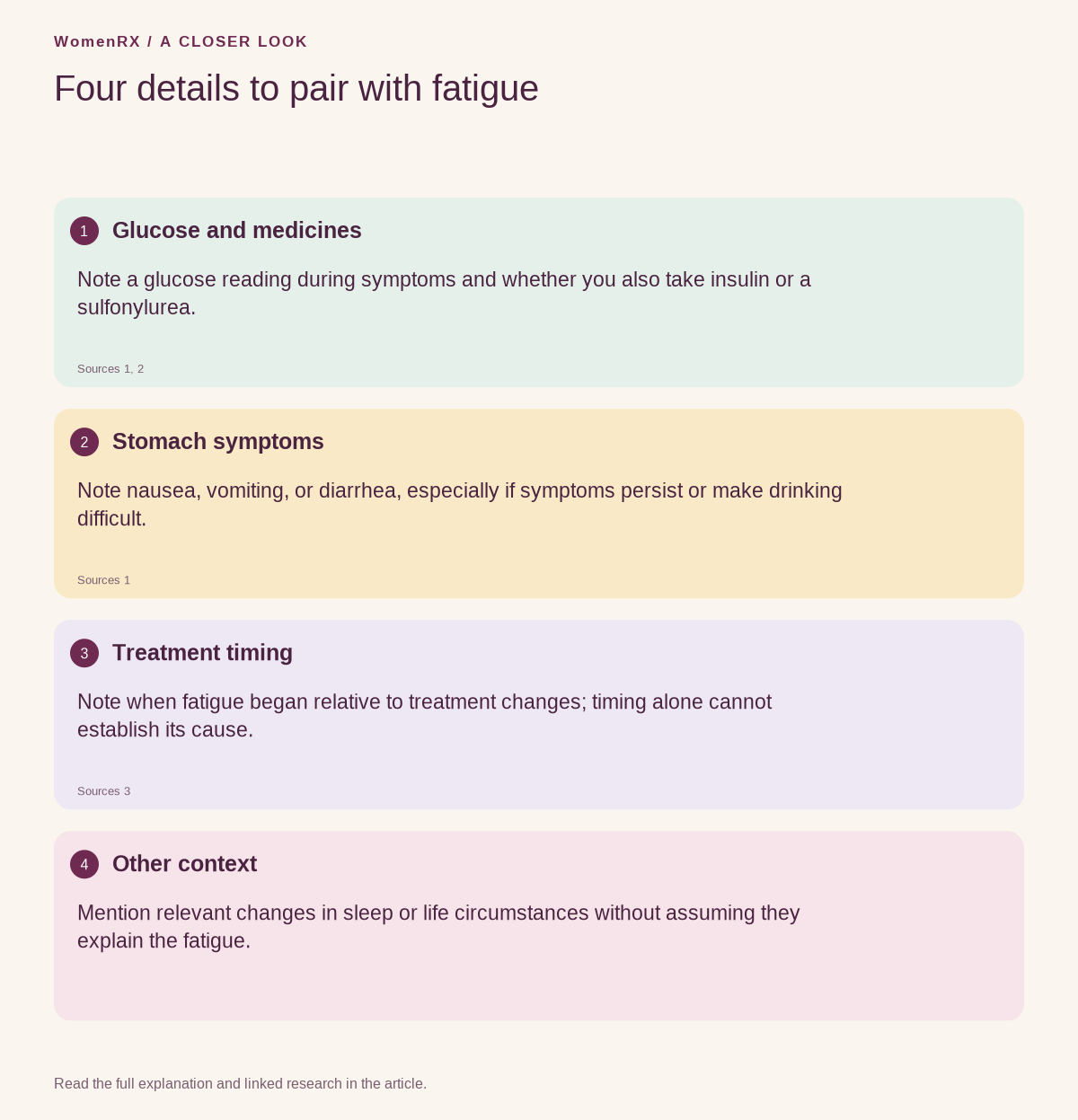
Four details to pair with fatigue
Glucose and medicines: Note a glucose reading during symptoms and whether you also take insulin or a sulfonylurea.12
Stomach symptoms: Note nausea, vomiting, or diarrhea, especially if symptoms persist or make drinking difficult.1
Treatment timing: Note when fatigue began relative to treatment changes; timing alone cannot establish its cause.3
Other context: Mention relevant changes in sleep or life circumstances without assuming they explain the fatigue.
Read the figure as text
These details make a description of fatigue more useful; they are not a test for whether Ozempic caused it.- Glucose and medicines: Note a glucose reading during symptoms and whether you also take insulin or a sulfonylurea.12
- Stomach symptoms: Note nausea, vomiting, or diarrhea, especially if symptoms persist or make drinking difficult.1
- Treatment timing: Note when fatigue began relative to treatment changes; timing alone cannot establish its cause.3
- Other context: Mention relevant changes in sleep or life circumstances without assuming they explain the fatigue.
More questions, answered
Does feeling tired mean my blood sugar is low?
No. Symptoms alone don’t establish your glucose level. Low blood sugar risk can be higher when Ozempic is combined with insulin or a sulfonylurea, and the Ozempic guide lists dizziness, light-headedness, and jitteriness among possible symptoms. A glucose reading during an episode can help put those feelings in context.12
Sources you can check
- OZEMPIC (SEMAGLUTIDE) INJECTION, SOLUTION [A-S MEDICATION SOLUTIONS] | US prescribing information and patient instructionsAccessed 2026-09-25Return to first citation
- Diabetes | Type 1 Diabetes | Type 2 Diabetes | MedlinePlusAccessed 2026-09-25Return to first citation
- Gradual Titration of Semaglutide Results in Better Treatment Adherence and Fewer Adverse Events: A Randomized Controlled Open-Label Pilot Study Examining a 16-Week Flexible Titration Regimen Versus Label-Recommended 8-Week Semaglutide Titration Regimen.Eldor R, Avraham N, Rosenberg O, Shpigelman M, Golan-Cohen A, Cukierman-Yaffe T, Merzon E, Buch A. · Diabetes care · 2025Return to first citation