Fatigue on Ozempic: What Could Be Behind It?
Tiredness after starting semaglutide can have several explanations, so the timing, your intake, other medicines, and accompanying symptoms matter.
Feeling tired while taking Ozempic doesn’t by itself show that semaglutide is the cause. Reduced appetite may mean you’re eating or drinking less, and low blood sugar is a particular consideration if Ozempic is used with insulin or a sulfonylurea. Sleep loss, pregnancy, and other health conditions can also contribute to fatigue. Track what changed and when, then discuss persistent fatigue with your care team. 1 2 4
Start with the pattern, not the assumption
If fatigue began after starting Ozempic or after a dose change, that timing is worth recording, but it cannot identify the cause on its own. Semaglutide may also affect appetite and food intake, and fatigue has many possible causes beyond medication. 2 4
A more useful question is: What changed around the time the tiredness began? Note whether it followed treatment starting or changing, a stretch of nausea or vomiting, eating or drinking less, disrupted sleep, or a change in another medicine. This kind of timeline can make a conversation about possible causes more specific.
Check intake, fluids, and glucose-related medicines
Semaglutide can reduce appetite. If that leaves you eating much less than usual, or if nausea, vomiting, or diarrhea are making it hard to eat and drink, reduced intake or dehydration may be part of the picture. Those are possibilities, not proof that the medicine caused your fatigue or that you have a nutrient deficiency. 4
Also note other medicines used for diabetes. Ozempic’s prescribing information says the chance of low blood sugar may be higher when it is used with insulin or a sulfonylurea. If you take either and feel unusually tired, ask your care team whether low blood sugar could be relevant to your situation. Don’t use fatigue alone to decide what is happening. 1
Keep other explanations in view
Fatigue can follow too little sleep or stress, but it can also accompany conditions such as anemia, thyroid disease, infection, diabetes, pregnancy, or sleep disorders. A symptom diary can help show patterns in sleep, daily activities, appetite, and energy; it doesn’t diagnose the cause. 2
If relevant, include life-stage context without treating it as an explanation: possible pregnancy, unusually heavy menstrual bleeding, or menopause-related sleep changes. Fatigue is a broad symptom, and these details don’t establish what is causing yours. 2 3 5
A short record that can help
For several days, jot down:
- When the fatigue started and whether it changed after a treatment or dose change.
- Any nausea, vomiting, diarrhea, or change in how much you are eating or drinking.
- Sleep quality and any recent changes in your routine.
- Other medicines, especially insulin or a sulfonylurea; include glucose readings if you already monitor them.
- Other symptoms and relevant context, such as possible pregnancy, heavy bleeding, or menopause-related sleep disruption.
You don’t need to track perfectly. A few clear examples, such as “more tired after several nights of poor sleep” or “started when nausea made meals difficult,” may be more useful than a long list without dates.
When to get help
If fatigue hasn’t improved after several weeks, contact your healthcare provider to discuss possible causes. They may ask about sleep, daily activities, appetite, and exercise and decide whether an exam or tests are appropriate. 2
Seek prompt medical advice for severe, persistent abdominal pain, especially pain that may spread to the back, with or without vomiting. Ozempic’s prescribing information identifies this as a possible sign of pancreatitis that needs immediate attention. 1
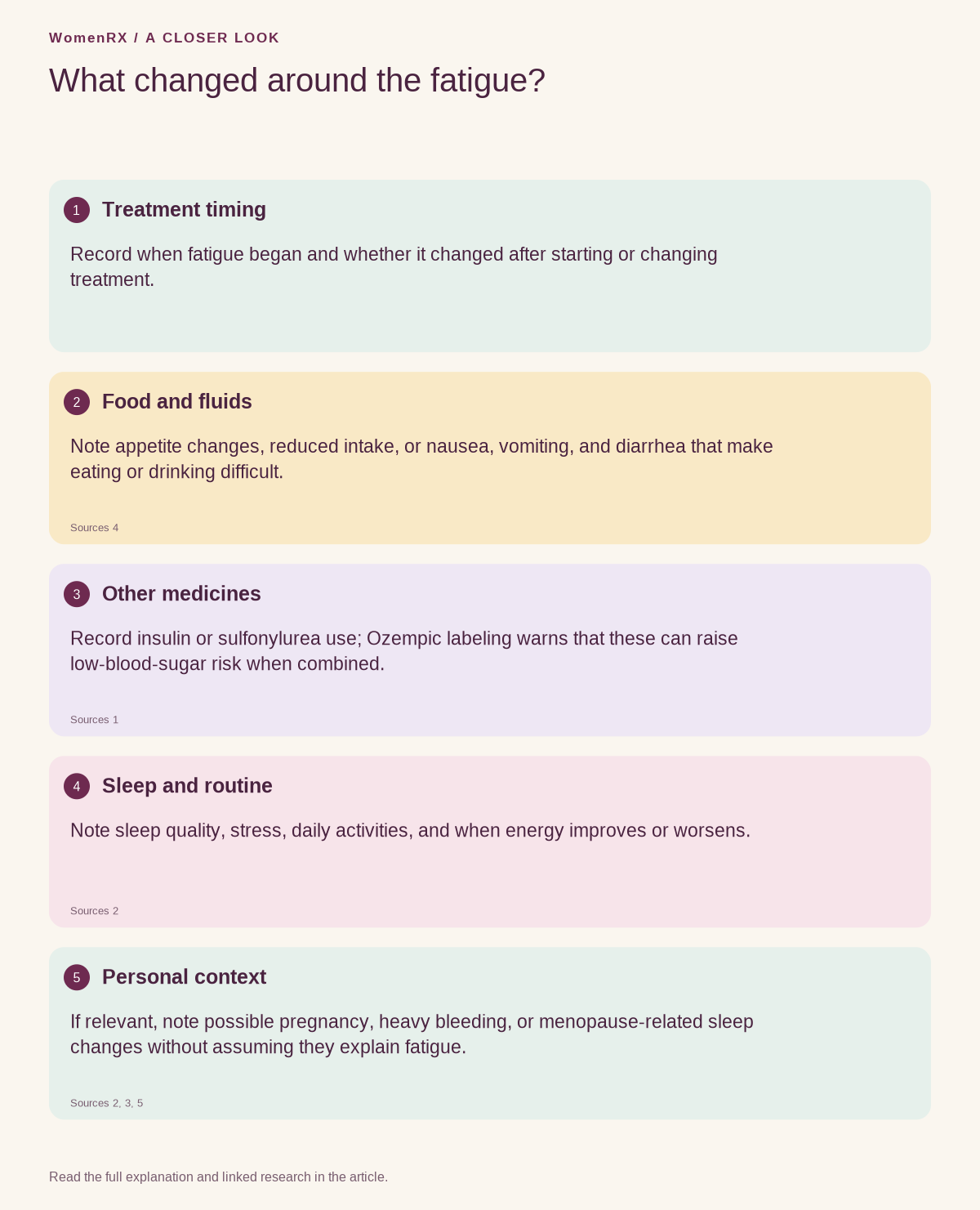
What changed around the fatigue?
Treatment timing: Record when fatigue began and whether it changed after starting or changing treatment.
Food and fluids: Note appetite changes, reduced intake, or nausea, vomiting, and diarrhea that make eating or drinking difficult.4
Other medicines: Record insulin or sulfonylurea use; Ozempic labeling warns that these can raise low-blood-sugar risk when combined.1
Sleep and routine: Note sleep quality, stress, daily activities, and when energy improves or worsens.2
Personal context: If relevant, note possible pregnancy, heavy bleeding, or menopause-related sleep changes without assuming they explain fatigue.235
Read the figure as text
Use these prompts to organize a timeline. They can help distinguish possible contributors but do not diagnose the cause.- Treatment timing: Record when fatigue began and whether it changed after starting or changing treatment.
- Food and fluids: Note appetite changes, reduced intake, or nausea, vomiting, and diarrhea that make eating or drinking difficult.4
- Other medicines: Record insulin or sulfonylurea use; Ozempic labeling warns that these can raise low-blood-sugar risk when combined.1
- Sleep and routine: Note sleep quality, stress, daily activities, and when energy improves or worsens.2
- Personal context: If relevant, note possible pregnancy, heavy bleeding, or menopause-related sleep changes without assuming they explain fatigue.235
More questions, answered
Does feeling tired mean I have a nutrient deficiency?
No. Fatigue has many possible causes, including sleep problems, pregnancy, anemia, and other health conditions. Eating less while taking a medicine that reduces appetite is one detail to note, but tiredness alone can’t identify a deficiency. 2 4
Why mention insulin or a sulfonylurea?
Ozempic’s prescribing information warns that low blood sugar risk may be higher when it is used with insulin or a sulfonylurea. If you take one of these medicines, ask your care team whether glucose could be part of the picture. 1
Sources you can check
- OZEMPIC (SEMAGLUTIDE) INJECTION, SOLUTION [A-S MEDICATION SOLUTIONS] | US prescribing information and patient instructionsAccessed 2026-09-25Return to first citation
- Fatigue: MedlinePlusAccessed 2026-09-25Return to first citation
- The effectiveness of psychosocial interventions on physiological symptoms of menopause: a systematic review and meta-analysis.Robinson K, Hardy R, Melville M, Saidel S, Desai R, Spector A. · BMC women's health · 2026Return to first citation
- Harnessing Facebook to Investigate Real-World Mentions of Adverse Events of Glucagon-Like Peptide-1 Receptor Agonist (GLP-1 RA) Medications: Observational Study of Facebook Posts From 2022 to 2024.Alibilli AS, Jain V, Mane H, Yue X, Ratzki-Leewing A, Merchant JS, Criss S, Nguyen QC, McCoy RG, Nguyen TT. · JMIR infodemiology · 2025Return to first citation
- Transcutaneous auricular neurostimulation to reduce heavy menstrual bleeding in women with and without von Willebrand disease.Czura CJ, Weyand AC, Baldwin MK, Recht M, McWade MA, Covalin A, Khodaparast N. · Frontiers in medicine · 2025Return to first citation