Could Perimenopause Be Behind Your Joint Pain?
Joint aches can occur around the menopausal transition, but their timing can’t tell you what’s causing them.
Joint aches can occur during perimenopause and menopause, but that doesn’t mean hormones are the cause of your pain. An injury or a joint condition may also be responsible. How the pain started, whether a joint is swollen, and whether the ache is worsening or affecting daily life can help you decide when to get it assessed. 1
Joint aches can appear during the menopausal transition. NHS joint-pain guidance recognizes perimenopause and menopause among possible explanations, and a review discusses possible effects of changing sex hormones on joints and tendons. But timing is context, not a diagnosis. 15
That distinction matters because a sore joint during perimenopause could also reflect an injury, repeated activity, arthritis, or another problem. Finding the cause helps guide what to do about the pain. 12
What the menopause connection tells us
Changing hormones may play a part in joint aches, but the research doesn’t let you tell whether a particular ache is hormone-related. A review discusses joint and tendon responses to declining sex hormones alongside muscle loss associated with aging. Those possible contributors don’t separate menopause-related pain from other causes in one person. 5
There’s also a difference between an everyday ache and inflammatory arthritis. In a prospective study of women already being assessed for clinically suspect arthralgia, postmenopausal women had a higher observed risk of developing one type of inflammatory arthritis than premenopausal women. That finding comes from a selected group with concerning joint symptoms. It doesn’t establish the cause of ordinary aches during perimenopause. 4
Nor does a possible hormone connection mean hormone therapy is a proven treatment for joint pain. The North American Menopause Society’s 2022 position statement identifies established hormone therapy benefits for vasomotor symptoms, genitourinary symptoms, and prevention of bone loss; the statement’s summary does not establish joint-pain treatment as one of them. 3
Clues that point beyond perimenopause
The pattern of pain can suggest what else needs consideration, though it can’t confirm a diagnosis. For example, pain with swelling or bruising after intense or repetitive activity may fit a sprain or strain. Pain that’s worse when walking, with stiffness after activity, can occur with osteoarthritis. 1
A warm, swollen joint that hurts when you move or press it can occur with bursitis. Pain and stiffness on both sides of the body that feel worse after you’ve been still can occur with rheumatoid arthritis. A suddenly very painful, hot, swollen toe joint can occur with gout. These are reasons to look beyond the timing of perimenopause, not labels to assign yourself. 1
When the ache needs attention
Arrange a medical assessment if joint pain is getting worse, keeps returning, disrupts sleep, or stops you doing your usual activities. Seek prompt medical assessment for a hot, swollen joint, particularly if you also have a fever, chills, or feel generally unwell. Joint infection is one possible cause of that combination. 1
Some injury symptoms call for emergency care: very severe joint pain after a fall or injury, being unable to walk or put weight on the joint, or tingling or loss of feeling around the injured area. 1
If an ache is mild and settling, resting the affected joint may help. If it persists or changes, keep perimenopause in the picture without letting it become the only explanation. What helps next depends on what’s causing the pain. 1
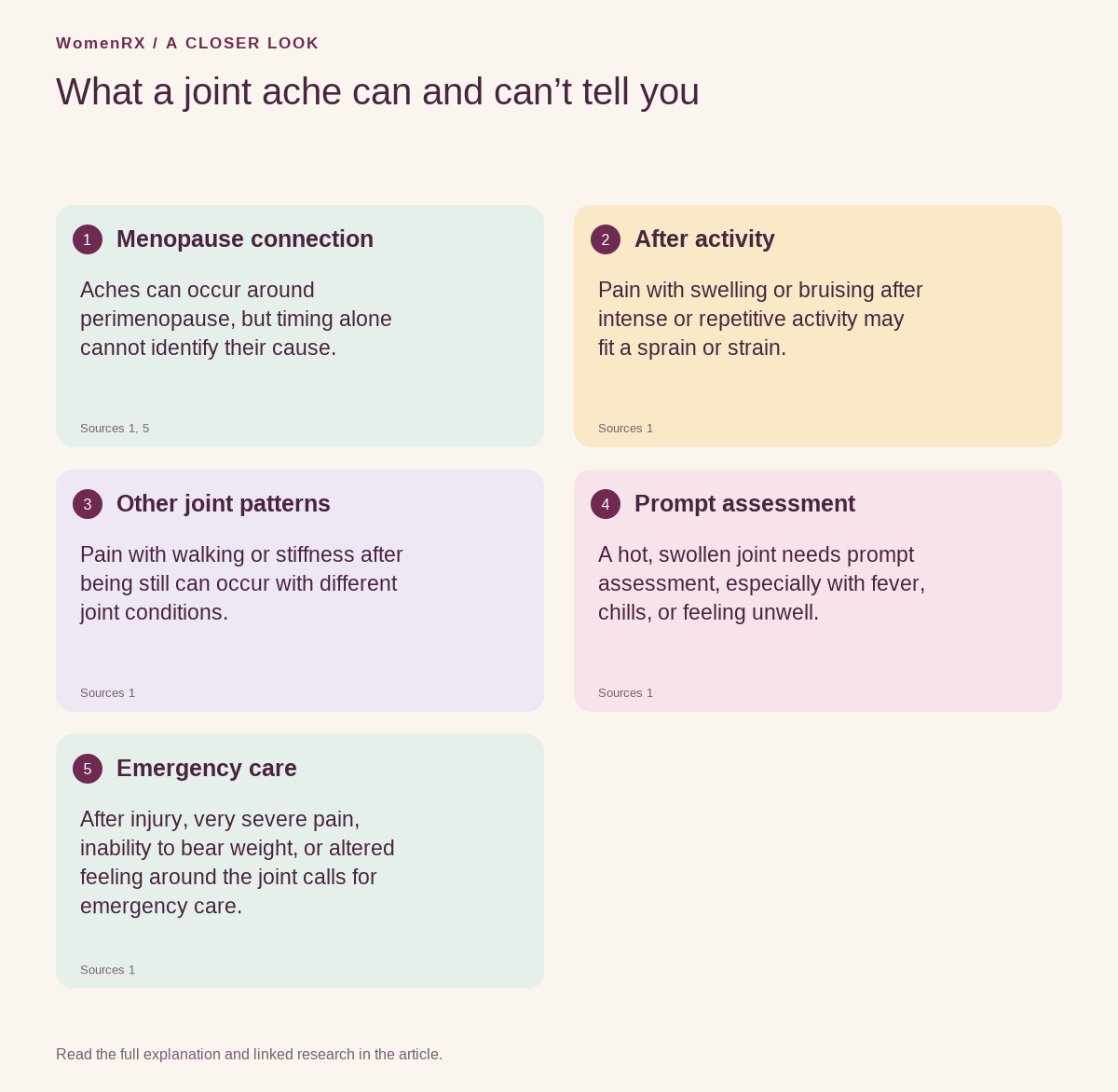
What a joint ache can and can’t tell you
Menopause connection: Aches can occur around perimenopause, but timing alone cannot identify their cause.15
After activity: Pain with swelling or bruising after intense or repetitive activity may fit a sprain or strain.1
Other joint patterns: Pain with walking or stiffness after being still can occur with different joint conditions.1
Prompt assessment: A hot, swollen joint needs prompt assessment, especially with fever, chills, or feeling unwell.1
Emergency care: After injury, very severe pain, inability to bear weight, or altered feeling around the joint calls for emergency care.1
Read the figure as text
Timing offers context; the pain pattern and accompanying symptoms can point to other possibilities or change how quickly you need care.- Menopause connection: Aches can occur around perimenopause, but timing alone cannot identify their cause.15
- After activity: Pain with swelling or bruising after intense or repetitive activity may fit a sprain or strain.1
- Other joint patterns: Pain with walking or stiffness after being still can occur with different joint conditions.1
- Prompt assessment: A hot, swollen joint needs prompt assessment, especially with fever, chills, or feeling unwell.1
- Emergency care: After injury, very severe pain, inability to bear weight, or altered feeling around the joint calls for emergency care.1
More questions, answered
Does joint pain mean I’m in perimenopause?
No. Joint aches can occur around the menopausal transition, but pain alone can’t establish that you’re in perimenopause or identify its cause. Injury and arthritis are among the other possibilities. 1
Will hormone therapy help perimenopause-related joint pain?
That isn’t established by the possible connection between menopause and joint aches. The North American Menopause Society’s 2022 position statement describes other established hormone therapy benefits, but its summary does not establish hormone therapy as a joint-pain treatment. 3
Sources you can check
- Joint pain - NHSAccessed 2026-09-25Return to first citation
- Pain | MedlinePlusAccessed 2026-09-25Return to first citation
- The 2022 hormone therapy position statement of The North American Menopause Society.“The 2022 Hormone Therapy Position Statement of The North American Menopause Society” Advisory Panel. · Menopause (New York, N.Y.) · 2022Return to first citation
- Shorter reproductive time span and early menopause increase the risk of ACPA-negative inflammatory arthritis in postmenopausal women with clinically suspect arthralgia.Heutz JW, Boeren AMP, Claassen S, van Mulligen E, de Jong PHP, van der Helm-van Mil AHM. · Rheumatology (Oxford, England) · 2025Return to first citation
- Arthralgia of menopause - A retrospective review.Blumer J. · Post reproductive health · 2023Return to first citation