Can Turmeric or Curcumin Help With Joint Pain?
Some curcumin products show promise for osteoarthritis pain, but results depend on the formulation and don’t establish that turmeric in food works like a supplement.
Curcumin supplements may ease osteoarthritis pain for some people, but the evidence is mixed across products and study designs. A small hand-arthritis trial and a short trial of one topical gel found encouraging results, while a larger trial of a multi-ingredient supplement found no benefit over placebo. These findings don’t show that turmeric in food treats joint pain or that curcumin replaces standard care. 4 5 6 7
Turmeric in food isn’t the same question as a supplement
Turmeric is a spice; curcumin is one of its compounds. But evidence about a concentrated capsule or a specially formulated gel doesn’t tell you whether adding turmeric to a meal eases arthritis pain. The human studies discussed here tested specific products, not ordinary food use, and curcumin products can differ in their ingredients and delivery methods. 4 5 6
That distinction matters because the body doesn’t handle every formulation in the same way. Researchers have developed products intended to improve curcumin’s absorption, but the available review found that differences among products and studies make it hard to say which formulation works best. There also haven’t been direct comparisons that establish a top-performing formulation. 5
What the human studies actually found
Oral curcumin for hand osteoarthritis: A small, three-month randomized trial enrolled 27 people over 50 with hand osteoarthritis. In the curcumin group, pain and hand-function scores improved compared with that group’s starting scores by month three. The abstract doesn’t establish that these changes were greater than the placebo group’s changes. One person taking curcumin stopped because of gastrointestinal symptoms. The result is a reason for further research, not a firm answer about benefit. 4
A topical gel for knee osteoarthritis: In a 28-day randomized trial of 60 adults, one specific curcumin gel improved the study’s knee-pain score and daily pain ratings more than placebo. The study found no group differences in several other function and performance measures. Skin staining occurred and resolved after use stopped. This result applies to the tested gel and short study period, not to turmeric creams or supplements generally. 6
A multi-ingredient oral supplement: In a 12-week trial, 84 adults with knee osteoarthritis received either placebo or a combination containing curcumin, piperine, and three other ingredients. Pain improved by nearly the same amount in both groups, with no meaningful difference between them. Because it tested a combination, the study can’t isolate curcumin’s effect; it also doesn’t support that particular combination as better than placebo. 7
A review combining earlier reviews found signals of improvement in osteoarthritis pain and function, sometimes comparable to NSAIDs in the studies included. But the evidence varied substantially by product and study quality, safety reporting was incomplete, and there were no direct comparisons that establish equivalence, superiority, or the best formulation. “Comparable signals” is not the same as proof that curcumin works as well as an NSAID for you. 5
How it compares with standard osteoarthritis care
Curcumin hasn’t been shown to replace the treatments commonly used to manage osteoarthritis. Exercise that strengthens muscles and supports general fitness is a core part of care. Depending on the joint and your circumstances, standard options may also include topical anti-inflammatory medicines and other pain-relief approaches. The curcumin studies don’t establish that a supplement can take the place of these options. 3 5
Osteoarthritis symptoms can affect the knees, hips, or hands, and pain or stiffness that persists deserves attention because other joint conditions can cause similar symptoms. 1 2 A supplement trial in hand osteoarthritis doesn’t automatically apply to knee pain, inflammatory arthritis, a recent injury, or unexplained joint symptoms.
What women should know about the evidence
The studies don’t establish a women-specific effect. The multi-ingredient knee trial reported that 57% of participants were female, but its reported results were for the study group as a whole, not separate outcomes for women. The available reports of the hand and topical studies also don’t provide a women-specific treatment result. 4 6 7
A sensible way to weigh a product
If you’re considering a concentrated curcumin product, look beyond the word “turmeric” on the front label. Check which formulation and ingredients it contains, and remember that a result for one product doesn’t confirm the benefit of another. Evidence for a specially formulated gel, for example, isn’t evidence for an oral capsule. 5 6
Safety is also product-specific. Gastrointestinal symptoms occurred in the small hand trial, and reviews note that safety reporting across studies is incomplete. The hand trial excluded people taking antiplatelet or anticoagulant medicines and those with abnormal liver function, so it doesn’t establish safety for those groups. 4 5 If you take one of those medicines or have a procedure planned, show the exact product and ingredient list to your prescriber or pharmacist before starting. That’s a precaution: these findings don’t establish a particular interaction or a safe time to stop a product.
The practical bottom line: turmeric can be part of food, and concentrated curcumin products are being studied for osteoarthritis symptoms. Current results are promising for some specific products but too uneven to treat all turmeric or curcumin products as proven pain relief, or as a replacement for established care.
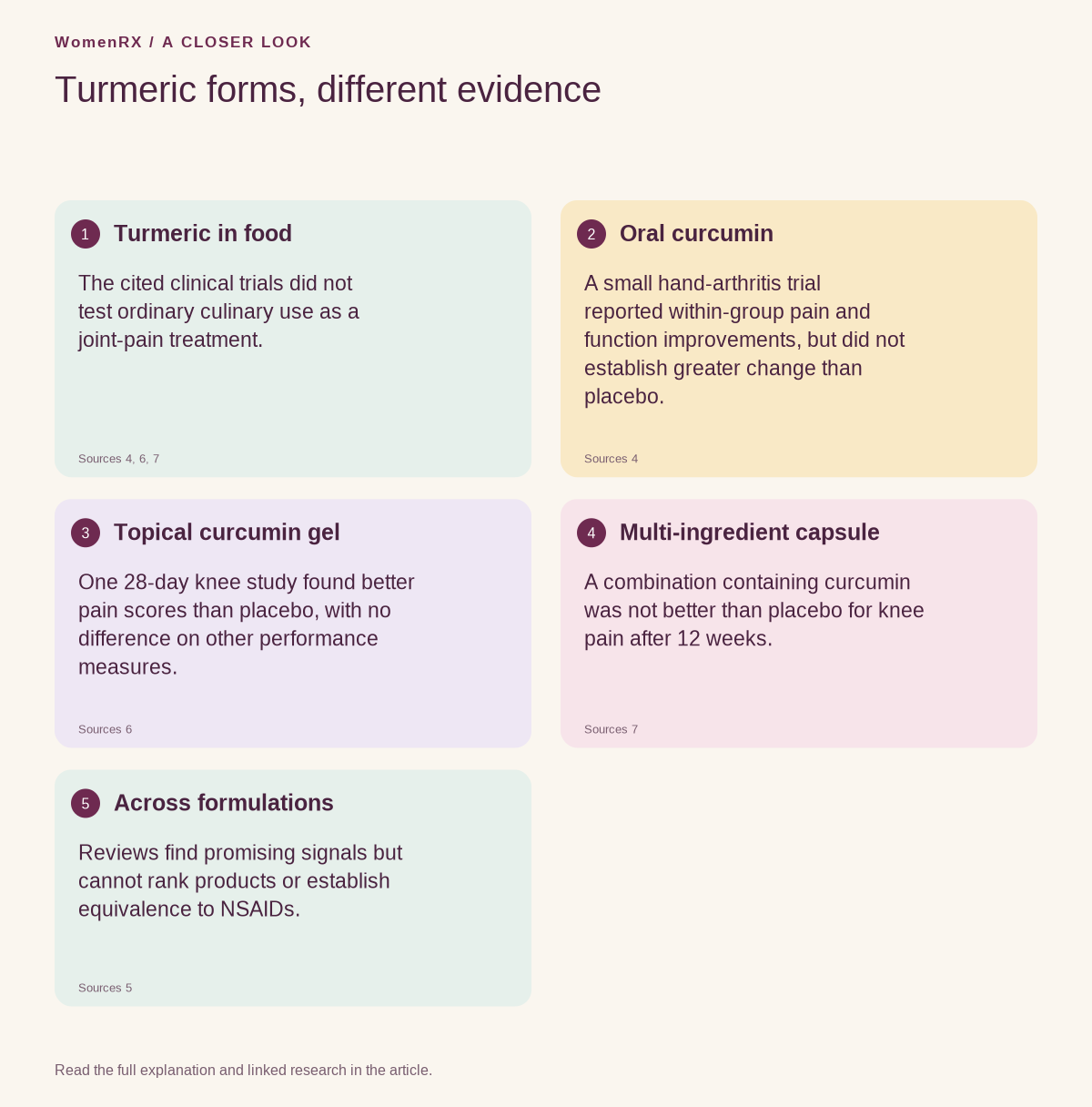
Turmeric forms, different evidence
Turmeric in food: The cited clinical trials did not test ordinary culinary use as a joint-pain treatment.467
Oral curcumin: A small hand-arthritis trial reported within-group pain and function improvements, but did not establish greater change than placebo.4
Topical curcumin gel: One 28-day knee study found better pain scores than placebo, with no difference on other performance measures.6
Multi-ingredient capsule: A combination containing curcumin was not better than placebo for knee pain after 12 weeks.7
Across formulations: Reviews find promising signals but cannot rank products or establish equivalence to NSAIDs.5
Read the figure as text
The evidence depends on the product tested and the outcome measured; a result for one form does not establish benefit for another.- Turmeric in food: The cited clinical trials did not test ordinary culinary use as a joint-pain treatment.467
- Oral curcumin: A small hand-arthritis trial reported within-group pain and function improvements, but did not establish greater change than placebo.4
- Topical curcumin gel: One 28-day knee study found better pain scores than placebo, with no difference on other performance measures.6
- Multi-ingredient capsule: A combination containing curcumin was not better than placebo for knee pain after 12 weeks.7
- Across formulations: Reviews find promising signals but cannot rank products or establish equivalence to NSAIDs.5
More questions, answered
Does curcumin rebuild cartilage or stop osteoarthritis?
The clinical evidence described here mainly concerns pain and function, not proof that curcumin changes the underlying progression of osteoarthritis. A review concluded that current evidence is insufficient to establish curcumin as a disease-modifying treatment. 8
Does a positive result for one curcumin product apply to another?
No. Studies have tested different oral ingredients and delivery methods, and reviews have not established which formulation works best. A finding for one gel or capsule shouldn’t be assumed to apply to another product. 5 6
Sources you can check
- Osteoarthritis - NHSAccessed 2026-09-25Return to first citation
- Osteoarthritis - Symptoms - NHSAccessed 2026-09-25Return to first citation
- Osteoarthritis - Treatment and support - NHSAccessed 2026-09-25Return to first citation
- Efficacy and safety of curcumin in patients with hand osteoarthritis: a pilot double-blinded randomised controlled trial.Tuntiyatorn P, Lerspongpaibool C, Kanchanathepsak T, Watcharananan I, Tawonsawatruk T. · BMC complementary medicine and therapies · 2025Return to first citation
- Efficacy and safety of different curcumin formulations in osteoarthritis: an umbrella review of systematic reviews.Shi C, Zhang T, Xie Y, Li J, Chen C, Liu J. · Frontiers in medicine · 2026Return to first citation
- The effect of a topical curcumin formulation (VAS-101) on knee pain in adults with knee osteoarthritis: a randomised, double-blind, placebo-controlled study.Lopresti AL, Antony B, Smith SJ. · Frontiers in pain research (Lausanne, Switzerland) · 2026Return to first citation
- Effect of an oral complementary medicine combination for symptomatic knee osteoarthritis: A double-blind, randomized, placebo-controlled trial.Yuan S, Liu X, Bracken K, Christensen R, Deveza LA, Collins S, Harnett JE, McLachlan AJ, Robbins S, Venkatesha V, Bowden JL, Hunter DJ. · Osteoarthritis and cartilage · 2026Return to first citation
- Curcumin as a natural therapeutic agent for osteoarthritis: molecular mechanisms, preclinical evidence, clinical applications, and future perspectives.Viswanathan N, Ramasamy V. · Inflammopharmacology · 2026Return to first citation