Turmeric and Curcumin: Benefits, Forms, and Safety
Turmeric in a meal and a concentrated curcumin supplement aren’t interchangeable, and the most encouraging trial results apply to particular products and groups.
Turmeric is a spice; curcumin is one of its active compounds, and supplements may contain concentrated extracts or specially formulated curcumin. Small or population-specific trials suggest possible benefits for migraine, hand osteoarthritis, and fatty liver in people with type 2 diabetes, but they don’t show that turmeric in food has the same effects. Concentrated products can also interact with medicines, especially through potential effects on bleeding and blood sugar. 2 4 5 1
Turmeric can mean the spice you cook with or a supplement made with concentrated curcumin, turmeric’s best-studied active compound. Those are different exposures. Supplement studies use particular extracts and delivery systems, sometimes with ingredients such as piperine to change absorption. A result from one formulation doesn’t establish that another supplement, or a shake of turmeric in food, will do the same thing. 1 3 5
What the human studies suggest
Migraine: In a randomized, placebo-controlled trial, 70 people with migraine without aura were assigned to phytosomal curcumin or placebo for eight weeks; 65 completed the study. The curcumin group had better reported migraine outcomes than the placebo group, including headache frequency, duration, and severity. That’s a promising result for one specific formulation, but a single small trial can’t establish how well other curcumin products work. 2
Hand osteoarthritis: A pilot randomized trial enrolled 27 people over 50 with hand osteoarthritis. The curcumin group reported improvements in pain and function after three months, while one participant stopped because of gastrointestinal side effects. The small study offers an early signal, not a dependable estimate of benefit for everyone with joint pain. 5
Fatty liver in type 2 diabetes: In a 12-month randomized trial, 227 obese people with type 2 diabetes received curcumin or placebo. The study reported improvements in liver fat and other measures in the curcumin group. These findings apply to the trial’s particular population and product; they don’t establish curcumin as a general treatment for liver disease or a substitute for standard care. 4
Taken together, these studies are reasons for further research, not proof that turmeric supplements treat these conditions broadly. The outcomes and formulations differ, and evidence for one health concern shouldn’t be transferred to another.
The product form changes the question
Curcumin is poorly absorbed in its conventional form. Some products are designed to increase absorption, but better absorption is not the same as proven better health outcomes. In an exploratory, single-dose trial, a nano-liposomal product produced much higher dose-adjusted blood exposure than free curcumin. The participants were healthy men, and the study tested short-term absorption and tolerability, not symptom relief or long-term safety. 3
Piperine, an extract of black pepper, is another ingredient used to increase curcumin absorption. Because it can also affect enzymes and transport systems involved in processing medicines, a product with piperine may raise different interaction questions from one without it. Don’t assume that “enhanced absorption” means a supplement is more suitable for you. 1
For practical comparison, check the label for the amount and form of curcumin, whether piperine is included, and any other active ingredients. Then compare that product with the one actually studied. If the formulation doesn’t match, the trial result may not apply.
Safety checks before taking a concentrated product
Curcumin may affect platelet activity and blood clotting, and a review identifies potential interaction concerns with anticoagulants such as warfarin and antiplatelet medicines such as clopidogrel. The review also describes possible changes to blood sugar when curcumin is used with diabetes medicines, including glyburide. These are reasons to have a pharmacist or prescriber check a concentrated product against your medication list, rather than assuming a supplement is harmless because it’s plant-derived. 1
Digestive discomfort is another practical consideration: it occurred in the hand osteoarthritis trial and was the most common non-serious adverse event in the fatty-liver trial. Those studies were not large enough to settle uncommon or long-term risks across all products. 4 5
If you’re pregnant, trying to become pregnant, or breastfeeding, the cited clinical trials don’t establish the safety of concentrated curcumin supplements for those stages. They also don’t show that supplement findings apply to ordinary culinary use. Ask your prenatal or postpartum care team about a concentrated product before using it; food use and supplement use are separate questions.
A useful bottom line
If you enjoy turmeric in food, that’s not the same decision as taking a high-concentration supplement. If you’re considering a supplement for a specific condition, look at the evidence for that condition and the exact formulation, and check for interactions with your medicines. The research is most encouraging in a few defined settings, but it’s still too limited to treat curcumin as a general-purpose remedy.
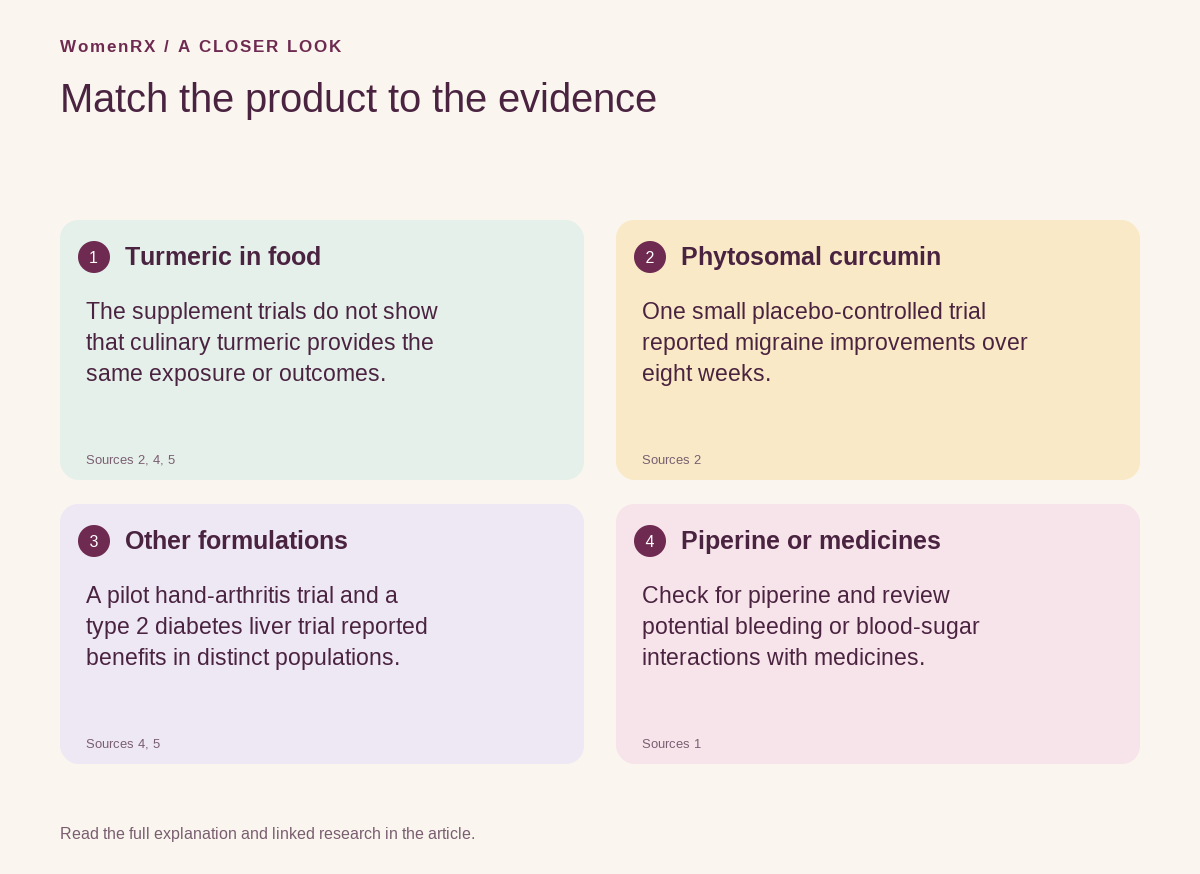
Match the product to the evidence
Turmeric in food: The supplement trials do not show that culinary turmeric provides the same exposure or outcomes.245
Phytosomal curcumin: One small placebo-controlled trial reported migraine improvements over eight weeks.2
Other formulations: A pilot hand-arthritis trial and a type 2 diabetes liver trial reported benefits in distinct populations.45
Piperine or medicines: Check for piperine and review potential bleeding or blood-sugar interactions with medicines.1
Read the figure as text
The findings depend on the form of curcumin, the health outcome, and who was studied. The safety check is separate from whether a benefit was reported.- Turmeric in food: The supplement trials do not show that culinary turmeric provides the same exposure or outcomes.245
- Phytosomal curcumin: One small placebo-controlled trial reported migraine improvements over eight weeks.2
- Other formulations: A pilot hand-arthritis trial and a type 2 diabetes liver trial reported benefits in distinct populations.45
- Piperine or medicines: Check for piperine and review potential bleeding or blood-sugar interactions with medicines.1
More questions, answered
Does a curcumin supplement work like turmeric in food?
The clinical trials discussed here tested specific concentrated supplements, not turmeric as a seasoning. Their findings don’t establish that food amounts produce the same exposure or health effects. 2 4 5
Does piperine make a curcumin supplement better?
Piperine can increase curcumin absorption, but greater absorption doesn’t by itself prove better symptom relief. It can also affect how the body processes some medicines, so its presence is worth checking when reviewing a product. 1
Sources you can check
- Curcumin in the Treatment of Kidney Disease: A Systematic Review with a Focus on Drug Interactions.Ofori-Attah E, Aning A, Simón L. · Antioxidants (Basel, Switzerland) · 2025Return to first citation
- Effect and Safety of Phytosomal Curcumin Supplementation on Migraine Patients: A Randomized, Double-Blind and Placebo-Controlled Trial.Shojaei M, Khorvash F, Sahebkar A, Sathyapalan T, Bagherniya M. · Chinese journal of integrative medicine · 2025Return to first citation
- Enhanced bioavailability of a novel double-layered nano-liposomal curcumin (BNT-C060): a randomized, double-blind, clinical trial.Kim DS, Kim HK, Ha KC, Jang GH, Park SH, Kim DH, Kim YM, Pyo J, Joo JC, Chae HJ. · Scientific reports · 2026Return to first citation
- Curcumin Attenuates Liver Steatosis via Antioxidant and Anti-Inflammatory Pathways in Obese Patients with Type 2 Diabetes Mellitus: A Randomized Controlled Trial.Yaikwawong M, Kamdee K, Chuengsamarn S. · International journal of molecular sciences · 2025Return to first citation
- Efficacy and safety of curcumin in patients with hand osteoarthritis: a pilot double-blinded randomised controlled trial.Tuntiyatorn P, Lerspongpaibool C, Kanchanathepsak T, Watcharananan I, Tawonsawatruk T. · BMC complementary medicine and therapies · 2025Return to first citation