Turmeric Supplements: Side Effects and Safety Checks
Liver injury has been linked to concentrated turmeric supplements, so the exact product and your medicines matter.
Turmeric used as a seasoning and a concentrated curcumin supplement aren’t the same exposure. Reports of liver injury involve supplements, including some high-bioavailability formulations, and don’t tell us the risk from ordinary food use. Before taking a supplement, review its full label and your medicines, especially if you have kidney disease or take blood-thinning or diabetes medication. Get prompt medical advice for jaundice or feeling unwell after starting one. 1234
Seasoning and supplements are different exposures
The liver-injury reports concern turmeric-containing supplements, not ordinary culinary use. They don’t establish that turmeric in food carries the same risk, and they can’t tell us how often supplement-related injury occurs. Italian reports and published cases included concentrated or high-bioavailability formulations. 123
Check the entire product label, including added ingredients and whether the formulation is designed to increase curcumin absorption. In a US case series, testing found piperine, an ingredient from black pepper, in three of seven products. That finding doesn’t show piperine caused the liver injuries. A review notes that formulations that increase bioavailability may also change toxicity and interaction risks. 24
Know which symptoms call for prompt attention
Turmeric supplements have been linked to liver injury that can be severe. In a US series of 10 identified cases, five people were hospitalized and one died of acute liver failure. These selected cases show that serious injury can occur, but they don’t estimate an individual user’s likelihood of harm. 2
Reported symptoms included malaise, or feeling unwell, and jaundice, which is yellowing of the skin or whites of the eyes. In a separate series of 11 cases, six people had abnormal liver tests without symptoms. If jaundice or unexplained feeling unwell develops after starting a turmeric supplement, seek prompt medical care and share the product label or a photo of it. 1
In the US series, liver injury began one to four months after supplement use started. That timing comes from a small group of cases; it isn’t a reliable window for ruling out a problem. 2
Put your medicines and kidney health on the checklist
Before adding a concentrated supplement, show the full label to a pharmacist or clinician if you take:
- Warfarin or another anticoagulant: A review describes possible effects of curcumin on clotting and platelet activity that could matter with anticoagulant treatment. 4
- An antiplatelet medicine, such as clopidogrel: The same review flags a possible bleeding concern. It doesn’t establish how often a harmful interaction occurs in everyday use. 4
- Medicine for diabetes: Curcumin may affect blood glucose, so combining it with glucose-lowering treatment could change blood sugar. Don’t adjust prescribed medicine based on a supplement. 4
- Several medicines, or medicines with a narrow safety margin: Curcumin may affect drug-metabolizing enzymes and transporters, but the practical effect depends on the specific medicine and product. 4
Kidney disease is another reason to get a product-specific review, particularly if you take several medicines. A review focused on kidney disease describes potential interaction concerns and notes that formulation differences can affect exposure. This isn’t a blanket reason that everyone with kidney disease must avoid curcumin; it is a reason to check the exact combination. 4
These are potential interaction concerns, not proof that every pairing causes harm. Don’t stop or change prescribed treatment on your own; have the specific supplement and medication list reviewed together. 4
Pregnancy and breastfeeding need a separate check
A study of a curcumin-and-serratiopeptidase supplement excluded pregnant participants because the supplement’s systemic effects in pregnancy were unknown. That study doesn’t establish safety in pregnancy, and it provides no breastfeeding safety answer. If you’re pregnant or breastfeeding, ask for individualized advice before using a concentrated turmeric or curcumin supplement. 5
A practical product review
Before taking a supplement, make a note of the exact ingredients, formulation, and any added piperine, then bring the label and your medication list to a pharmacist or clinician if one of the concerns above applies. If you develop jaundice or feel unwell after starting it, seek prompt care and share the product information. Keep prescribed medicines unchanged unless the person managing them advises otherwise. 124
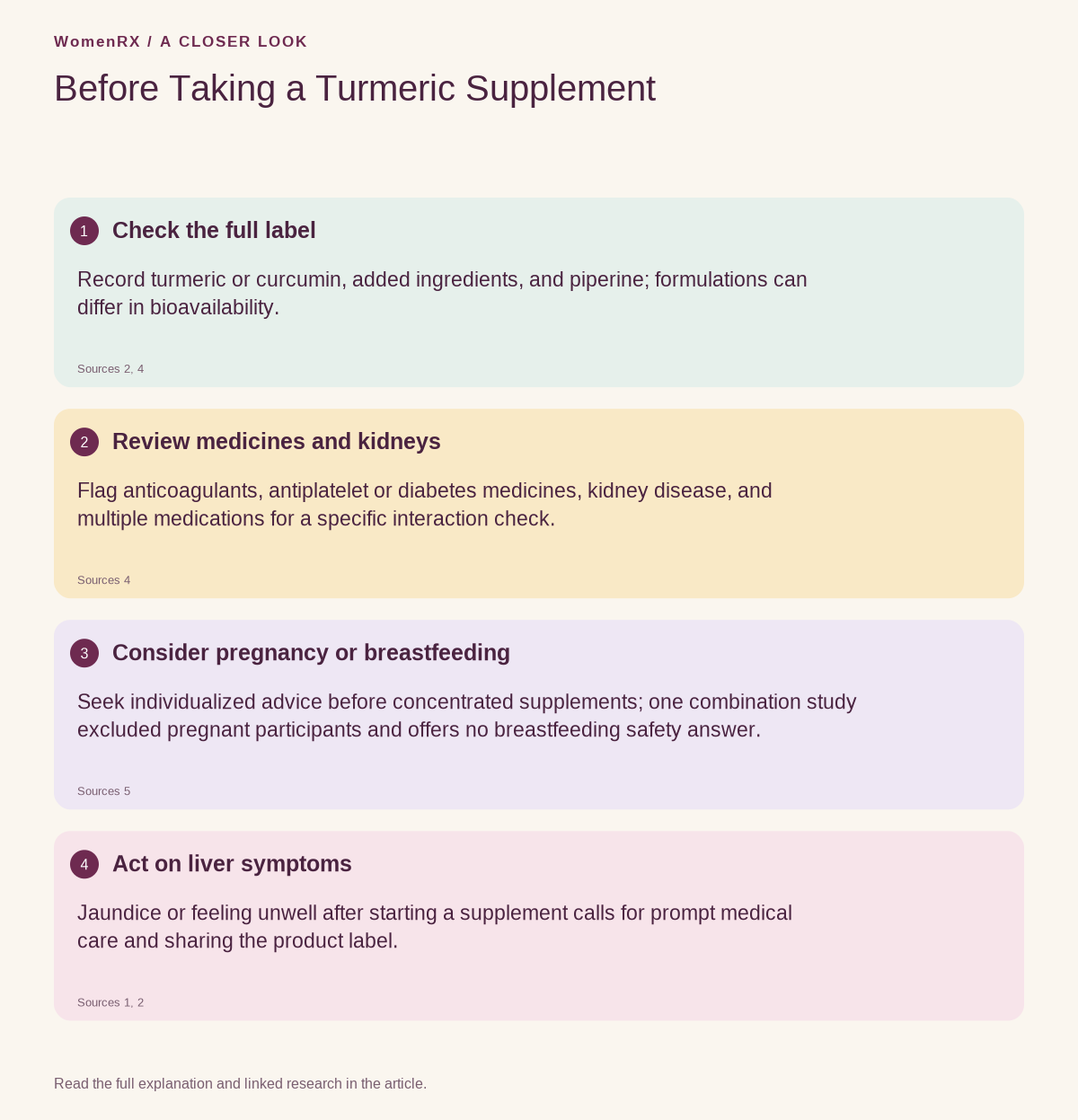
Before Taking a Turmeric Supplement
Check the full label: Record turmeric or curcumin, added ingredients, and piperine; formulations can differ in bioavailability.24
Review medicines and kidneys: Flag anticoagulants, antiplatelet or diabetes medicines, kidney disease, and multiple medications for a specific interaction check.4
Consider pregnancy or breastfeeding: Seek individualized advice before concentrated supplements; one combination study excluded pregnant participants and offers no breastfeeding safety answer.5
Act on liver symptoms: Jaundice or feeling unwell after starting a supplement calls for prompt medical care and sharing the product label.12
Read the figure as text
Use these prompts to focus a product-specific safety review. They are not a validated screening score.- Check the full label: Record turmeric or curcumin, added ingredients, and piperine; formulations can differ in bioavailability.24
- Review medicines and kidneys: Flag anticoagulants, antiplatelet or diabetes medicines, kidney disease, and multiple medications for a specific interaction check.4
- Consider pregnancy or breastfeeding: Seek individualized advice before concentrated supplements; one combination study excluded pregnant participants and offers no breastfeeding safety answer.5
- Act on liver symptoms: Jaundice or feeling unwell after starting a supplement calls for prompt medical care and sharing the product label.12
More questions, answered
Does finding piperine in some products mean it caused liver injury?
No. Piperine was detected in three of seven products tested in one US case series, but that observation doesn’t show it caused the injuries. Because formulations that increase curcumin absorption may also affect interaction or toxicity risks, include piperine and other added ingredients in a product review. 24
Can a turmeric supplement be linked to liver problems without symptoms?
Yes. In one series of 11 people with turmeric-supplement-associated hepatitis, six had abnormal liver tests without symptoms. That selected case series can’t say how often this happens, but feeling well doesn’t rule out every liver-test abnormality. 1
Sources you can check
- Turmeric supplement-associated hepatitis: a clinicopathological series of 11 cases highlighting pan-lobular and zone 3 injury.Papke DJ, Viveiros K, Zota V, Gill RM, González IA, Misdraji J, Patil DT. · Histopathology · 2025Return to first citation
- Liver Injury Associated with Turmeric-A Growing Problem: Ten Cases from the Drug-Induced Liver Injury Network [DILIN].Halegoua-DeMarzio D, Navarro V, Ahmad J, Avula B, Barnhart H, Barritt AS, Bonkovsky HL, Fontana RJ, Ghabril MS, Hoofnagle JH, Khan IA, Kleiner DE, Phillips E, Stolz A, Vuppalanchi ... · The American journal of medicine · 2023Return to first citation
- Acute liver injury following turmeric use in Tuscany: An analysis of the Italian Phytovigilance database and systematic review of case reports.Lombardi N, Crescioli G, Maggini V, Ippoliti I, Menniti-Ippolito F, Gallo E, Brilli V, Lanzi C, Mannaioni G, Firenzuoli F, Vannacci A. · British journal of clinical pharmacology · 2021Return to first citation
- Curcumin in the Treatment of Kidney Disease: A Systematic Review with a Focus on Drug Interactions.Ofori-Attah E, Aning A, Simón L. · Antioxidants (Basel, Switzerland) · 2025Return to first citation
- Evaluating the efficacy of curcumin plus serratiopeptidase formulation in inflammatory acne: a quasi-experimental study.Junaid S, Naz Khan K, Zameer F, Mudassir M, Bukhari S, Maheshwary N, Khan MA. · Drugs in context · 2025Return to first citation